
Extreme Microbes Can Survive The Journey Between Planets, Experiments Show : ScienceAlert
Here’s the rewritten news article with a viral and tech-focused tone, followed by a list of viral tags and phrases:
Hold Up, Are We Actually Martians? Scientists Just Found Out These Tiny Creatures Can Survive an Asteroid Impact and a Space Journey!
What if I told you that the key to understanding life’s origins might be hiding in the most extreme corners of the universe? A groundbreaking new study just dropped, and it’s blowing minds everywhere. Scientists have discovered that certain microscopic lifeforms, known as extremophiles, can survive the insane pressures of being blasted off Mars by an asteroid impact—and then endure the perilous journey through space to land on another planet. Yep, you read that right. Life might actually be able to hop from planet to planet like it’s no big deal.
This isn’t just some sci-fi fantasy. The idea, called panspermia, has been around since ancient Greece, but now it’s getting a serious upgrade thanks to modern science. Researchers at Johns Hopkins University decided to put one of the toughest organisms on Earth to the test: Deinococcus radiodurans. This little guy is basically the Chuck Norris of microbes—it can survive radiation, freezing temperatures, dehydration, vacuum, and even acid. So, naturally, scientists wanted to see if it could handle the ultimate challenge: being shot into space by an asteroid impact.
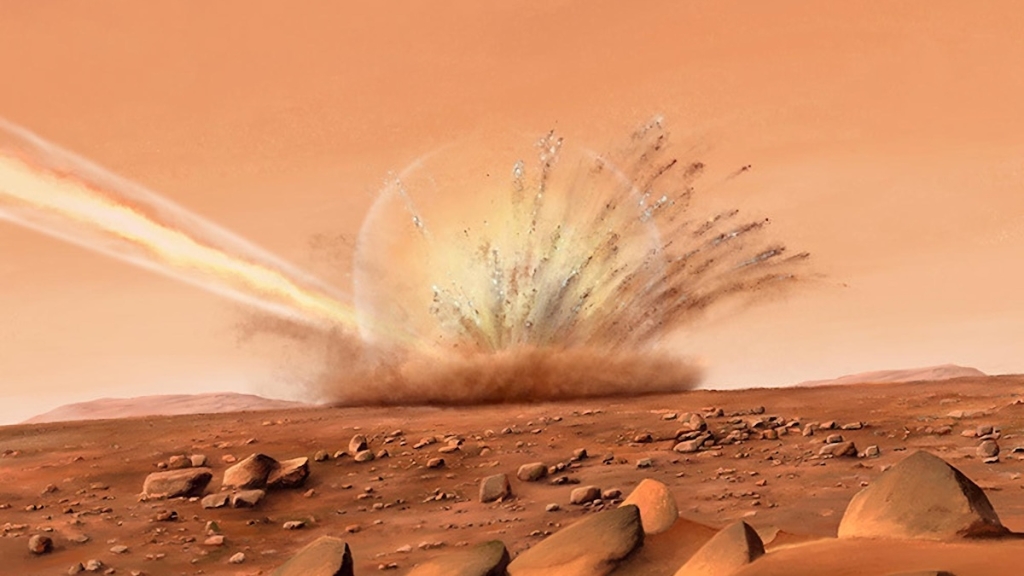
Here’s how they did it: The team simulated the extreme pressures of an asteroid strike on Mars, which can reach up to 5 gigapascals (GPa). They blasted D. radiodurans with pressures up to 3 GPa and watched in awe as the microbes shrugged it off like it was nothing. Even when the lab equipment started breaking under the pressure, these tiny survivors kept on going. Talk about resilience!
But surviving the impact is only half the battle. The journey between planets is filled with hazards like cosmic radiation, extreme temperatures, and the vacuum of space. Yet, D. radiodurans has already proven it can handle these conditions. In fact, it’s been known to survive for years in the harsh environment of outer space. So, if it can survive the impact, it can probably survive the trip.
The implications of this discovery are mind-blowing. If life can survive being ejected from one planet and landing on another, it raises the possibility that life on Earth might have originated on Mars—or even further away. As lead researcher Lily Zhao put it, “Maybe we’re Martians!” And senior author K.T. Ramesh added, “This is a really big deal that changes the way you think about the question of how life begins and how life began on Earth.”
But it’s not just about the origins of life. This research also has serious implications for space exploration. If microbes can survive the journey between planets, we need to be extra careful about contaminating other worlds with Earth life. As Ramesh warned, “We might need to be very careful about which planets we visit.”
So, what’s next? The team plans to continue studying extremophiles and their ability to survive extreme conditions. Who knows what other secrets these tiny survivors might hold? One thing’s for sure: the universe just got a whole lot more interesting.
Tags & Viral Phrases:
- Are we Martians?
- Life can hop between planets!
- This microbe is tougher than Chuck Norris.
- Asteroid impacts just got a whole lot cooler.
- Space travel for microbes? Yes, please!
- The universe is wild, and we’re just living in it.
- Panspermia is back, and it’s better than ever.
- Microbes surviving space? Mind blown.
- The origins of life just got a major upgrade.
- Space exploration just got a lot more complicated.
- These tiny survivors are rewriting the rules of life.
- The ultimate cosmic road trip: from Mars to Earth.
- Microbes: the original space explorers.
- This discovery is a game-changer for science.
- The universe is full of surprises, and this is just the beginning.
,

Leave a Reply
Want to join the discussion?Feel free to contribute!