
Astronomers Spot a Record-Breaking ‘Space Laser’ 8 Billion Light-Years Away : ScienceAlert
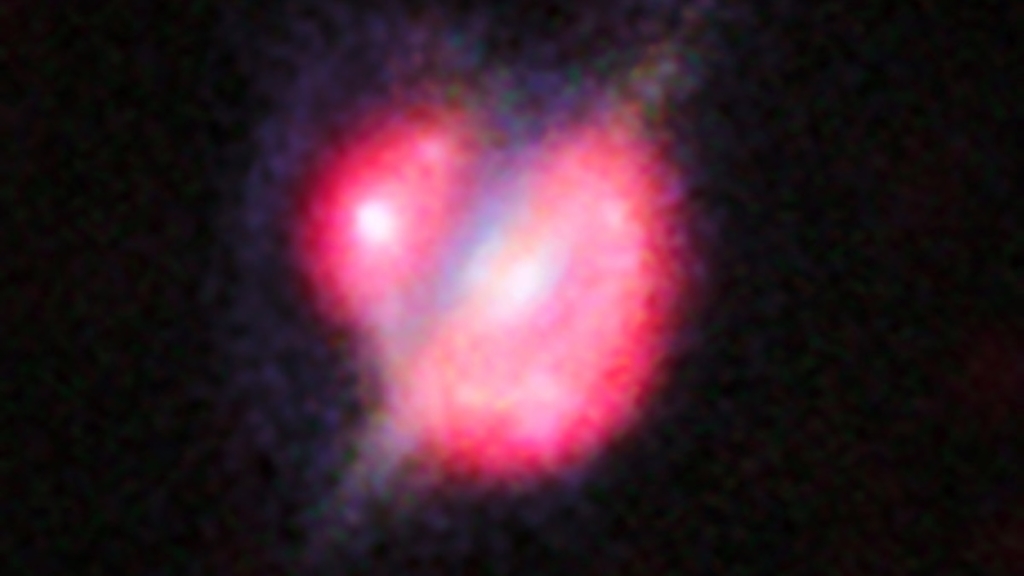
The Brightest ‘Space Laser’ Ever Detected: A Cosmic Megamaser from 8 Billion Years Ago
In a discovery that sounds ripped straight from the pages of a vintage science fiction novel, astronomers have detected the most distant and brightest cosmic “space laser” ever observed—a record-breaking megamaser blasting from the heart of a colossal galactic collision nearly 8 billion light-years away.
This extraordinary phenomenon, designated HATLAS J142935.3–002836, represents the radio equivalent of a laser halfway across the observable universe. The discovery was made possible through the combined power of South Africa’s MeerKAT radio telescope and the fortuitous alignment of a gravitational lens—nature’s own cosmic magnifying glass.
The Science Behind the “Space Laser”
While “space laser” might evoke images of futuristic weapons, the reality is far more fascinating. The term “laser” originally stood for “Light Amplification by Stimulated Emission of Radiation.” When you replace “light” with “microwave,” you get a “maser”—and when you scale that up to astronomical proportions, you get a megamaser or even a gigamaser.
These natural cosmic phenomena occur when specific conditions align in the universe. In this case, compressed gas from two galaxies violently merging together stimulates hydroxyl (OH) molecules to emit intense radio waves at a precise wavelength. The process is remarkably similar to how laboratory masers work, but on a scale that defies comprehension.
“The photons from newly formed stars stimulate hydroxyl molecules floating in the interstellar medium,” explains Thato Manamela, astrophysicist at the University of Pretoria. “This amplification process creates what we detect as an intense microwave laser emission.”
A Journey Through Time and Space
What makes this discovery particularly remarkable is not just the distance—7.82 billion light-years—but the journey these radio waves have undertaken. The light we’re detecting today left its source when the universe was less than half its current age, providing astronomers with a glimpse into cosmic history.
Adding to the wonder, this ancient signal received a boost from gravitational lensing—a phenomenon predicted by Einstein’s theory of general relativity. As the radio waves traveled toward Earth, they passed through the gravitational field of a foreground galaxy. This massive object bent and amplified the signal, much like a water droplet on a window pane distorts and magnifies light passing through it.
“We have a radio laser passing through a cosmic telescope before being detected by the powerful MeerKAT radio telescope,” says Manamela. “This perfect alignment of circumstances enabled a wonderfully serendipitous discovery.”
Breaking Records and Expectations
This megamaser shatters previous records in multiple categories. Not only does it surpass the previous distance record of 5 billion light-years, but it also represents the brightest such emission ever detected. The energy released is billions of times more powerful than a typical astrophysical maser—hence the classification as a gigamaser.
The discovery was made during routine observations with MeerKAT, which consists of 64 individual radio dishes working in concert. The telescope’s exceptional sensitivity and the natural amplification from gravitational lensing combined to reveal this extraordinary signal hidden in the data.
What This Tells Us About Galactic Evolution
Beyond the sheer spectacle, this discovery provides valuable insights into how galaxies evolve and merge. The intense emission indicates that the colliding galaxies are undergoing a period of rapid star formation—a cosmic “baby boom” triggered by the gravitational chaos of the merger.
“These megamasers serve as excellent tracers for exploring different aspects of galaxy outflows and merging activity,” the research team notes in their paper. “They allow us to probe conditions in the interstellar medium during some of the most energetic events in the universe.”
The hydroxyl molecules responsible for the emission are typically found in regions where gas is dense and conditions are right for star formation. Their stimulated emission effectively turns these molecules into natural amplifiers, broadcasting the energetic processes occurring deep within the merging galaxies.
The Power of Modern Astronomy
This discovery highlights the transformative capabilities of modern radio astronomy. MeerKAT, completed in 2018, has quickly established itself as one of the world’s premier radio observatories. Its ability to detect such faint and distant signals demonstrates how far astronomical instrumentation has advanced in recent years.
The finding also showcases the importance of serendipity in scientific discovery. While the team was conducting a different survey, the distinctive spectral signature of the megamaser stood out clearly in their data—a reminder that the universe still holds many surprises for patient observers.
Looking to the Future
As astronomers continue to probe deeper into the cosmos with increasingly sensitive instruments, discoveries like this megamaser suggest that even more extraordinary phenomena await detection. Future telescopes, including the Square Kilometre Array (SKA) currently under development, promise to extend our observational reach even further.
The study has been accepted for publication in the Monthly Notices of the Royal Astronomical Society Letters and is currently available as a preprint, allowing the global astronomical community to examine and build upon these findings.
This cosmic space laser—emitted when the universe was young, amplified by gravitational fortune, and detected by cutting-edge technology—stands as a testament to both the universe’s capacity for wonder and humanity’s determination to understand it.
Tags: space laser, megamaser, gigamaser, galactic collision, hydroxyl molecules, radio astronomy, MeerKAT, gravitational lensing, cosmic discovery, astrophysical maser, star formation, galaxy merger, radio waves, cosmic telescope, record-breaking discovery
Viral sentences:
- “Space lasers are real—and astronomers just found the brightest one yet”
- “A cosmic laser halfway across the universe amplified by nature’s telescope”
- “Billions of times brighter than a normal maser—this is a gigamaser!”
- “Detecting light that left when the universe was half its current age”
- “Two galaxies colliding to create the universe’s most powerful microwave laser”
- “Einstein’s relativity helping us see farther than ever before”
- “The radio equivalent of a laser traveling 8 billion years to reach us”
- “Nature’s own cosmic magnifying glass reveals hidden wonders”
- “From pulpy ’50s sci-fi to real astronomical discovery”
- “The universe’s most energetic events broadcasting across time and space”
,


Leave a Reply
Want to join the discussion?Feel free to contribute!