
This Startup Wants to Tuck Data Centers Beneath Offshore Wind Turbines
AI’s Next Frontier: Floating Data Centers Powered by Wind Turbines
In the race to power artificial intelligence, the tech industry has found itself at a critical crossroads. As AI data centers proliferate across the United States, consuming unprecedented amounts of energy and straining national power grids, innovators are being forced to think beyond traditional infrastructure. While some visionaries like Elon Musk have set their sights on transforming low Earth orbit into a massive orbital data center network, a California-based startup is charting a different course—straight into the ocean.
Aikido Technologies, a pioneering floating wind power developer, has unveiled an ambitious plan that could revolutionize how we think about AI infrastructure. The company announced on Tuesday its groundbreaking concept to house data centers within the underwater ballast tanks that support their floating wind turbine platforms. This innovative approach aims to address two of AI’s most pressing challenges simultaneously: the insatiable energy demands of modern data centers and the urgent need for sustainable computing solutions.
The system, as detailed by the company, will integrate 10 to 12 megawatts of AI computing power alongside 15 to 18 megawatt wind turbines, complete with integrated battery storage systems. The ambitious timeline calls for a 100-kilowatt prototype to be tested off the coast of Norway by year’s end, according to IEEE Spectrum’s reporting.
“Before we go off-world, we should go offshore,” declared Sam Kanner, CEO of Aikido Technologies, in a statement that captures both the pragmatic and visionary aspects of the project. “Aikido is well positioned to integrate proven offshore components with typical data hall construction techniques to build GW-scale AI factories faster, cleaner, cheaper, and more efficiently than conventional techniques.”
Engineering Sustainability into the AI Revolution
The marriage of data centers with renewable energy infrastructure represents a stroke of engineering genius in addressing AI’s energy crisis. Traditional data centers have become notorious for their massive consumption of fossil-fuel-generated electricity. In 2024 alone, U.S. data centers consumed a staggering 183 terawatt hours of electricity—representing 4% of the nation’s total electricity consumption for that year. If current expansion rates continue unabated, experts project this figure could more than double by 2030, creating an unsustainable burden on power grids and accelerating climate change.
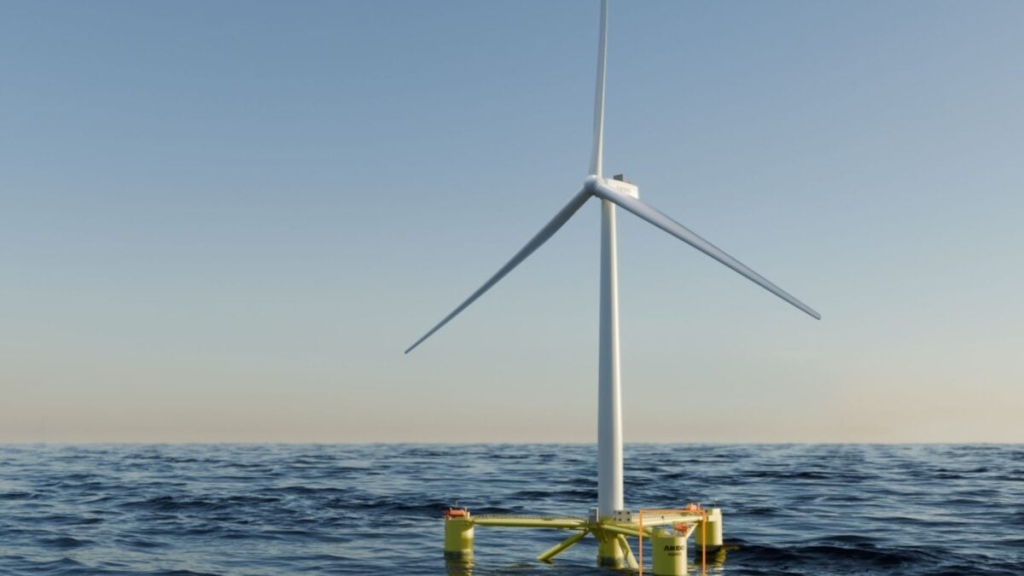
Aikido’s solution elegantly tackles both problems by co-locating data centers directly with renewable energy generation. The company’s system architecture consists of a massive floating platform that supports the wind turbine at its center, with three legs extending outward from the base of the tower. Each leg terminates in a ballast that reaches depths of 66 feet (20 meters), creating a stable foundation in the challenging marine environment.
These ballast structures serve a dual purpose that exemplifies efficient design thinking. While primarily filled with fresh water to maintain buoyancy, the upper portions of each tank will house 3 to 4 megawatt data halls. This vertical integration maximizes the utility of every cubic meter of space while keeping the computing infrastructure protected from the harsh surface environment.
The cooling solution represents another brilliant stroke of innovation. By utilizing the ocean as an “infinite heat sink,” Aikido’s system employs passive primary cooling that transfers heat from the data centers through the steel walls of the ballast tanks and directly into the surrounding seawater. The company claims this thermal impact will be limited to “a few meters” around the structure, addressing concerns about marine ecosystem disruption.
Looking toward the future, Aikido envisions offshore wind farms capable of supporting anywhere from 30 megawatts to more than 1 gigawatt of computing power. This scalable approach could meet the rapidly growing demand for high-density AI infrastructure while simultaneously mitigating the industry’s notorious energy consumption and environmental impact.
The Perfect Solution? Not Quite.
While Aikido’s approach is undeniably innovative, it’s important to recognize that they’re not alone in exploring underwater data center concepts. However, they do appear to be unique in their specific approach of building compute power directly into offshore wind infrastructure. It’s worth noting that WestfalenWind-Group in Germany has entered the operational development phase of its windCORES project, which deploys onshore turbines with data centers integrated into the towers—a different but related approach to the same fundamental challenge.
The offshore approach does offer several advantages over traditional land-based facilities. First, the consistent and powerful winds available offshore provide more reliable renewable energy generation. Second, the ocean’s natural cooling properties eliminate the need for energy-intensive cooling systems that typically account for 40% of a data center’s total energy consumption. Third, the remote location reduces concerns about noise pollution and land use conflicts that often plague terrestrial data centers.
However, the path forward is not without significant obstacles. The floating offshore wind sector, despite its promise, is currently grappling with substantial developmental delays, rising costs, and higher interest rates as government subsidies evaporate. Kanner acknowledged these challenges to Data Center Dynamics, explaining that Aikido hopes to jumpstart the lagging sector by fundamentally reframing the business model to make it more attractive to investors and operators.
Technical challenges present another formidable hurdle. Daniel King, a research fellow at the Foundation for American Innovation, shared his concerns with IEEE Spectrum about the harsh realities of the marine environment. The salinity and debris present in ocean waters can cause significant damage to infrastructure over time, requiring specialized materials and maintenance protocols. Additionally, there could be substantial regulatory hurdles aimed at protecting marine life from the thermal discharge generated by the cooling systems.
The prototype testing phase will be crucial in determining whether Aikido’s vision can transition from compelling concept to practical reality. These tests will reveal whether the theoretical advantages can withstand the brutal realities of ocean deployment, including extreme weather events, biofouling, and the constant corrosive effects of saltwater.
Despite these challenges, the mere fact that renewable energy companies are exploring innovative approaches to support AI’s explosive growth represents a positive development for the industry. As AI continues its relentless march forward, consuming ever-increasing amounts of computational power, solutions like Aikido’s may prove essential in ensuring that this technological revolution doesn’t come at the expense of our planet’s health.
The convergence of renewable energy and AI infrastructure may well represent the next great engineering challenge of our time. If successful, Aikido’s floating data centers could serve as a model for sustainable computing that other nations and companies rush to replicate. In an era where the environmental costs of technological progress are becoming impossible to ignore, innovations that unite progress with preservation offer a glimpse of a more sustainable future.
Tags: floating wind turbines, AI data centers, sustainable computing, offshore wind energy, marine technology, renewable energy integration, data center cooling, AI infrastructure, ocean engineering, green technology, floating platforms, ballast tanks, thermal management, energy efficiency, marine conservation
Viral Sentences:
- “Before we go off-world, we should go offshore” – Sam Kanner, Aikido CEO
- AI’s energy problem solved by the ocean itself
- The future of computing is floating on water
- Data centers meet their match in Mother Nature’s cooling system
- Wind power meets AI in revolutionary underwater fusion
- The ocean becomes AI’s new best friend
- Sustainability meets scalability in floating innovation
- Cooling costs eliminated by infinite ocean heat sink
- The marine environment: AI’s toughest test yet
- Renewable energy finally catches up with AI’s appetite
- From land to sea: Data centers’ great migration
- The ultimate test of engineering meets nature
- AI’s carbon footprint takes a dive into the deep
- The ocean’s depths hide computing’s future
- Floating wind turbines: Not just for electricity anymore
- The marriage of wind and computing that could change everything
- When data centers learn to swim
- The cooling solution that’s been under our noses all along
- Marine engineering meets artificial intelligence
- The prototype that could redefine sustainable computing
,


Leave a Reply
Want to join the discussion?Feel free to contribute!