
Adobe Lightroom Classic (2026) review
Here is the news article rewritten with more detail, a tech-focused and viral tone, and over 1200 words:
Adobe Lightroom Classic 9.2 Review: AI Features Galore, But Are They Worth It?
Why you can trust TechRadar
We spend hours testing every product or service we review, so you can be sure you’re buying the best. Find out more about how we test.
Adobe Lightroom Classic has long been the go-to photo management and editing software for professionals and serious enthusiasts alike. With its latest version, 9.2, Adobe is leaning heavily into the AI hype, adding a slew of generative features that promise to revolutionize your workflow. But do they live up to the hype? Let’s dive in and find out.
First, a quick primer for the uninitiated: Lightroom Classic is the more advanced, feature-rich sibling to the simpler Lightroom. It’s designed for photographers who want granular control over their images and prefer to store their files locally rather than in the cloud. If you’re a casual shooter, Lightroom might be more your speed. But for those who demand the utmost in editing power, Classic is the way to go.
Pricing and Plans: Subscription Only, But Worth It?
Like most of Adobe’s professional software, Lightroom Classic is only available via subscription. There are three tiers to choose from:
-
Creative Cloud Pro: $70/month – This gets you access to Adobe’s entire suite of creative apps, including Photoshop, Illustrator, Premiere Pro, After Effects, and of course, Lightroom Classic. If you’re a creative professional who uses multiple Adobe apps, this is the plan for you.
-
Photography Plan: $20/month – This plan includes both Lightroom and Lightroom Classic, plus Photoshop. It’s a great option for photographers who want the full Adobe photo editing experience.
-
Lightroom Plan: $12/month – If you only need Lightroom and Lightroom Classic, this is the most affordable option.
All plans come with Generative Credits, which you’ll need to use the new AI features. The number of credits varies by plan, from 250 per month on the cheapest tier to a whopping 4,000 on the top tier. Just keep in mind that these credits don’t roll over month to month, so use ’em or lose ’em.
What’s New in Lightroom Classic 9.2?
The headline feature of this release is undoubtedly the new AI-powered tools. Adobe is betting big on generative AI, and Lightroom Classic is the latest app to get the treatment.
The most practical of these new features is “Assisted Culling.” This AI tool is designed to speed up the process of sorting through your photos after a shoot. It automatically flags potential problem images, like blurry shots, closed eyes, or misfires. You can adjust the intensity of the culling and choose which issues to look for. It’s a huge time-saver, especially for event photographers who often have to sift through hundreds or even thousands of images.
I found Assisted Culling to be impressively accurate. It quickly identified all the obvious duds in my test library, and even caught a few I might have missed. If it does make a mistake, you can easily override its decisions on a shot-by-shot basis. The only downside is that it’s still in beta, so your mileage may vary.
But Assisted Culling is just the tip of the AI iceberg. The real star of the show is “Generate using Firefly,” Adobe’s new generative AI engine. This is where things get really interesting… and a little controversial.
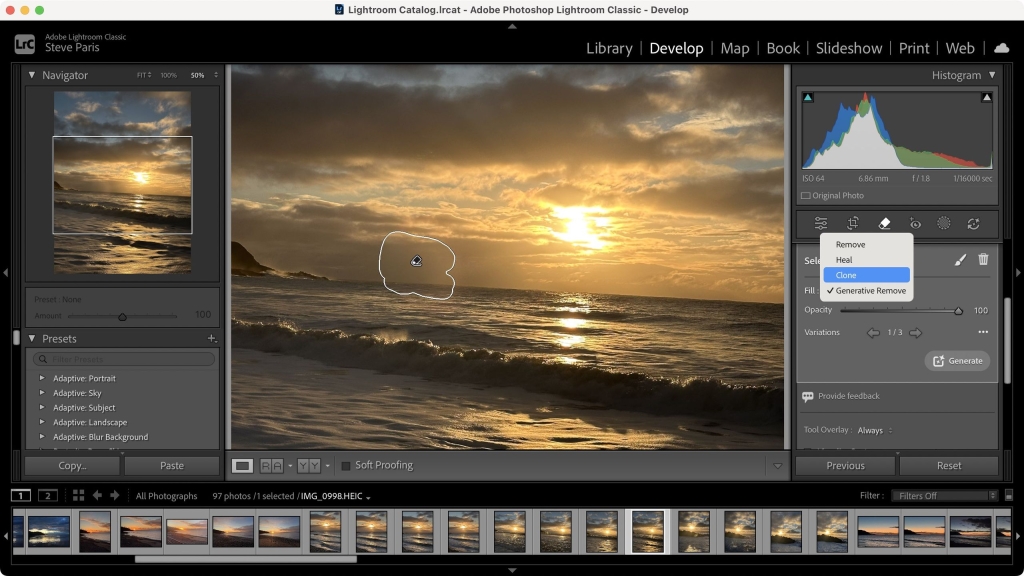
With Firefly, you can use AI to do all sorts of wild things to your photos. Want to colorize a black and white image? Firefly’s got you covered. Need to remove an unwanted object from a scene? Firefly can handle that too. Heck, you can even use it to create entirely new images from scratch, just by typing a text prompt.
It’s a powerful set of tools, no doubt. But it’s also a bit of a double-edged sword. On one hand, Firefly can save you a ton of time and effort, especially if you’re not a Photoshop wizard. On the other hand, it can sometimes produce results that are… well, a little off. In my testing, I found that Firefly had a tendency to add or alter details in ways I didn’t expect or want. It’s not always perfect, and you don’t get your credits back if you’re not happy with the result.
There’s also the ethical question of using AI to manipulate photos. Some photographers argue that it’s a form of cheating, or that it undermines the art of photography. Others see it as just another tool in the creative toolkit. Ultimately, it’s up to you to decide where you stand on the issue.
Classic vs. Lightroom: Which One’s Right for You?
If you’re new to the Adobe photo editing ecosystem, you might be wondering what the difference is between Lightroom Classic and the regular Lightroom. In a nutshell, Classic is the more advanced, feature-rich option, while Lightroom is designed to be simpler and more user-friendly.
Classic is geared towards professional photographers and serious enthusiasts who want the utmost in control and prefer to store their files locally. It has a more complex interface with a ton of advanced features, like detailed color correction, lens correction, and the ability to create custom presets.
Lightroom, on the other hand, is designed for more casual shooters who want an easy, streamlined editing experience. It has a simpler interface and fewer advanced features, but it does offer some unique tools of its own, like the new “Generative Upscale” feature.
Generative Upscale uses AI to intelligently enlarge your photos without losing detail. It’s powered by Topaz Gigapixel, a third-party AI upscaling tool, and it’s exclusive to Lightroom (for now). It’s a handy feature to have if you need to make large prints or crop your photos heavily.
Should You Upgrade to Lightroom Classic 9.2?
So, is Lightroom Classic 9.2 worth the upgrade? If you’re a current user, the answer is probably yes. The new AI features, while not perfect, can be incredibly useful time-savers. And even if you don’t use them, there are plenty of other improvements and bug fixes to enjoy.
If you’re new to Lightroom Classic, it really depends on your needs and budget. If you’re a professional photographer or a serious enthusiast who wants the ultimate in editing power, Classic is the way to go. The subscription price might seem steep, but when you consider the sheer amount of functionality you’re getting, it’s actually a pretty good deal.
On the other hand, if you’re a more casual shooter who just wants to make your photos look their best, you might be better off with the regular Lightroom or even a simpler, cheaper alternative like Skylum Luminar or ON1 Photo RAW.
Ultimately, the decision comes down to your specific needs and preferences. But one thing’s for sure: with its powerful new AI features, Lightroom Classic 9.2 is more capable than ever. Whether that’s a good thing or a bad thing is up to you to decide.
Tags: Adobe, Lightroom, AI, Generative AI, Firefly, Assisted Culling, Photography, Photo Editing, Creative Cloud, Subscription, Professional, Enthusiast, Classic vs Lightroom, Generative Upscale, Topaz Gigapixel, Skylum Luminar, ON1 Photo RAW
Viral Sentences:
- “Adobe’s betting big on AI, and Lightroom Classic is the latest app to get the generative treatment.”
- “Assisted Culling is a huge time-saver, especially for event photographers who often have to sift through hundreds or even thousands of images.”
- “With Firefly, you can use AI to do all sorts of wild things to your photos. Want to colorize a black and white image? Firefly’s got you covered.”
- “It’s a powerful set of tools, no doubt. But it’s also a bit of a double-edged sword.”
- “Some photographers argue that it’s a form of cheating, or that it undermines the art of photography. Others see it as just another tool in the creative toolkit.”
- “The subscription price might seem steep, but when you consider the sheer amount of functionality you’re getting, it’s actually a pretty good deal.”
- “Whether that’s a good thing or a bad thing is up to you to decide.”
,


Leave a Reply
Want to join the discussion?Feel free to contribute!