
Rust 1.94 Released With Stable Support For AVX-512 FP16 Intrinsics, Array Windows
Rust 1.94 Released: AVX-512 FP16 Intrinsics Stabilized, Cargo Gets Enhanced Config Sharing
The Rust programming language has just received a significant update with the release of version 1.94, bringing a wealth of new capabilities that will excite both systems programmers and performance enthusiasts. This latest stable release continues Rust’s tradition of steady, incremental improvements that collectively push the language forward in meaningful ways.
Array Windows: A New Iteration Pattern
One of the most notable language-level additions in Rust 1.94 is the introduction of the array_windows method for slices. This new iterator function operates similarly to Rust’s existing windows method but with a crucial difference: it produces arrays of constant length rather than slices. This seemingly subtle distinction has important implications for performance and safety.
The array_windows method allows developers to iterate over overlapping windows of a slice where each window is represented as a fixed-size array. This is particularly useful when you need to process data in chunks of a known size, such as when implementing sliding window algorithms or working with fixed-size data structures. The constant-length guarantee provided by arrays can enable better compiler optimizations and more precise type checking compared to the more flexible but less constrained windows method.
AVX-512 FP16 Intrinsics: Hardware Acceleration Arrives
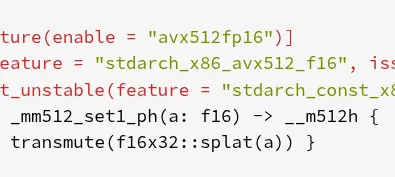
Perhaps the most technically significant addition in Rust 1.94 is the stabilization of x86 AVX-512 FP16 (16-bit floating point) intrinsics. This marks a major milestone for Rust’s support of cutting-edge CPU instruction sets and represents years of work to bring these capabilities to stable Rust.
The FP16 format, which uses half the storage of traditional 32-bit floats, has been gaining traction in fields where memory bandwidth and storage efficiency are critical, such as machine learning, graphics processing, and scientific computing. By stabilizing these intrinsics, Rust now provides direct, low-level access to instructions that can process sixteen 16-bit floating point values in parallel using AVX-512 instructions.
This functionality has been in development since at least 2024, reflecting the careful consideration and testing that goes into stabilizing such low-level features. The intrinsics will be particularly valuable for developers working on performance-critical applications that can leverage the computational density offered by FP16 operations.
It’s worth noting that while the intrinsics themselves are now stable, they still depend on the f16 data type, which remains unstable. This means developers will need to use nightly Rust if they want to work with the f16 type directly, though they can still use the intrinsics with other data representations.
Arm NEON FP16 Support
Rust 1.94 doesn’t leave Arm users behind in the FP16 revolution. The release also stabilizes AArch64 NEON FP16 intrinsics, bringing similar hardware acceleration capabilities to Arm-based systems. This ensures that Rust maintains its cross-platform consistency while still allowing developers to take full advantage of platform-specific optimizations.
The inclusion of both x86 and Arm FP16 support demonstrates Rust’s commitment to being a truly portable systems programming language that doesn’t sacrifice performance on any major architecture.
Hardware Availability and Future Prospects
The AVX-512 FP16 instructions have been available on Intel Xeon Scalable processors since the Sapphire Rapids generation, making this Rust stabilization particularly relevant for server and high-performance computing environments. Looking ahead, AMD has announced plans to support these instructions in their upcoming Zen 6 processor architecture, which will bring this capability to a broader range of hardware platforms.
This cross-vendor support for FP16 acceleration suggests that the industry sees real value in half-precision floating point operations, and Rust developers are now well-positioned to take advantage of this trend across different hardware ecosystems.
Cargo Configuration Enhancements
On the tooling side, Rust 1.94 brings meaningful improvements to Cargo, Rust’s package manager and build system. The update introduces an include key in configuration files, which allows for better organization and sharing of Cargo configurations between different projects and environments.
This new feature addresses a common pain point for developers who work across multiple Rust projects or need to maintain consistent build configurations across different development environments. The ability to include configuration files means that common settings can be centralized and reused, reducing duplication and the potential for configuration drift between projects.
The include functionality also supports optional paths, giving developers fine-grained control over which configurations are mandatory and which are environment-specific. This flexibility makes it easier to maintain a base configuration while allowing for project-specific customizations.
TOML 1.1 Support
Alongside the configuration inclusion feature, Cargo in Rust 1.94 now supports TOML 1.1 for manifests and configuration files. TOML (Tom’s Obvious, Minimal Language) is the format used for Rust’s configuration files, and the 1.1 update brings several improvements and clarifications to the specification.
This update ensures that Rust stays current with the latest standards in configuration file formats and may enable new features or improved error handling in future Cargo releases that take advantage of TOML 1.1’s enhancements.
Looking Forward
Rust 1.94 represents another solid step forward for the language and its ecosystem. The combination of new language features, hardware acceleration capabilities, and tooling improvements shows that Rust continues to evolve in ways that benefit both low-level systems programmers and those building high-level applications.
The stabilization of AVX-512 FP16 intrinsics is particularly noteworthy as it brings Rust to parity with other systems programming languages in terms of access to cutting-edge CPU instructions. This makes Rust an even more compelling choice for performance-critical applications in fields like machine learning, scientific computing, and high-frequency trading.
Meanwhile, the Cargo improvements demonstrate that the Rust team hasn’t forgotten about developer experience and productivity. Better configuration management and updated standards support make the daily work of Rust development smoother and more efficient.
As Rust continues its rapid evolution, releases like 1.94 show that the language is maturing while still maintaining the innovative spirit that has made it popular among developers who need the performance of low-level languages with the safety guarantees of higher-level ones.
Tags: #Rust #Rust194 #Programming #SystemsProgramming #AVX512 #FP16 #MachineLearning #HPC #Cargo #TOML #Arm #x86 #Performance #Intrinsics #SoftwareDevelopment
Viral Sentences:
- Rust 1.94 drops with AVX-512 FP16 intrinsics – game changer for ML and HPC!
- Array_windows method in Rust 1.94 brings constant-length iteration power
- Cargo gets include key and TOML 1.1 support in Rust’s latest release
- Intel Sapphire Rapids users rejoice – Rust now supports your FP16 acceleration
- AMD Zen 6 users will soon get Rust’s FP16 love too
- Rust continues its march toward systems programming dominance
- Half-precision floating point operations come to stable Rust
- The future of high-performance computing speaks Rust
- Rust 1.94 proves safety and performance aren’t mutually exclusive
- Developers can now harness hardware acceleration without leaving Rust’s safety guarantees
,


Leave a Reply
Want to join the discussion?Feel free to contribute!