
The Rage at OpenAI Has Grown So Immense That There Are Entire Protests Against It
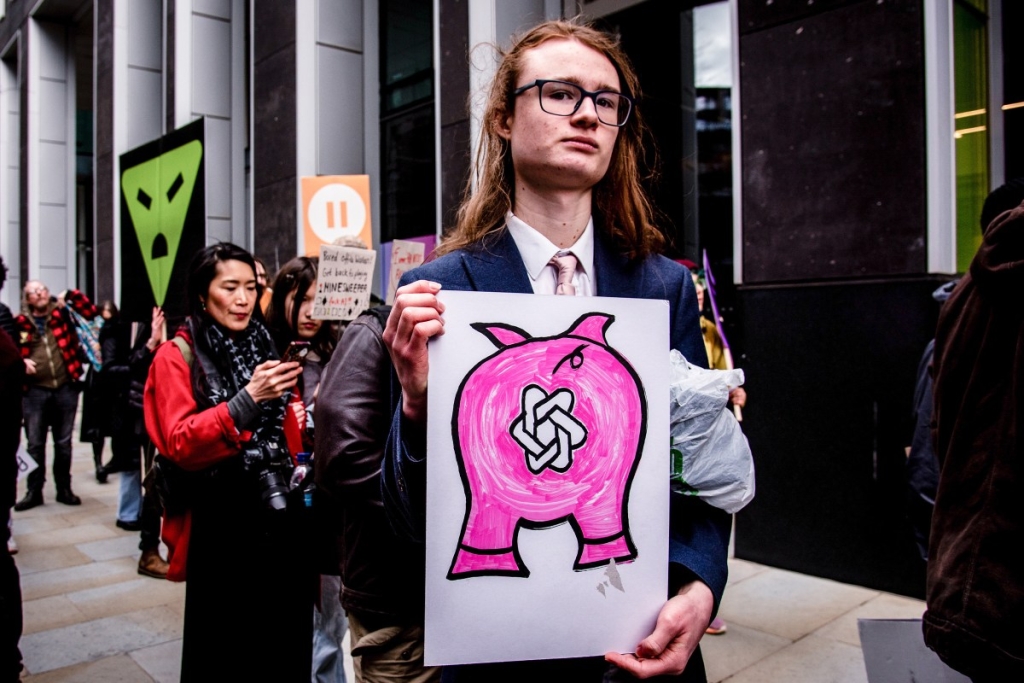
OpenAI Faces Unprecedented Backlash as Protests Erupt Over Pentagon AI Deal
The artificial intelligence landscape is experiencing seismic tremors as OpenAI, once the darling of Silicon Valley, finds itself at the epicenter of a rapidly escalating controversy that threatens to reshape the entire industry. What began as a routine business announcement has exploded into a full-blown crisis, with thousands of users abandoning ship, employees staging walkouts, and protesters taking to the streets in what analysts are calling the most significant challenge to AI dominance in recent memory.
The Spark That Lit the Fire
On Friday, OpenAI CEO Sam Altman dropped a bombshell announcement: the company had entered into a strategic partnership with the United States Department of Defense to deploy its cutting-edge AI systems across military operations. While the details remained deliberately vague, the implications were crystal clear—OpenAI’s technology would now be powering America’s military apparatus, from intelligence gathering to potentially autonomous weapons systems.
The response was immediate and ferocious. Within hours, ChatGPT’s app store rankings began plummeting as users flocked to alternatives. Claude, the chatbot developed by Anthropic, surged to the top of download charts, capitalizing on its competitor’s misstep. Uninstallation rates for ChatGPT spiked by an astonishing 300 percent, according to industry tracking data, marking one of the most dramatic user exodus events in tech history.
The QuitGPT Movement Gains Momentum
What started as individual users canceling their subscriptions quickly coalesced into something far more organized and impactful. The “QuitGPT” movement, born from the ashes of OpenAI’s Pentagon announcement, has transformed from an online hashtag into a bona fide protest phenomenon.
On Tuesday, approximately fifty demonstrators gathered outside OpenAI’s San Francisco headquarters, braving the city’s notorious weather to voice their opposition. But these weren’t your typical protesters. The crowd included tech workers wearing cardboard robot masks, environmental activists decrying AI’s massive energy consumption, artists concerned about creative displacement, and even former OpenAI employees who felt betrayed by the company’s direction.
“I never go to protests. This is new for me,” confessed a 26-year-old tech worker from Oakland who wore a robot mask to protect his identity. “We’re not normally political people. We’re techies, you know—we want to build stuff. But what OpenAI is doing in terms of building legal mass surveillance technology for the government… is frankly, insane.”
Environmental and Economic Concerns Take Center Stage
The protests revealed a complex tapestry of grievances that extended far beyond simple anti-military sentiment. Environmental activists highlighted the staggering energy consumption required to train and operate large language models, pointing out that AI data centers are increasingly competing with local communities for water resources and driving up electricity costs for ordinary citizens.
“AI is taking water from communities, polluting communities, and it is also increasing communities’ electricity bills,” explained Perrin Millekin, one of the San Francisco protesters. “They’re not even paying for it—we are.”
This economic angle resonated particularly strongly with working-class communities who feel increasingly marginalized by the tech industry’s relentless expansion. The narrative of AI as a luxury good that benefits corporations while imposing costs on ordinary people struck a chord with many observers.
Cultural and Philosophical Objections
Beyond the practical concerns, the protests also tapped into deeper philosophical anxieties about AI’s impact on human culture and creativity. Megan Matson, who has completely sworn off AI technology, articulated a fear shared by many artists and cultural critics.
“As soon as I saw it start showing up in visuals and imagery, I could see exactly where it heads,” Matson told reporters. “It destroys journalism, it destroys art, it destroys the expression of our common humanity.”
These concerns reflect a growing unease about AI’s role in reshaping creative industries and potentially homogenizing human expression. The fear isn’t just about job displacement but about the fundamental nature of human creativity and what it means to be authentically human in an increasingly automated world.
The London Protests: A Global Phenomenon
The discontent wasn’t confined to American shores. On Saturday, hundreds of activists gathered in London’s King’s Cross, a tech hub that houses the UK headquarters of OpenAI, Meta, and Google DeepMind. The London protests demonstrated that concerns about AI’s trajectory are truly global, transcending national boundaries and cultural differences.
The timing was particularly significant, coming just days after the UK hosted a major AI Safety Summit, highlighting the disconnect between governmental enthusiasm for AI development and public apprehension about its implications.
Altman’s Damage Control Operation
Sam Altman, typically known for his confident public persona, appeared visibly rattled by the intensity of the backlash. Within 24 hours of the Pentagon announcement, he hosted a rare Ask Me Anything session on X (formerly Twitter), a platform he rarely uses for direct engagement with critics.
During the AMA, Altman made several striking admissions. He acknowledged that the Pentagon deal had been “rushed” and that its “optics don’t look good.” This level of candor from a tech CEO facing a crisis is virtually unprecedented, suggesting that OpenAI may be facing more serious challenges than initially apparent.
By Monday, Altman was in full damage control mode, releasing a lengthy apology statement that outlined several key policy changes. Most notably, OpenAI would explicitly prohibit the use of its AI systems for surveillance of US citizens—a restriction that had been one of the key differentiators between OpenAI and its competitor Anthropic.
However, the apology notably omitted any mention of autonomous weapons systems, a critical concern for many protesters and ethicists. This omission suggests that while OpenAI may be willing to make cosmetic changes to appease public opinion, it remains committed to maintaining deep ties with military and intelligence agencies.
Internal Dissent: When Employees Rebel
Perhaps most damaging to OpenAI’s reputation is the revelation that the protests aren’t just coming from outside the company. Nearly 1,000 workers from both OpenAI and Google have signed an open letter demanding that their companies refuse Pentagon demands to use AI technology for mass surveillance and autonomous weaponry.
This internal dissent represents a significant fracture within the tech industry itself. These aren’t external critics or Luddites—they’re the very engineers and researchers who helped build these systems and understand their capabilities and limitations better than anyone else.
The open letter, hosted at NotDivided.org, argues that tech companies have a moral obligation to consider the broader implications of their work and resist pressure from government agencies to develop technologies that could be used for oppressive purposes.
The Broader Context: AI’s Troubled Relationship with Power
The OpenAI controversy must be understood within the broader context of AI’s evolving relationship with governmental and military power. For years, the tech industry maintained a somewhat uneasy truce with the defense establishment, with companies like Google and Microsoft providing cloud services and other infrastructure to military clients while generally avoiding direct involvement in weapons systems.
However, the rapid advancement of AI capabilities has made this distinction increasingly meaningless. Modern AI systems can process intelligence data, identify targets, and even make decisions about lethal force with minimal human intervention. The line between “civilian” AI applications and military ones has become increasingly blurred.
The Anthropic Advantage
OpenAI’s crisis has created a significant opportunity for its competitors, particularly Anthropic. The company has positioned itself as the “ethical alternative” to OpenAI, refusing military contracts and emphasizing safety and alignment in its AI development.
Claude’s surge to the top of app store charts demonstrates that there is a substantial market for AI products that prioritize ethical considerations over rapid expansion and military partnerships. This suggests that the AI industry may be entering a new phase where ethical positioning becomes a key competitive advantage rather than a secondary consideration.
Looking Forward: The Future of AI Governance
The protests and backlash against OpenAI raise fundamental questions about how AI technology should be governed and who gets to make those decisions. The current model, where individual companies make unilateral decisions about partnerships and applications, appears increasingly untenable in the face of growing public concern.
Several potential paths forward are emerging:
-
Increased Regulation: Governments may step in to create stricter guidelines around AI development and deployment, particularly for military and surveillance applications.
-
Industry Self-Governance: The tech industry itself may develop more robust ethical frameworks and oversight mechanisms to prevent similar controversies in the future.
-
Decentralization: The rise of open-source AI models could reduce the power of individual companies to make unilateral decisions about AI’s future.
-
Public Pressure: Continued activism and consumer choice may force companies to be more transparent and accountable in their decision-making.
The Stakes Could Not Be Higher
What makes this moment so significant is that it represents a potential turning point in AI’s development trajectory. For years, the narrative around AI has been dominated by promises of unprecedented progress and utopian visions of technological advancement. The backlash against OpenAI suggests that the public is increasingly skeptical of these promises and concerned about the potential downsides.
The outcome of this crisis could determine whether AI develops as a tool primarily for corporate and military power, or whether it can be shaped into something that genuinely benefits humanity as a whole. The choices made by companies like OpenAI in the coming months and years will have profound implications for the future of technology, democracy, and human society itself.
As the protests continue and the debate intensifies, one thing is clear: the era of unquestioning enthusiasm for AI is over. The public is demanding accountability, transparency, and ethical consideration in how these powerful technologies are developed and deployed. Whether the tech industry is willing and able to meet these demands remains one of the defining challenges of our time.
Tags: OpenAI protests, ChatGPT backlash, Pentagon AI deal, QuitGPT movement, Sam Altman controversy, AI ethics debate, Claude surge, Anthropic advantage, tech worker dissent, AI military applications, environmental AI concerns, creative industry disruption, London anti-AI protests, AI governance crisis, autonomous weapons debate, mass surveillance technology, tech industry ethics, Silicon Valley controversy, AI safety concerns, military AI partnerships
Viral Sentences:
- “AI is taking water from communities, polluting communities, and it is also increasing communities’ electricity bills.”
- “As soon as I saw it start showing up in visuals and imagery, I could see exactly where it heads.”
- “We’re not normally political people. We’re techies, you know—we want to build stuff.”
- “What OpenAI is doing in terms of building legal mass surveillance technology for the government… is frankly, insane.”
- “They’re not even paying for it—we are.”
- “It destroys journalism, it destroys art, it destroys the expression of our common humanity.”
- “The optics don’t look good.”
- “This is new for me. We never go to protests.”
- “Nearly 1,000 workers from both OpenAI and Google have signed an open letter.”
- “The era of unquestioning enthusiasm for AI is over.”
,

Leave a Reply
Want to join the discussion?Feel free to contribute!