
Scientists Reconstruct The Face of a 3.7-Million-Year-Old Human Relative : ScienceAlert
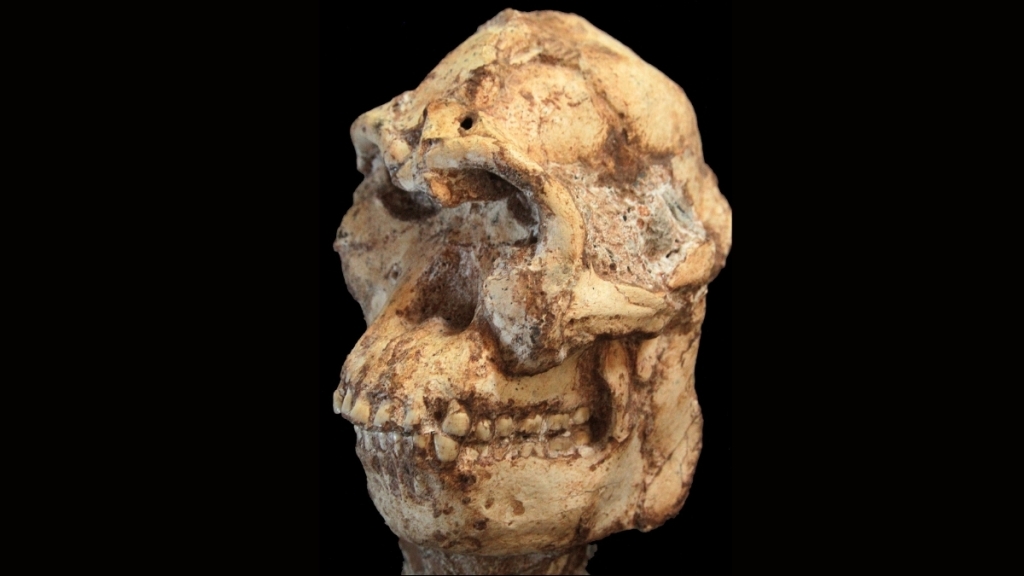
Digital Resurrection: Scientists Reconstruct the Face of ‘Little Foot,’ Our 3.67-Million-Year-Old Ancestor
In a groundbreaking achievement that bridges the vast chasm between our ancient past and modern technology, scientists have digitally reconstructed the face of one of the most complete and significant hominin fossils ever discovered. Affectionately nicknamed “Little Foot,” this remarkable Australopithecus specimen, dating back an astonishing 3.67 million years, has finally revealed its features after being entombed in South African rock for eons.
The painstaking reconstruction, led by paleoanthropologist Amélie Beaudet at the Université de Poitiers in France, represents a technological triumph that has brought new clarity to our understanding of human evolution. Using state-of-the-art X-ray micro-CT scanning at the Diamond Light Source synchrotron facility in the United Kingdom, the team created a digital 3D model with microscopic precision—capturing details as small as 21 micrometers.
What makes Little Foot truly extraordinary is its completeness. Discovered in 1980 at Sterkfontein Cave in South Africa, the fossil initially revealed itself through just four small ankle bones. It took until the 1990s for researchers to uncover the rest of the skeleton embedded in the cave wall, and another 15 years of meticulous work to extract it from the concrete-like rock that had preserved it for millions of years.
However, the skull presented a formidable challenge. Crushed and deformed by the immense pressure of rock movement over millennia, it resembled a shattered puzzle frozen in time. The research team approached this challenge with the precision of master craftsmen, digitally separating the bones and teeth from surrounding rock and dividing the skull into five distinct “blocks.”
Using advanced computational techniques, they virtually manipulated these blocks like pieces of a three-dimensional jigsaw puzzle, carefully repositioning them to their presumed original locations. This digital reconstruction allowed scientists to analyze Little Foot’s facial features with unprecedented accuracy.
The team then conducted a comprehensive comparative analysis, measuring and examining “landmarks” on the reconstructed skull and comparing them to other Australopithecus specimens, as well as modern humans and our closest primate relatives—gorillas, chimpanzees, and orangutans. This comparative approach has yielded fascinating insights into our evolutionary history.
One of the most intriguing discoveries is that despite Little Foot’s southern African origins, its skull size and shape bear a closer resemblance to Australopithecus specimens found in eastern Africa. This finding suggests complex migration patterns and evolutionary relationships among early hominins that challenge previous assumptions about geographic isolation in human evolution.
Perhaps most notably, Little Foot exhibits distinctly shaped orbital regions—its eye sockets—compared to other specimens. This unique feature has led researchers to speculate about evolutionary pressures that may have shaped facial development in southern African Pliocene hominins. Beaudet and her colleagues propose that environmental instability during this period might have created selective pressures on visual capabilities, perhaps related to food scarcity or the need to identify specific types of food resources.
“This reconstruction represents more than just putting bones back together,” Beaudet explains. “It’s about understanding the evolutionary forces that shaped our ancestors’ faces and, by extension, our own.”
However, the research team emphasizes that their work, while groundbreaking, remains preliminary. The reconstruction, published in the journal Comptes Rendus Palevol, represents their best interpretation based on current technology and understanding, but refinements are likely as techniques improve and new discoveries emerge.
The classification of Little Foot itself remains a subject of scientific debate. While generally attributed to Australopithecus, some researchers argue it may represent an entirely new species. This uncertainty is compounded by the possibility of significant sexual dimorphism within species—meaning males and females might have looked quite different, potentially leading to misclassification of specimens.
The technological achievement of this reconstruction cannot be overstated. The use of synchrotron facilities, which accelerate particles to nearly the speed of light to produce incredibly detailed X-ray images, represents the cutting edge of paleontological research. This non-destructive approach allows scientists to examine fossils in ways that would have been impossible just decades ago, preserving these precious specimens while extracting maximum scientific value.
Looking ahead, this research opens exciting possibilities for understanding human evolution. As technology continues to advance, we may see even more detailed reconstructions of our ancient relatives, potentially revealing features and adaptations that have remained hidden for millions of years.
The story of Little Foot is ultimately a testament to human curiosity and technological innovation—a bridge across time that connects us to our most distant ancestors through the power of science and digital reconstruction.
Tags: #Paleoanthropology #HumanEvolution #LittleFoot #Australopithecus #DigitalReconstruction #FossilDiscovery #AncientAncestors #ScienceBreakthrough #EvolutionaryBiology #SouthAfricaFossils
Viral Phrases: “Meet your 3.67-million-year-old ancestor,” “Scientists digitally resurrect ancient face,” “The most complete hominin fossil finally reveals its secrets,” “Technology brings ancient history to life,” “Eye sockets that tell an evolutionary story,” “A face from the dawn of humanity,” “Cracking the code of our ancient past,” “Digital jigsaw puzzle solves million-year mystery,” “From crushed skull to crystal-clear reconstruction,” “The face that changed our understanding of human evolution”
,


Leave a Reply
Want to join the discussion?Feel free to contribute!