
Silicon Valley tech vet: ‘No better time to start companies than now’
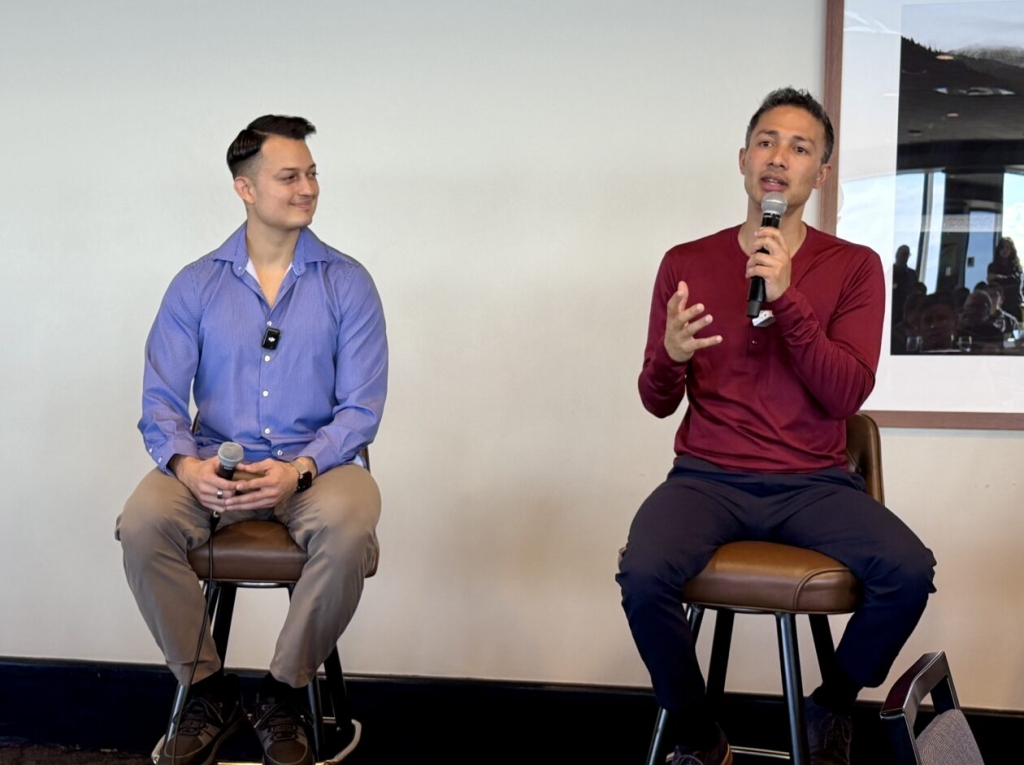
AI Gold Rush: Why Now Is the Most Magical Time to Build a Startup, According to Industry Veteran Sudheesh Nair
In a packed room at the Seattle Enterprise AI Summit, hosted by OneSixOne Ventures, veteran tech executive Sudheesh Nair delivered a rallying cry to entrepreneurs that felt less like a typical conference keynote and more like a startup founder’s battle hymn. With the AI revolution accelerating at breakneck speed, Nair, co-founder and CEO of TinyFish and former leader at both Nutanix and ThoughtSpot, declared that the current moment represents “one of the best openings founders have seen in years” – a window of opportunity so significant it might rival the birth of the internet itself.
“There is no better time to start companies than now,” Nair proclaimed to the audience, his voice carrying the unmistakable excitement of someone who’s witnessed multiple technology waves but sees something genuinely different in this one. “It’s just magical.”
The magic, according to Nair, stems from what he describes as AI’s unprecedented capability to make reasoning “on tap” for the first time in human history. This isn’t just another incremental improvement in technology – it’s a fundamental shift in what’s possible. “The way I think of it is, completely be constrained by your imagination — but nothing else,” he explained, painting a picture of a landscape where the only limit to what entrepreneurs can build is their creativity.
Nair’s credentials lend significant weight to his enthusiasm. After helping scale enterprise giants like Nutanix and ThoughtSpot to market leadership, he couldn’t resist the gravitational pull of the AI revolution. In 2024, he launched TinyFish, an enterprise web agent startup that has already raised an impressive $47 million to build infrastructure enabling AI agents to operate seamlessly across the web. “I couldn’t stand on the sidelines,” he admitted, capturing the sentiment of countless tech leaders who are diving into the AI gold rush.
To illustrate the magnitude of the opportunity, Nair drew a compelling parallel to the California Gold Rush of 1849. But here’s where his analogy takes an unexpected turn: the most enduring outcomes from that historical moment weren’t the gold nuggets themselves, but the second-order innovations that emerged to support the frenzy. Durable jeans from Levi Strauss, safer elevators from Elisha Otis, and modern banking systems from Wells Fargo – these weren’t products built for the gold rush, but because of it.
This historical lens offers a powerful insight for today’s AI entrepreneurs. While everyone’s eyes are on the frontier AI models and breakthrough applications, Nair suggests that the real, lasting value might lie in the infrastructure, tools, and supporting systems that enable the AI economy to function. Just as the Gold Rush created demand for reliable transportation, secure storage, and durable goods, the AI revolution is creating unprecedented demand for robust infrastructure, safety mechanisms, and operational tools.
However, Nair was careful not to paint an overly rosy picture. He acknowledged that company-building remains brutally difficult, and explicitly stated that startups aren’t for everyone. Some people are better suited to join early-stage companies or build innovations within larger organizations. His message wasn’t that everyone should drop everything and start a company, but rather that for those with the inclination and capability, the current moment offers a rare convergence of technological capability, market readiness, and available capital.
Perhaps most refreshingly, Nair pushed back against the common impulse to wait for clarity in rapidly evolving markets. In a space where even the leading AI labs are still figuring out how their most advanced models behave, waiting for perfect understanding would mean missing the opportunity entirely. “No one who knows what the heck is happening,” he stated bluntly, capturing the collective uncertainty even among industry leaders.
This embrace of uncertainty as a feature rather than a bug of the current moment is perhaps the most empowering aspect of Nair’s message. In traditional markets, entrepreneurs are taught to wait for clarity, to find whitespace, to identify unmet needs with precision. But in the AI gold rush, the map is still being drawn – and that’s precisely what makes it so exciting.
Nair’s closing metaphor brought everything into sharp focus: “If you just happen to have a pickaxe and shovel, the best thing might be to just jump in.” In the context of AI, those pickaxes and shovels might be coding skills, domain expertise, or simply the willingness to experiment and learn. The key is recognizing that we’re in the early days of what could be a multi-decade transformation of how humans interact with technology, make decisions, and build businesses.
The implications of Nair’s perspective extend far beyond individual entrepreneurs. For venture capitalists, it suggests a continued appetite for bold bets in the AI space. For established companies, it signals that the threat of disruption is real and imminent. For policymakers, it raises questions about how to foster innovation while managing the societal impacts of increasingly capable AI systems.
What makes Nair’s message particularly compelling is that it comes from someone who has already achieved significant success in traditional enterprise software. He’s not a young founder caught up in hype, but a seasoned executive who has seen technology waves come and go, and has chosen to bet his next chapter on AI because he genuinely believes it represents a step change in what’s possible.
As the Seattle Enterprise AI Summit demonstrated, the Pacific Northwest is emerging as a significant hub in this new gold rush, with companies like TinyFish and a growing ecosystem of AI startups and investors positioning the region as a key player in shaping the future of artificial intelligence. The energy in the room that day reflected a broader sentiment across the tech industry: we’re not just witnessing a new technology trend, but potentially the birth of a new industrial revolution.
For entrepreneurs watching from the sidelines, Nair’s message is both a challenge and an invitation. The path will be difficult, the uncertainty real, and the competition fierce. But for those willing to embrace the chaos and build with imagination as their only constraint, the current moment offers possibilities that may not come again for generations.
In the end, Nair’s rallying cry captures something essential about innovation: the greatest opportunities often emerge not when the path is clear, but when the landscape is shifting beneath our feet, when old certainties are crumbling, and when imagination becomes the most valuable currency of all. The AI gold rush is underway, and for those with the courage to participate, the tools to contribute, and the vision to see beyond the immediate frenzy, the possibilities are limited only by what we can imagine.
Tags & Viral Phrases:
AI Gold Rush, magical time to start companies, reasoning on tap, TinyFish $47M funding, Seattle Enterprise AI Summit, Sudheesh Nair Nutanix ThoughtSpot, AI infrastructure opportunity, Gold Rush jeans elevators banking analogy, no one knows what’s happening, pickaxe and shovel moment, constrained only by imagination, AI revolution bigger than internet, enterprise web agent startup, OneSixOne Ventures event, AI agent infrastructure, second-order innovations, California Gold Rush 1849 parallel, AI startup opportunity window, TinyFish co-founder CEO, AI market uncertainty as feature, enduring outcomes from gold rush, AI infrastructure jeans elevators banking, startup leap moment, frontier AI labs figuring it out, AI economy supporting systems, multi-decade AI transformation, Pacific Northwest AI hub, industrial revolution AI, chaos and imagination currency, path shifting beneath feet, greatest opportunities in uncertainty, AI capability step change, AI gold rush underway, tools to contribute vision, possibilities limited by imagination
,


Leave a Reply
Want to join the discussion?Feel free to contribute!