
Shift in the Gulf Stream could signal ocean current collapse
Breaking: Scientists Detect Critical Shift in Gulf Stream – AMOC Collapse Could Be Closer Than We Thought
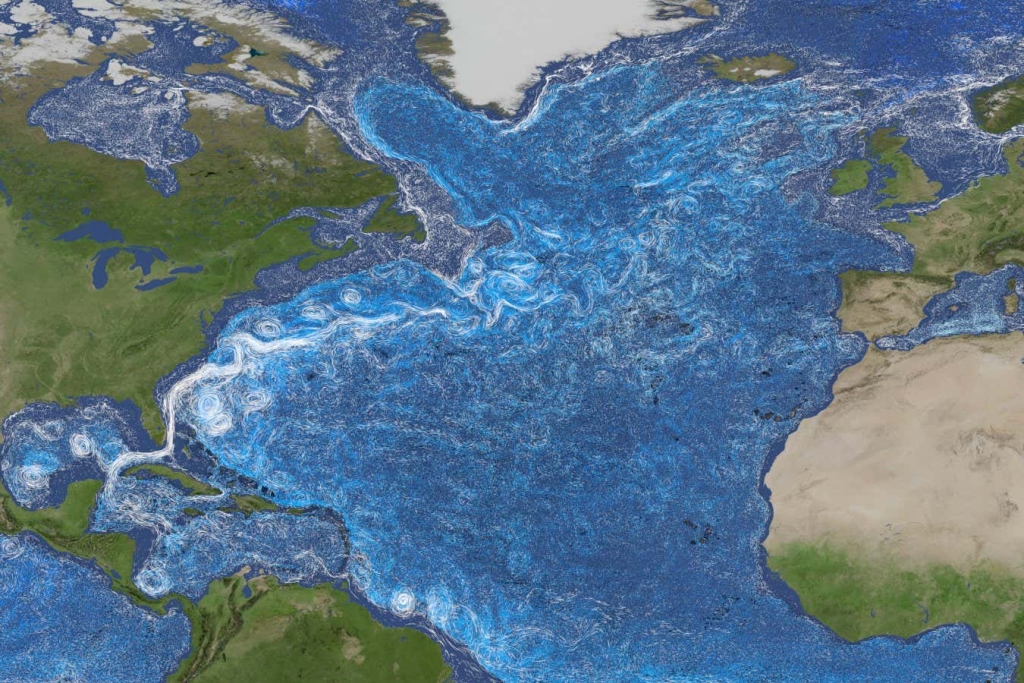
In a discovery that has oceanographers and climate scientists buzzing, new research reveals that the Gulf Stream—the mighty ocean current that keeps Europe temperate and influences global weather patterns—has shifted dramatically northward over the past three decades. This shift, detected through high-resolution satellite data and sophisticated ocean modeling, may be the smoking gun we’ve been waiting for: concrete evidence that the Atlantic Meridional Overturning Circulation (AMOC) is weakening far faster than climate models predicted.
The findings, published by researchers at Utrecht University in the Netherlands, show the Gulf Stream has moved approximately 50 kilometers northward since the early 1990s. But here’s where it gets truly alarming: their computer simulations suggest that when the Gulf Stream makes an abrupt, dramatic jump northward—potentially shifting more than 200 kilometers in just two years—an AMOC collapse could follow within two and a half decades.
“The Gulf Stream is essentially telling us the AMOC is weakening,” explains lead researcher René van Westen. “This isn’t just a subtle change we’re inferring from indirect measurements—we can actually see it happening from space.”
The AMOC functions like a massive conveyor belt in the Atlantic Ocean. Warm, salty water flows northward along the surface, releases heat to the atmosphere (keeping Europe’s climate mild), then cools, becomes denser, and sinks before flowing back southward along the ocean floor. This circulation pattern transports roughly 1.5 petawatts of heat—equivalent to about one million nuclear power plants—across the Atlantic.
The system is now under threat from climate change. As Greenland’s ice sheet melts at accelerating rates, vast amounts of freshwater pour into the North Atlantic. This freshwater dilutes the salty surface waters, making them less dense and reducing the sinking that drives the entire circulation. Think of it like adding cold freshwater to a hot saltwater bath—the dynamics change fundamentally.
What makes this new research particularly compelling is the mechanism it identifies. As the AMOC weakens, so does the Deep Western Boundary Current—the cold, dense return flow that normally hugs the North American coastline beneath the Gulf Stream. This deep current typically tugs the Gulf Stream southward. When it weakens, the Gulf Stream gradually shifts northward, following the coastline further before turning east into the Atlantic.
The Utrecht team achieved these insights using an unusually high-resolution ocean model with 10-kilometer pixels instead of the typical 100-kilometer resolution. This allowed them to track the subtle bulge in sea surface height where the Gulf Stream carries massive volumes of water. Their simulation revealed something startling: 392 years into the future scenario, the Gulf Stream suddenly jumped more than 200 kilometers north in just two years, followed by AMOC collapse 25 years later.
While this timeline shouldn’t be taken literally—the model represents an idealized scenario—it suggests the Gulf Stream’s behavior could serve as an early warning system for AMOC collapse. This would be the first concrete, observable precursor we’ve identified for such a catastrophic climate tipping point.
The implications are staggering. Previous research indicates that AMOC collapse would trigger rapid, severe cooling across the Northern Hemisphere, particularly in Europe. London could experience cold snaps plummeting to -20°C (-4°F), while Oslo, Norway, might see temperatures as low as -48°C (-54°F). These aren’t gradual changes over centuries—they would occur within years or decades of collapse.
The disruption would extend far beyond temperature changes. Agricultural zones would shift dramatically, potentially making large parts of Europe unsuitable for current crops. Monsoon patterns that billions depend on could fail. Sea levels along the eastern North American coast could rise by an additional meter. Marine ecosystems would face unprecedented stress as water temperatures and nutrient distributions change abruptly.
What makes this discovery especially concerning is that it suggests climate models may be significantly underestimating how quickly these changes could occur. While most models project AMOC weakening over the coming century, this research indicates the process may already be accelerating beyond our projections.
Not all scientists are ready to sound the alarm bells just yet. Oceanographer Dan Seidov, retired from the US National Oceanic and Atmospheric Administration, notes that Greenland’s meltwater could affect the AMOC differently than the model assumes—potentially at different rates or in different locations. The exact timing and mechanisms remain uncertain.
Stefan Rahmstorf at the University of Potsdam in Germany, however, sees the findings as additional evidence that AMOC weakening is occurring earlier than global warming scenarios suggest. “Climate models appear to underestimate the problem and thus potentially how soon an AMOC tipping point will be reached,” he warns.
The good news? If the Gulf Stream’s behavior proves to be a reliable early warning signal, we may have time to prepare. While preventing AMOC collapse might now be impossible, societies could take steps to adapt: improving building insulation for harsher winters, developing cold-resistant crop varieties, and planning for potential agricultural relocation.
The bad news? We’re essentially watching a planetary-scale experiment unfold in real-time, with civilization’s climate stability hanging in the balance. The Gulf Stream’s northward shift isn’t just an academic curiosity—it’s potentially the first visible symptom of a system that, once broken, cannot be easily repaired.
As van Westen puts it: “There is now a very proper early warning indicator that actually goes off. You can measure this very easily.” The question is whether we’ll recognize the warning signs in time to act on them.
#AMOC #GulfStream #ClimateEmergency #ClimateTippingPoints #OceanCurrents #ClimateChange #ClimateScience #EnvironmentalCrisis #GlobalWarming #ClimateModeling #ClimateResearch #ClimateAction #ClimateCrisis #Oceanography #ClimateWarning #ClimateEmergencyNow #ClimateBreakdown #ClimateDisaster #ClimateThreat #ClimateImpact #ClimateUrgency #ClimateAlert #ClimateThreat #ClimateWarning #ClimateCollapse #ClimateInstability #ClimateRisk #ClimateVulnerability #ClimateAdaptation #ClimateMitigation,


Leave a Reply
Want to join the discussion?Feel free to contribute!