
I Thought These Takeout Containers Were Recyclable. An Expert Explains Why They’re Not
The Hidden Truth About Recycling Takeout Containers: What You’re Doing Wrong (And How to Fix It)
The Recycling Crisis No One’s Talking About
That blue recycling bin in your kitchen? It’s not the magical solution you think it is. Every week, millions of Americans participate in what experts call “wish-cycling” – the well-intentioned but misguided practice of tossing questionable items into recycling bins hoping they’ll somehow get recycled. The reality? This habit is causing more harm than good to our recycling infrastructure.
Jeremy Walters, sustainability ambassador for Republic Services, America’s second-largest recycling company, has witnessed the devastating effects of wish-cycling firsthand. “People want to do the right thing,” Walters explains, “but good intentions without proper knowledge are actually making our recycling crisis worse.”
The Dirty Truth About “Recyclable” Labels
Here’s the shocking reality: just because a container has that familiar recycling symbol doesn’t mean it can actually be recycled in your community. Many manufacturers intentionally label products as “recyclable” even when local facilities can’t process them. This misleading practice has created a false sense of environmental responsibility while overwhelming recycling centers with contaminated materials.
The problem is so severe that some municipalities are considering eliminating curbside recycling altogether. When non-recyclable items enter the system, they contaminate entire batches of otherwise recyclable materials, forcing facilities to send everything to landfills – exactly what you were trying to avoid.
The 7 Most Common Recycling Mistakes That Are Killing Our Planet
1. Styrofoam Containers: The Silent Environmental Killer
Those white foam containers from your favorite takeout spot? They’re literally never recycled. Polystyrene foam, commonly known as Styrofoam, is one of the most problematic materials in our waste stream. It’s lightweight, breaks into tiny pieces that contaminate other recyclables, and costs more to recycle than the recycled material is worth.
The solution? Start a conversation with your local restaurants. Many are switching to compostable alternatives when customers request them. Your voice matters more than you think.
2. Black Plastic Containers: The Recycling Industry’s Blind Spot
Those sleek black plastic containers from your local bistro seem recyclable, right? Wrong. Recycling facilities use optical sorting technology that can’t detect black plastic because it absorbs the light used to identify materials. This means black plastic containers are automatically sorted as trash, regardless of their actual recyclability.
3. Chinese Takeout Boxes: Not What They Seem
Those iconic white paper boxes with the metal handle? Most can’t be recycled due to food contamination and the wax coating that makes them leak-proof. The metal handle is also problematic for recycling equipment.
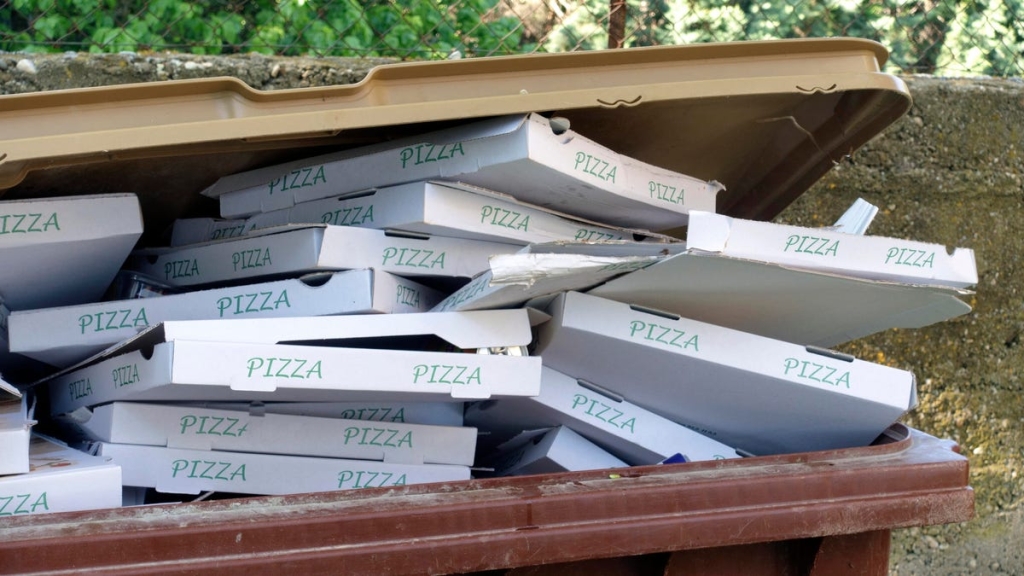
4. Oil-Soaked Pizza Boxes: When “Cardboard” Becomes “Garbage”
Here’s a mind-blowing fact: clean cardboard can be recycled indefinitely, but once it’s contaminated with grease or food residue, it becomes landfill-bound. That means only the top half of your pizza box (if it’s clean) can be recycled. The bottom half? Straight to the trash.
5. Plastic Bags: The Recycling Facility’s Worst Nightmare
Plastic bags are the bane of recycling facilities everywhere. They get tangled in sorting equipment, causing expensive shutdowns and dangerous working conditions. Never put plastic bags in your curbside recycling bin.
6. Plastic Utensils: Small but Mighty Problematic
Those little plastic forks and knives seem harmless, but they’re too small and oddly shaped to be properly sorted by recycling equipment. They fall through sorting screens and end up as waste anyway.
7. Soiled Paper Products: When Recycling Becomes Contamination
Paper plates, napkins, and paper towels contaminated with food or grease can’t be recycled. The fibers are too short to be reprocessed, and the contamination ruins entire batches of recyclable paper.
The 5 Takeout Containers You CAN Actually Recycle
1. Clear Plastic Clamshells (Check the Number!)
Look for the recycling symbol with a number 1 or 2 inside. These clear plastic containers are widely recyclable and should always go in your recycling bin – but only if they’re clean and dry.
2. Aluminum Containers: The Recycling Superstar
Those aluminum containers from your local takeout? They’re infinitely recyclable and one of the most valuable materials in the recycling stream. Just rinse them out and toss them in.
3. Clean Paper and Cardboard Containers
Many restaurants are switching to paper-based containers made from recycled materials. These are often recyclable themselves, provided they’re not heavily soiled with grease or food.
4. Paper Bags: The Simple Solution
Those brown paper bags your takeout comes in? Absolutely recyclable. They’re also compostable if your community offers that service.
5. Clean Paper Products
Paper plates, napkins, and cardboard pizza boxes that aren’t heavily soiled can generally be recycled. When in doubt, check your local guidelines.
The Game-Changing Recycling Tips You Need to Know
1. Become a Recycling Detective
The most important thing you can do is research what’s actually recyclable in your specific area. Every municipality has different rules, and what’s recyclable in one city might be trash in another.
2. Clean is Key
Food residue is the number one contaminant in recycling streams. Give containers a quick rinse before recycling. If it’s too dirty to clean quickly, it probably shouldn’t be recycled at all.
3. When in Doubt, Throw it Out
This might sound counterintuitive, but it’s better to throw away one questionable item than to contaminate an entire batch of recyclables. One contaminated item can ruin everything in that recycling batch.
4. Support Businesses Making the Switch
Many restaurants are transitioning to compostable or truly recyclable containers. Support these businesses and let others know you’d appreciate similar changes.
5. Consider Composting
Some cities, like Austin, Texas, offer curbside composting for food-soiled paper products. If your community doesn’t offer this service, consider starting a backyard compost bin or using a service like Block Bins.
The Future of Food Packaging: What’s Coming Next
The good news? The industry is evolving rapidly. Companies are developing truly compostable containers made from materials like bamboo, sugarcane, and even mushroom mycelium. Some restaurants are experimenting with reusable container programs where customers pay a deposit and return containers for cleaning and reuse.
Emerging Technologies Changing the Game
New sorting technologies are being developed that can better identify black plastics and other previously unrecyclable materials. Chemical recycling processes can break down plastics into their original components for true recycling rather than downcycling.
Your Action Plan: How to Make a Real Difference
-
Audit your recycling habits for one week. Note what you’re putting in your recycling bin and research whether each item is actually recyclable in your area.
-
Start conversations with your favorite local restaurants about their packaging choices. Many owners want to make changes but don’t know customers care.
-
Reduce before recycling. The most environmentally friendly option is always to reduce waste in the first place. Bring your own containers when possible.
-
Support progressive policies in your community that expand recycling and composting services.
-
Educate others about proper recycling. Share this information with friends and family – knowledge is power.
The Bottom Line
Recycling isn’t broken, but it’s definitely misunderstood. By becoming more informed about what can and cannot be recycled, you’re not just reducing waste – you’re becoming part of the solution to our global waste crisis.
Remember: the goal isn’t to recycle more, it’s to recycle better. Every properly recycled item is a victory for our planet.
Viral Tags: recycling crisis, wish-cycling, takeout containers, environmental impact, sustainable living, zero waste, plastic pollution, eco-friendly habits, green lifestyle, recycling tips, food packaging, waste reduction, composting, circular economy, environmental awareness
Viral Phrases: “wish-cycling is killing recycling,” “clean recycling is effective recycling,” “one contaminated item ruins everything,” “reduce before you recycle,” “your recycling bin isn’t magic,” “the dirty truth about recycling,” “be a recycling detective,” “support the packaging revolution,” “compostable vs recyclable confusion,” “the future of food packaging”
,


Leave a Reply
Want to join the discussion?Feel free to contribute!