
Asteroid defense mission shifted the orbit of more than its target
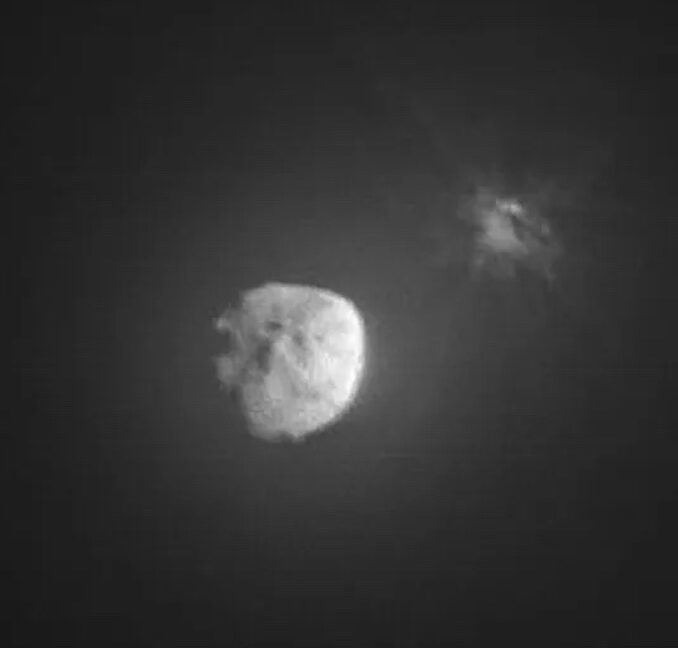
NASA’s DART Mission Successfully Altered Asteroid’s Orbit, Proving Planetary Defense is Possible
In a groundbreaking achievement for planetary defense, NASA’s DART (Double Asteroid Redirection Test) mission has successfully demonstrated that humanity can alter the trajectory of a celestial body. The findings, published in a comprehensive study spanning over two years of observations, confirm that the intentional collision with an asteroid can indeed change its orbit—a crucial capability if we ever need to protect Earth from a potential impact threat.
The Didymos System: Our Cosmic Laboratory
The target of this historic mission was the Didymos binary asteroid system, located approximately 11 million kilometers from Earth. This system consists of a larger asteroid, Didymos (measuring about 780 meters in diameter), and its smaller companion, Dimorphos (roughly 160 meters across), which orbits the larger body.
Between October 2022 and March 2025, astronomers captured 22 stellar occultations—precise moments when the asteroids passed in front of distant stars, allowing scientists to measure their positions with extraordinary accuracy. This data was combined with an extensive dataset from the Minor Planet Center containing nearly 6,000 ground-based astrometric measurements collected over 29 years, optical navigation data from DART’s approach, and ground-based radar measurements.
The Moment of Impact
On September 26, 2022, the vending-machine-sized DART spacecraft, traveling at over 22,000 kilometers per hour (approximately 6.1 kilometers per second), deliberately collided with Dimorphos. The impact was more than just a spectacular collision—it was a carefully orchestrated experiment in planetary defense.
“When you do it early enough, even a small impulse can accumulate over years and cause a meaningful shift,” explained Makadia, one of the lead researchers on the project.
The Numbers Don’t Lie
The impact achieved something remarkable: it decreased the along-track velocity of the entire Didymos system by approximately 11.7 micrometers per second. While this change might seem infinitesimal—roughly the width of a human hair every second—astronomers emphasize that over time, such small changes can accumulate into significant orbital alterations.
Combined with the massive dataset available, researchers could finally discern how Didymos’ orbit has changed since the impact. The results were clear: the mission succeeded beyond expectations.
The “Ejecta Engine” Effect
What made this impact particularly effective wasn’t just the kinetic energy of the spacecraft itself. When DART struck Dimorphos, it created a spectacular explosion of pulverized rock and dust that was blasted into space. This phenomenon proved to be a crucial factor in the orbital change.
“The material kicked up off an asteroid surface acts like an extra rocket plume,” Makadia noted. This effect, known as the momentum enhancement factor or “beta,” proved to be the secret weapon of the DART mission.
Understanding Beta: The Game-Changer
In physics terms, if the spacecraft impact had transferred exactly its own momentum with no debris being kicked up, the beta parameter would have been exactly one. However, the actual value proved to be around two—meaning the impact was twice as effective as a simple collision would have been.
Here’s why: because Dimorphos orbits Didymos, some of the ejecta remained trapped in the system, altering the mutual orbit between the two rocks. But crucially, a significant fraction of the ejecta achieved escape velocity from the entire binary system. The momentum carried away by this escaping debris is what ultimately contributed to shoving the center of mass of the whole Didymos-Dimorphos pair.
Implications for Planetary Defense
This successful demonstration represents a watershed moment for planetary defense. For the first time in human history, we’ve proven that we can intentionally alter the trajectory of a celestial body. While Didymos posed no threat to Earth, the technology and understanding gained from this mission could prove invaluable if we ever detect a potentially hazardous asteroid on a collision course with our planet.
The study’s findings suggest that kinetic impactors—spacecraft deliberately crashed into asteroids—could be a viable strategy for planetary defense, especially when given sufficient lead time. The “ejecta engine” effect means that even smaller spacecraft can have outsized effects when they create significant debris plumes upon impact.
Looking Forward
As we continue to catalog near-Earth objects and improve our detection capabilities, the knowledge gained from DART provides a crucial tool in our planetary defense arsenal. The mission has opened new avenues for research and has given scientists and engineers valuable data for future missions.
The success of DART proves that when faced with existential threats from space, humanity has the technological capability to respond. It’s a powerful reminder that with preparation, innovation, and international cooperation, we can protect our planet from cosmic dangers.
Tags: NASA, DART mission, asteroid deflection, planetary defense, Didymos, Dimorphos, space exploration, kinetic impactor, ejecta, momentum enhancement, beta parameter, celestial mechanics, planetary science, asteroid impact, space technology
Viral Phrases: “Humanity’s first planetary defense test,” “Vending machine vs. asteroid,” “The ejecta engine that saved Earth (theoretically),” “11.7 micrometers per second that could save humanity,” “When a tiny push becomes a cosmic shove,” “NASA just proved we can move mountains in space,” “The day we learned to wrestle with asteroids,” “From science fiction to science fact,” “Our cosmic insurance policy just got activated,” “The small change that could prevent Armageddon”
,


Leave a Reply
Want to join the discussion?Feel free to contribute!