
Starkiller Phishing Suite Uses AitM Reverse Proxy to Bypass Multi-Factor Authentication
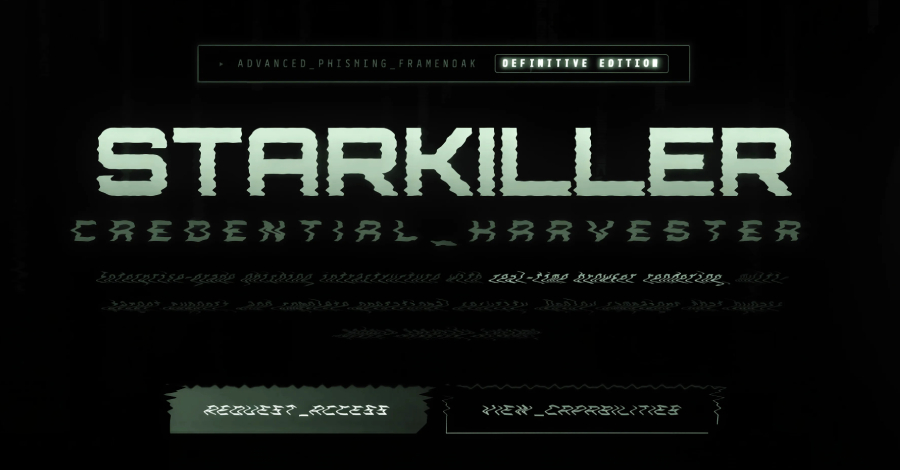
Starkiller Phishing Kit: The New SaaS of Cybercrime That Bypasses MFA with Live Website Proxying
In a shocking development that cybersecurity experts are calling “the democratization of cybercrime,” a new phishing toolkit named Starkiller has emerged on the dark web, fundamentally changing the landscape of online fraud and credential theft. This sophisticated platform represents a quantum leap in phishing technology, making sophisticated attacks accessible to even the most novice cybercriminals.
The Evolution of Phishing: From Templates to Live Proxying
Traditional phishing attacks have long relied on static HTML templates that mimic legitimate login pages. These required constant updating as companies modified their actual websites, creating a cat-and-mouse game between attackers and defenders. Starkiller completely eliminates this vulnerability through its revolutionary live website proxying technology.
According to researchers from Abnormal Security, Starkiller operates by launching a headless Chrome instance inside a Docker container, which then loads the genuine target website and acts as a reverse proxy between the victim and the legitimate site. This means victims are served authentic page content directly through the attacker’s infrastructure, ensuring the phishing page is never out of date.
“The genius of Starkiller is that it proxies the real site live,” explain Abnormal researchers Callie Baron and Piotr Wojtyla. “There are no template files for security vendors to fingerprint or blocklist.” This architectural approach makes Starkiller virtually undetectable by traditional security measures that rely on recognizing known phishing page patterns.
How Starkiller Works: The Technical Breakdown
When a victim clicks on a Starkiller-generated link, they’re directed to what appears to be the legitimate website of the targeted brand. Behind the scenes, every keystroke, form submission, and session token is routed through attacker-controlled infrastructure. The headless Chrome instance captures all user inputs and forwards them to the actual website, then relays the legitimate site’s responses back to the victim.
This creates a seamless experience where users believe they’re interacting with the real company, while attackers capture credentials, session tokens, and even multi-factor authentication codes in real-time. The platform integrates URL shorteners like TinyURL to obscure destination URLs and allows users to select custom keywords like “login,” “verify,” “security,” or “account” to make phishing emails appear more legitimate.
The Cybercrime-as-a-Service Revolution
Starkiller represents a disturbing trend toward Cybercrime-as-a-Service (CaaS), where sophisticated attack tools are packaged into user-friendly platforms. The threat group behind Starkiller, calling themselves Jinkusu, offers customers access to a dashboard that lets them select brands to impersonate or enter real URLs directly.
This commoditization of cybercrime dramatically lowers the barrier to entry. Where sophisticated phishing attacks once required technical expertise, Starkiller’s interface allows even low-skill criminals to launch professional-grade attacks. The platform centralizes infrastructure management, phishing page deployment, and session monitoring within a single control panel.
Starkiller’s Growing Threat Landscape
The emergence of Starkiller coincides with other concerning developments in the phishing ecosystem. Researchers at Datadog have documented the evolution of the 1Phish kit, which has progressed from a basic credential harvester in September 2025 into a multi-stage phishing kit specifically targeting 1Password users.
The updated 1Phish version incorporates pre-phishing fingerprint and validation layers, support for capturing one-time passcodes (OTPs) and recovery codes, and browser fingerprinting logic to filter out bots. “This progression reflects deliberate iteration rather than simple template reuse,” notes security researcher Martin McCloskey. “Each version builds upon the previous one, introducing controls designed to increase conversion rates and reduce automated analysis.”
Advanced Phishing Campaigns: Beyond Simple Credential Theft
The threat landscape extends beyond toolkits like Starkiller and 1Phish. A sophisticated phishing campaign targeting North American businesses has been abusing the OAuth 2.0 device authorization grant flow to bypass multi-factor authentication and compromise Microsoft 365 accounts.
In this attack, the perpetrator registers a Microsoft OAuth application and generates a unique device code delivered to victims via targeted phishing emails. Victims are directed to the legitimate Microsoft domain (microsoft.com/devicelogin) to enter an attacker-supplied device code. This authenticates the victim and issues a valid OAuth access token to the attacker’s application, granting persistent access to corporate data.
Financial Sector Under Siege
Financial institutions are facing particularly aggressive targeting. BlueVoyant researchers have identified a multi-stage phishing campaign against U.S.-based banks and credit unions that operates in two distinct phases. The campaign began with an initial wave in late June 2025, followed by a more sophisticated set of attacks starting in mid-November 2025.
These attacks use co.com domains that spoof financial institution websites, presenting credible impersonations of real financial institutions. When visited from a clickable link in a phishing email, these domains load fraudulent Cloudflare CAPTCHA pages that mimic the targeted institution. The CAPTCHA is non-functional but creates a deliberate delay before redirecting users to credential harvesting pages.
To evade detection, directly accessing the co.com domains triggers a redirect to a malformed “www.www” URL. The campaign employs multiple evasion techniques including referrer validation, cookie-based access controls, intentional delays, and code obfuscation, creating a resilient infrastructure that presents significant barriers for automated security tools.
The Implications: A New Era of Cybercrime
The sophistication and accessibility of tools like Starkiller signal a troubling shift in the cybercrime landscape. As phishing becomes increasingly SaaS-like, with user-friendly interfaces and comprehensive feature sets, the skill barrier necessary to execute large-scale attacks continues to drop.
Organizations must recognize that traditional security measures focusing on known phishing patterns are becoming obsolete. The live proxying approach used by Starkiller means that even the most vigilant users may be unable to distinguish between legitimate and fraudulent websites. This necessitates a fundamental rethinking of cybersecurity strategies, with increased emphasis on behavioral analytics, zero-trust architectures, and user education about the evolving nature of phishing threats.
The cybercrime ecosystem is evolving rapidly, and tools like Starkiller represent a new paradigm where sophisticated attacks are just a few clicks away for anyone with malicious intent. As we move further into 2025, organizations and individuals alike must remain vigilant and adaptive in the face of these increasingly sophisticated threats.
Tags: Starkiller, phishing kit, MFA bypass, Cybercrime-as-a-Service, live website proxying, headless Chrome, Docker container, credential theft, multi-factor authentication, OAuth 2.0, Microsoft 365, 1Phish, co.com domains, cybersecurity threats, phishing evolution, reverse proxy, Abnormal Security, Datadog, BlueVoyant
Viral Phrases: “the democratization of cybercrime,” “phishing becomes SaaS,” “live website proxying,” “the new face of phishing,” “cybercrime in the cloud,” “MFA’s fatal flaw exposed,” “the end of traditional phishing detection,” “crime as a service,” “the phishing revolution,” “security’s new nightmare,” “credentials in the cloud,” “the invisible attack,” “phishing’s final form,” “the perfect crime platform,” “cybercrime’s user-friendly future”
,

Leave a Reply
Want to join the discussion?Feel free to contribute!