
Why Boeing Built A Real-Life Star Wars X-Wing Starfighter
Boeing’s X-Wing Drones: The Rise and Fall of a Galactic Dream
In a galaxy not so far away, Boeing once brought a piece of Star Wars magic to life with two real-life X-wing starfighters that captured the imagination of fans and aviation enthusiasts alike. This isn’t a story about lightsabers or the Force, but rather about how one of the world’s largest aerospace companies partnered with Disney to create something truly out of this world.
The X-wing starfighter is arguably one of the most iconic spacecraft in science fiction history. Its distinctive X-shaped wing configuration, powerful twin engines, and role as the Rebel Alliance’s primary snub fighter have made it a symbol of hope and resistance across the Star Wars universe. So when Boeing decided to create real-life versions of these legendary ships, the aerospace community and Star Wars fans alike were understandably excited.
In 2019, Boeing teamed up with Walt Disney to celebrate the grand opening of Star Wars: Galaxy’s Edge at Walt Disney World in Florida. As part of this collaboration, Boeing took two of its CV2 Cargo Air Vehicles (CAVs) and transformed them into flying X-wings. These weren’t just static displays or elaborate costumes – these were functional drones that could actually take to the skies, albeit in a limited capacity.
The transformation was nothing short of remarkable. Boeing engineers designed lightweight shells that mimicked the X-wing’s distinctive profile, complete with the iconic twin engines and laser cannons. The drones themselves were equipped with advanced stabilization systems to maintain their formation during flight, creating the illusion of X-wings soaring through the skies above the theme park.
What made this display particularly impressive was the attention to detail. Disney’s Imagineers employed ultraviolet spotlights to create a stunning visual effect. These special lights would illuminate the X-wing shells while keeping the actual drones hidden from view, creating the illusion that the starfighters were floating on their own power. It was a perfect blend of aerospace engineering and theatrical magic that left attendees in awe.
However, it’s important to note that these weren’t exactly life-size X-wings. With a wingspan of just 20.2 feet, they were more like scale models than full-size replicas. But from a distance, and especially with the clever lighting effects, most people couldn’t tell the difference. The drones were designed to slowly hover rather than perform the high-speed maneuvers their fictional counterparts are known for, but that didn’t diminish the impact of seeing what appeared to be real X-wings flying overhead.
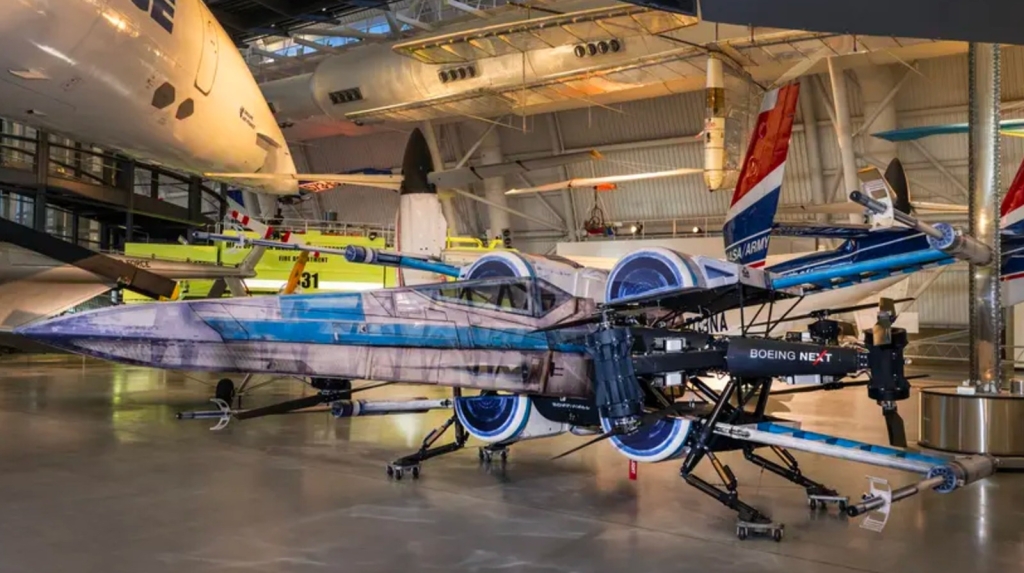
One of these remarkable X-wing drones now resides in the Smithsonian National Air and Space Museum’s Steven F. Udvar-Hazy Center in Chantilly, Virginia. There, visitors can see the drone up close, without the theatrical lighting, and appreciate the engineering that went into creating this unique piece of pop culture history. It stands as a testament to what can be achieved when cutting-edge aerospace technology meets creative vision.
The story of Boeing’s X-wing drones, however, is tinged with a bittersweet irony. These drones were part of Boeing’s NeXt division, which was focused on developing autonomous air vehicles and other advanced aerospace technologies. The CV2 CAV itself was originally conceived as a remote-controlled delivery drone capable of carrying 500 pounds of cargo. It also served as a testbed for Boeing’s engineers, becoming the first remotely piloted large eVTOL (electrical vertical takeoff and landing) aircraft to be flown in support of a commercial operation in the United States.
The timing of the X-wing project was particularly poignant. It came at a time when Boeing was facing significant challenges with its 737 Max aircraft, which was involved in two fatal crashes in 2018 and 2019. These incidents forced Boeing to ground its entire fleet of 737 Max planes to address serious safety issues. The company was already under intense scrutiny, and these problems would have long-lasting effects on its reputation and operations.
Then, in 2020, the COVID-19 pandemic hit, bringing global travel to a near standstill and causing a dramatic decline in airplane ticket sales. This perfect storm of crises led Boeing to make the difficult decision to close its NeXt division, effectively ending the development of projects like the CV2 CAV.
The irony of this situation is almost painful to consider. Just as Boeing was forced to shutter its drone development wing, the world was on the cusp of a drone revolution. The pandemic actually accelerated the push for autonomous delivery systems and other drone technologies. In China, for example, drone fleets began delivering everything from lunches to hospital supplies. The U.S. Army started testing laser weapons capable of shooting down potentially dangerous drones. The timing couldn’t have been worse for Boeing’s ambitious drone projects.
Imagine if Boeing had continued its drone development. We might now be seeing fleets of CV2 CAVs delivering military supplies, or perhaps even more elaborate displays at theme parks and events. The technology that powered those brief, magical moments when X-wings seemed to fly over Disney World could have been refined and expanded, potentially revolutionizing cargo transport and other industries.
The story of Boeing’s X-wing drones is a fascinating glimpse into what might have been. It’s a tale of innovation and creativity, of the intersection between science fiction and real-world technology. It’s also a reminder of how quickly the winds of fortune can change in the aerospace industry, and how external factors can dramatically alter the course of technological development.
As we look to the future of drone technology and autonomous flight, the legacy of Boeing’s X-wing project serves as both inspiration and a cautionary tale. It shows us the incredible potential of aerospace engineering to bring our wildest dreams to life, while also reminding us of the unpredictable nature of technological progress. Who knows? Perhaps one day, we’ll see real X-wings soaring through our skies – not as mere displays, but as functional spacecraft exploring the stars. Until then, we can look back on Boeing’s brief foray into the Star Wars universe as a shining example of what happens when imagination takes flight.
#Boeing #Xwing #StarWars #Drones #Aviation #Aerospace #Technology #Innovation #Disney #GalaxyEdge #Smithsonian #Futuristic #SciFi #Engineering #PopCulture #Spacecraft #eVTOL #AutonomousFlight #CargoDrones #ThemeParks #Aeronautics #AviationHistory #TechNews #ScienceFiction #Boeing737Max #COVID19Impact #DroneDelivery #AdvancedTechnology #AerospaceEngineering #FutureOfFlight
“May the Force be with you” “X-wings take flight” “Boeing’s galactic dream” “From Star Wars to real skies” “The Force of innovation” “When sci-fi meets reality” “A bittersweet legacy” “The drones that almost were” “Galactic cosplay in the skies” “Boeing’s NeXt chapter ends” “Timing is everything in tech” “The X-wing that could have been” “From theme parks to cargo bays” “A tale of two crashes” “When the world stood still” “The drone revolution Boeing missed” “Science fiction becomes science fact” “Engineering meets imagination” “The irony of progress” “A bittersweet swan song” “The CV2’s final flight” “Boeing’s galactic misstep” “When X-wings ruled the sky” “The Force was not with them” “A dream deferred” “The X-wing that got away” “Boeing’s brush with the Force” “When drones became starfighters” “The X-wing that lives on” “A bittersweet victory” “The CV2’s last hurrah” “Boeing’s missed opportunity” “The X-wing that could have been” “When sci-fi became reality” “The drone that dazzled” “Boeing’s galactic gamble” “The X-wing that flew too soon” “A bittersweet legacy in the skies” “The drone that almost changed everything” “When Boeing reached for the stars” “The X-wing that got grounded” “A tale of innovation and irony” “The drone that dazzled Disney” “Boeing’s brush with galactic fame” “The X-wing that could have revolutionized cargo” “When technology met imagination” “The drone that almost was” “Boeing’s galactic near-miss” “The X-wing that flew into history” “A bittersweet chapter in aerospace” “The drone that dazzled and disappeared” “When Boeing played in a galaxy far, far away” “The X-wing that almost changed the world”,


Leave a Reply
Want to join the discussion?Feel free to contribute!