
CoreCollective is a New Consortium Bringing the Arm Software Ecosystem Under One Roof
Big Tech Unites: CoreCollective Launches to Revolutionize Arm Software Development
In a groundbreaking move that’s sending shockwaves through the tech industry, Arm and Linaro have joined forces to launch CoreCollective, a revolutionary open industry consortium aimed at supercharging the Arm software ecosystem. This unprecedented collaboration brings together tech giants like AMD, Google, Microsoft, Qualcomm, and Samsung, among others, to create a neutral space for tackling shared software challenges.
The Dawn of a New Era in Tech Collaboration
The tech world has been buzzing with news of increased cooperation among industry leaders. Just weeks after Meta’s decision to move React under a dedicated foundation for open governance, the announcement of CoreCollective marks another significant step towards industry-wide collaboration.
CoreCollective emerges as a free and open consortium, designed to foster innovation and address the growing complexities of the Arm software stack. This initiative comes at a crucial time when Arm’s reach has expanded far beyond its mobile roots, now encompassing AI, cloud computing, edge devices, automotive technology, and client computing.
Linaro’s Evolution: From Fragmentation to Foundation
To fully appreciate the significance of CoreCollective, we must first understand the role of Linaro. Founded in 2010, this UK-based organization has been tirelessly working to unify the fragmented Arm software ecosystem. Their efforts have yielded tangible results, most notably in the form of Arm64 support in the Linux kernel.
With the launch of CoreCollective, Linaro is undergoing a strategic restructuring. The organization will now operate in two distinct capacities: as the host of CoreCollective for open collaboration and as a fully commercial services provider for companies building products on Arm architecture.
Who’s Who in CoreCollective
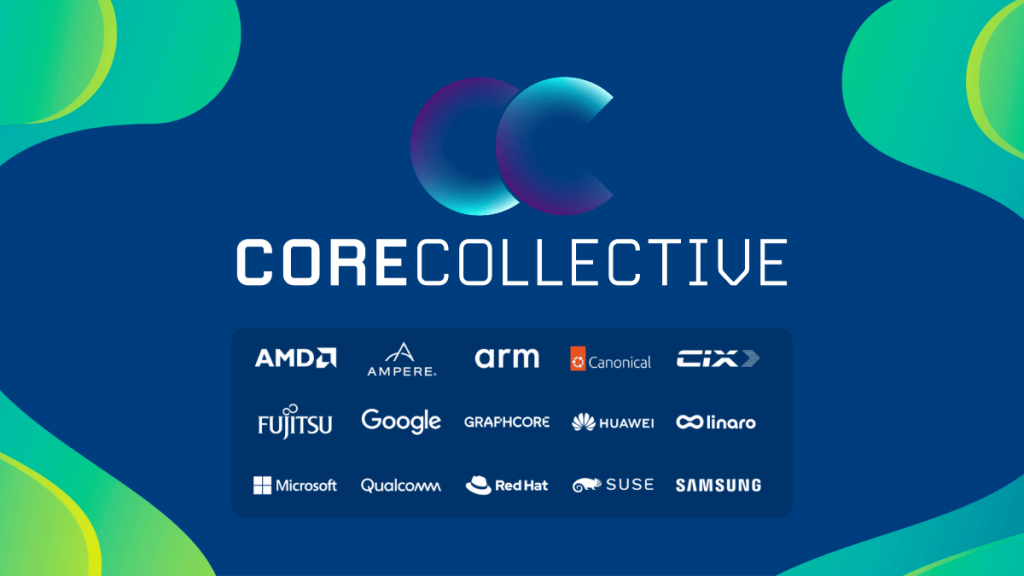
The consortium’s launch roster reads like a who’s who of the tech industry:
- AMD: Pushing the boundaries of high-performance computing
- Ampere: Specializing in Arm-based cloud processors
- Arm: The architect behind the Arm architecture
- Canonical: The company behind Ubuntu Linux
- CIX Technology: Emerging player in the Arm ecosystem
- Fujitsu: Japanese tech giant with a focus on computing solutions
- Google: The search engine behemoth and Android creator
- Graphcore: AI hardware and software specialist
- Huawei: Chinese tech conglomerate
- Linaro: The driving force behind CoreCollective
- Microsoft: Windows and cloud computing giant
- Qualcomm: Leader in mobile and wireless technologies
- Red Hat: Open-source software solutions provider
- Samsung: South Korean electronics and semiconductor powerhouse
- SUSE: Enterprise Linux and open-source software company
Why Now? The Growing Complexity of Arm’s Ecosystem
The formation of CoreCollective is a direct response to the expanding complexity of Arm’s ecosystem. As Arm’s influence grows across diverse sectors, the software challenges become increasingly intricate and multifaceted. No single company can effectively address all these challenges alone.
Li Gong, CEO of Linaro, emphasized the importance of this initiative:
“As the ecosystem expands, we must scale our impact. CoreCollective with Arm’s backing removes the financial barrier to entry, making collaboration more inclusive, free and open to anyone to join and participate. By running CoreCollective alongside Linaro’s commercial services, we can support more partners in the Arm ecosystem, be it through industry-wide cooperation or tailored, one-to-one service agreements.”
What to Expect: Working Groups and Collaborative Innovation
CoreCollective operates through specialized working groups, each focusing on a specific aspect of the Arm software stack. At launch, seven working groups have been confirmed:
- Linux Fundamentals: Ensuring robust Linux support for Arm architectures
- Confidential Compute: Advancing secure computing technologies
- Windows on Arm: Improving Windows compatibility and performance on Arm devices
- Android: Enhancing the Android experience on Arm-based devices
- Edge Compute: Optimizing Arm for edge computing applications
- Virtualization: Improving virtualization technologies for Arm
- Data Center: Advancing Arm’s presence in data center environments
These working groups serve as the engine of innovation within CoreCollective, allowing members to propose new initiatives and collaborate on solutions to common challenges. Importantly, members can propose new working groups at any time, ensuring the consortium remains dynamic and responsive to emerging needs.
Join the Revolution: Free Membership and Open Collaboration
In a move that underscores CoreCollective’s commitment to open collaboration, membership is completely free. Any company can join by filling out the CoreCollective Membership Agreement and sending it to the team for countersignature. The consortium offers three tiers of membership:
- General Members: Standard membership for companies of all sizes
- Sponsoring Members: For companies looking to provide additional support
- Individual Members: For individual contributors and smaller entities
All code contributions must use an OSI-approved license with a Developer Certificate of Origin sign-off. Documentation material falls under Creative Commons Attribution 4.0, ensuring transparency and accessibility.
A Governing Board handles oversight, while a Technical Advisory Committee manages the working groups, ensuring a balanced and effective governance structure.
The Future of Arm Software Development
CoreCollective represents a paradigm shift in how the tech industry approaches software development for Arm architectures. By creating a neutral space for collaboration, it removes barriers to entry and accelerates innovation across the entire Arm ecosystem.
This initiative has the potential to:
- Accelerate the development of Arm-compatible software
- Improve cross-platform compatibility and performance
- Foster innovation in emerging fields like AI and edge computing
- Enhance security and reliability across Arm-based devices
- Drive down costs through shared development efforts
As Arm continues to expand its influence in various tech sectors, CoreCollective positions itself as a crucial facilitator of this growth, ensuring that the software ecosystem can keep pace with hardware advancements.
The Ripple Effect: Implications for the Tech Industry
The launch of CoreCollective is more than just a new consortium; it’s a statement about the future of tech collaboration. It demonstrates that even fierce competitors can come together to address common challenges, potentially paving the way for more industry-wide initiatives in the future.
This move also highlights the growing importance of open-source principles in driving technological advancement. By creating a free and open platform for collaboration, CoreCollective is tapping into the collective intelligence of the tech industry, potentially leading to breakthroughs that would be impossible for any single company to achieve alone.
Conclusion: A New Chapter in Arm’s Story
As we witness the launch of CoreCollective, we’re not just seeing the birth of a new consortium; we’re observing a pivotal moment in the evolution of the Arm ecosystem. This initiative has the potential to reshape how software is developed for Arm architectures, driving innovation, improving compatibility, and ultimately benefiting consumers and businesses alike.
The tech industry will be watching closely as CoreCollective begins its work, eager to see how this unprecedented collaboration unfolds and what new innovations it will bring to the world of Arm computing.
Tags:
Arm, CoreCollective, Linaro, Tech Collaboration, Open Source, Software Development, Industry Consortium, AMD, Google, Microsoft, Qualcomm, Samsung, Linux, Android, AI, Cloud Computing, Edge Computing, Automotive Technology, Virtualization, Data Center, Open Collaboration, Tech Innovation, Arm Architecture, Software Ecosystem
Viral Phrases:
- “Big Tech Unites”
- “Revolutionizing Arm Software Development”
- “Game-Changing Collaboration”
- “Tech Giants Join Forces”
- “The Future of Arm Computing”
- “Open Source Revolution”
- “Breaking Down Barriers”
- “Innovation Without Boundaries”
- “The Power of Collaboration”
- “Shaping the Next Era of Tech”
- “From Fragmentation to Foundation”
- “Driving Arm’s Ecosystem Forward”
- “Unlocking the Potential of Arm”
- “Accelerating Arm Innovation”
- “The Dawn of a New Tech Era”
- “Collaboration is the New Competition”
- “Open Source: The Great Equalizer”
- “Tech’s United Front”
- “The Arm Ecosystem Reimagined”
- “Collaboration Without Borders”
,

Leave a Reply
Want to join the discussion?Feel free to contribute!