
Trees Seen Emitting a Ghostly Light During a Thunderstorm For The First Time : ScienceAlert
Scientists Capture Trees Glowing in Thunderstorms for the First Time — And It’s More Mind-Blowing Than You Think
For the first time in history, scientists have caught trees emitting tiny bursts of ultraviolet light during thunderstorms — a phenomenon so subtle it’s invisible to the naked eye, yet so fascinating it could reshape how we understand forest ecosystems and atmospheric science.
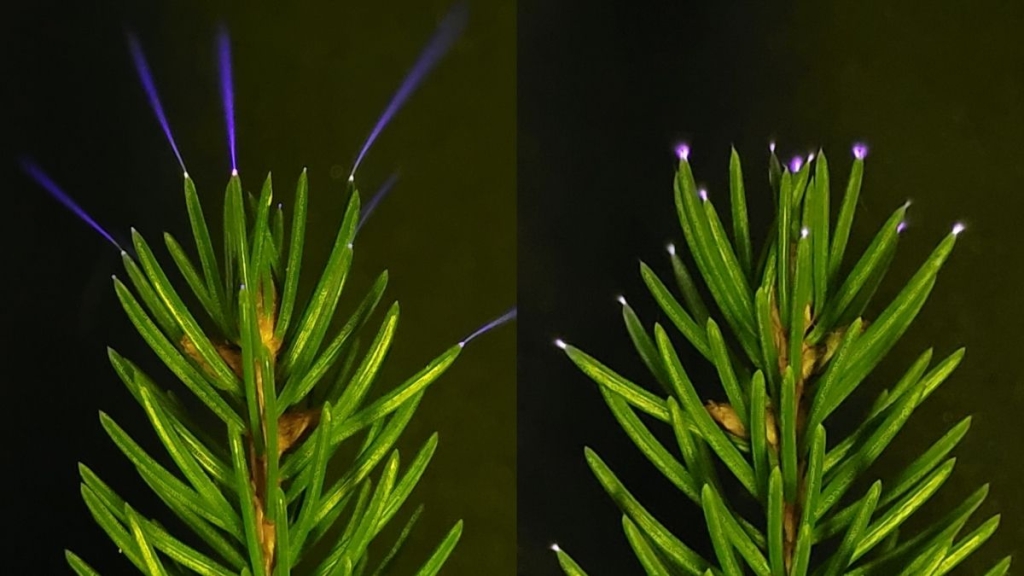
For years, meteorologists suspected that trees were silently glowing beneath storm clouds. The theory? As thunderstorms pass overhead, their massive electrical charge induces a current in the moisture-rich branches and leaves below. This charge builds up at the tips of leaves until it can’t go any further, creating a faint corona discharge — essentially a microscopic ultraviolet light show happening right above our heads.
Now, thanks to groundbreaking research from Pennsylvania State University, we finally have proof.
The Hunt for Invisible Light
Led by meteorologist Patrick McFarland, the team spent months storm-chasing across the eastern United States, armed with cutting-edge equipment. Their mobile lab? A 2013 Toyota Sienna outfitted with a weather station, electric field detector, laser rangefinder, and a roof-mounted periscope feeding into an ultraviolet camera.
In controlled lab experiments, they first recreated the phenomenon using small spruce and maple trees placed beneath charged metal plates. When the lights went out, they saw it: a barely visible blue glow at the leaf tips. But seeing it in the wild was another challenge entirely.
What They Actually Saw
The footage itself doesn’t look like much at first glance — just sweetgum leaves blowing in the wind during a North Carolina storm. But the UV-sensitive equipment detected something extraordinary: 41 distinct bursts of ultraviolet light across the branches, each lasting between 0.1 and 3 seconds. The coronae appeared to “hop” from leaf to leaf, sometimes repeating on the same leaf, matching predictions from earlier lab studies.
Similar effects were observed in loblolly pines and sweetgums along the US East Coast. If humans had superhuman vision, McFarland says, we’d see “a swath of glow on the top of every tree under the thunderstorm” — like “thousands of UV-flashing fireflies descended on the treetops.”
The Science Behind the Glow
Each corona emitted approximately 100 billion photons at a wavelength of around 260 nanometers. While that sounds like a lot, these bursts are incredibly faint — each one releasing energy equivalent to a tiny fraction of what a lightning bolt produces.
The phenomenon occurs because trees, with their water-filled trunks and branches, provide an excellent path for electrical currents. When a thunderstorm’s charge passes overhead, it induces a voltage in the tree. The charge travels up the tree but stops at the air-leaf interface, where it builds up and eventually discharges as UV light.
Why This Matters
This isn’t just a cool visual effect — it could have significant implications for forest ecology, atmospheric chemistry, and even climate science.
Atmospheric Chemistry: Trees emit various hydrocarbons, and these electrical discharges might help break them down, affecting air quality and atmospheric composition.
Forest Health: Repeated exposure to these electrical surges could damage or kill upper branches, similar to how trees form upward lightning leaders during cloud-to-ground strikes.
Climate Change: As global temperatures rise, thunderstorms are becoming more frequent and intense. More storms mean more coronae, potentially amplifying these effects across forest ecosystems worldwide.
Thunderstorm Electrification: The widespread nature of these coronae might actually influence how thunderstorms develop their electrical charge, creating a feedback loop between forests and storm systems.
The Bigger Picture
This discovery opens up entirely new avenues of research. How do different tree species respond? Do younger trees produce stronger coronae than older ones? Could this phenomenon explain certain patterns of forest damage after severe storms?
As McFarland and his team conclude: “The impacts these coronae have on atmospheric chemistry, forest ecology, health, and evolution, and thunderstorm electrification must be re-evaluated and understood, especially as thunderstorms, and therefore coronae, increase in a warming climate.”
The research, published in Geophysical Research Letters, represents a perfect example of how modern technology — even something as humble as a modified minivan — can reveal nature’s hidden wonders.
Tags: #Thunderstorms #Trees #UltravioletLight #ForestScience #AtmosphericPhenomena #ClimateChange #WeatherResearch #NatureDiscovery #ScientificBreakthrough #InvisibleLight #StormChasing #PennsylvaniaStateUniversity #GeophysicalResearchLetters #UVScience #ForestEcology
Viral Sentences:
- Trees are silently glowing during thunderstorms and we’re just now seeing it
- Scientists caught nature’s invisible light show on camera
- The forest is putting on a UV light show every time it storms
- This discovery could change everything we know about forests and weather
- What if trees are communicating through ultraviolet light during storms?
- Nature’s secret ultraviolet fireworks display revealed
- The invisible phenomenon happening in forests worldwide
- How a minivan became the key to unlocking nature’s secrets
- Trees might be getting damaged by their own electrical glow
- The hidden connection between forests and thunderstorms
- Climate change could make this phenomenon even more common
- Scientists finally prove what they’ve suspected for decades
- The blue glow that only UV cameras can see
- What thunderstorms look like from a tree’s perspective
- The forest’s secret response to electrical storms
,


Leave a Reply
Want to join the discussion?Feel free to contribute!