
Physical AI simulation boosts ROI for factory automation
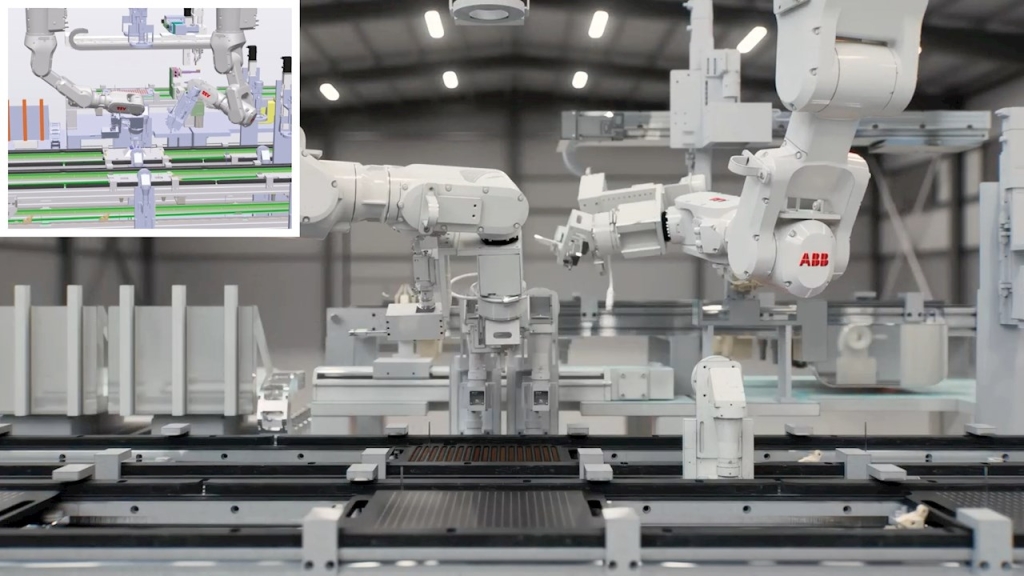
ABB and NVIDIA’s Breakthrough: Physical AI Simulation Bridges the Gap Between Virtual Training and Real-World Factory Automation
The manufacturing industry has long struggled with a fundamental challenge: translating digital robotics training into reliable real-world performance. Traditional approaches have forced companies to rely heavily on physical prototypes, creating bottlenecks that delay product launches and inflate costs. However, a groundbreaking partnership between ABB Robotics and NVIDIA is poised to revolutionize factory automation by bringing industrial-grade physical AI simulation to manufacturing floors worldwide.
The Longstanding Challenge of Digital-to-Physical Translation
Manufacturing engineers have historically faced an exasperating reality: robots that perform flawlessly in digital environments often stumble when deployed on actual factory floors. This disconnect stems from the complex interplay of variables that exist in physical spaces—variable lighting conditions, material inconsistencies, and subtle part variations that digital models simply cannot capture accurately.
The consequences have been significant. Companies have been forced to maintain extensive physical testing facilities, endure lengthy deployment cycles, and absorb substantial costs associated with trial-and-error implementation. For industries where time-to-market is critical, these limitations have represented a serious competitive disadvantage.
ABB and NVIDIA’s Revolutionary Approach
The partnership between ABB Robotics and NVIDIA represents a fundamental shift in how manufacturers approach automation deployment. By integrating NVIDIA Omniverse libraries directly into ABB’s existing RobotStudio software, the collaboration creates a unified platform that enables physically accurate digital testing before any hardware is installed.
Scheduled for release in the second half of 2026, RobotStudio HyperReality is already generating significant interest across the manufacturing sector. The technology promises to reduce deployment costs by up to 40% while accelerating time-to-market by as much as 50%—figures that have captured the attention of production leaders worldwide.
The Technical Architecture Behind the Innovation
The system’s effectiveness relies on a sophisticated workflow that begins with complete digital modeling. Engineers can design, test, and validate entire automation cells within the software environment before committing to physical implementation. This process involves exporting a fully parameterized station—including robots, sensors, lighting configurations, kinematic parameters, and parts—as a USD (Universal Scene Description) file directly into the Omniverse environment.
Within this digital space, a virtual controller executes identical firmware to that found on physical machines, achieving a remarkable 99% behavioral match between digital and physical implementations. This level of fidelity means that problems identified in simulation are virtually guaranteed to manifest in the real world, allowing engineers to address issues before they impact production.
Synthetic Data Training and Precision Enhancement
Rather than relying on manual programming for robot movements, the system employs computer vision models trained using synthetic images generated within the software. This approach, combined with Absolute Accuracy technology, dramatically improves positioning precision—reducing errors from 8-15 millimeters to approximately 0.5 millimeters. Such accuracy is essential for industrial applications where even minor deviations can result in defective products or equipment damage.
The synthetic data generation capability is particularly noteworthy. By creating vast libraries of training images that encompass every conceivable variation in lighting, material appearance, and environmental conditions, the system prepares robots for real-world scenarios that would be impractical or impossible to capture through traditional photography.
Early Adopter Success Stories
The technology’s potential is already being validated by early adopters on active production lines. Foxconn, the global electronics manufacturing giant, is testing the software for consumer device assembly—a domain characterized by frequent product changes and the handling of delicate metal components that complicate traditional automation approaches.
By leveraging synthetic data to train their systems virtually, Foxconn anticipates achieving high accuracy on factory floors while simultaneously reducing setup time and eliminating costly physical testing phases. This dual benefit addresses two of manufacturing’s most persistent pain points simultaneously.
Similarly, Workr, a California-based automation provider, has integrated its WorkrCore platform with ABB hardware trained via Omniverse. The company plans to showcase its capabilities at the NVIDIA GTC 2026 event in San Jose, demonstrating systems capable of onboarding new parts within minutes without requiring specialized programming expertise.
Industry Leaders Weigh In
Marc Segura, President of ABB Robotics, emphasized the significance of this technological milestone: “Combining RobotStudio with the physically accurate simulation power of NVIDIA Omniverse libraries, we have closed technology’s long-standing ‘sim-to-real’ gap—a huge milestone to deploying physical AI with industrial-grade precision, for real-world customer applications.”
Deepu Talla, VP of Robotics and Edge AI at NVIDIA, highlighted the broader implications: “The industrial sector needs high-fidelity simulation to bridge the gap between virtual training and real-world deployment of AI-driven robotics at scale. Integrating NVIDIA Omniverse libraries into RobotStudio brings advanced simulation and accelerated computing to ABB’s virtual controller technology, accelerating how thousands of manufacturers bring complex products to market.”
Edge Computing Integration
The hardware ecosystem is evolving to support this new paradigm. ABB is actively evaluating the integration of NVIDIA’s Jetson edge platform into its Omnicore controllers—a development that would enable real-time inference across existing robotic fleets. This edge computing capability is crucial for applications requiring immediate decision-making without relying on cloud connectivity.
The Competitive Advantage Equation
Manufacturers adopting this digital-first simulation approach for physical AI can reduce setup and commissioning times by up to 80%. As artificial intelligence transitions from software applications to hardware operations, the ability to prepare data pipelines and upskill engineering teams to work with synthetic data will increasingly determine which companies maintain competitive advantages.
The implications extend beyond mere efficiency gains. Organizations that master this technology will be positioned to respond more rapidly to market changes, accommodate greater product variation, and deliver higher quality at lower costs—all critical factors in today’s competitive manufacturing landscape.
Looking Ahead
As the 2026 release window approaches, manufacturing executives are carefully evaluating how to integrate these capabilities into their operations. The technology represents not just an incremental improvement but a fundamental reimagining of how automation is deployed and managed.
Companies that successfully navigate this transition will find themselves with unprecedented flexibility in their manufacturing processes, capable of adapting to new products and market demands with minimal downtime and investment. Those that hesitate may find themselves at a structural disadvantage as the industry’s competitive dynamics shift toward organizations that have embraced this new paradigm of physical AI simulation.
Tags
ABB #NVIDIA #RobotStudio #Omniverse #PhysicalAI #FactoryAutomation #ManufacturingInnovation #DigitalTwin #SyntheticData #IndustrialRobotics #SmartManufacturing #AIinIndustry #EdgeComputing #ProductionEfficiency #TimeTomarket #CostReduction #FactoryOfTheFuture #ManufacturingTechnology #Automation #RoboticsSimulation
Viral Phrases
“Closing the sim-to-real gap”
“Physical AI with industrial-grade precision”
“99% behavioral match between digital and physical”
“Reducing setup time by up to 80%”
“Deploying physical AI at scale”
“High-fidelity simulation for manufacturing”
“Synthetic data training for robotics”
“Virtual controller with real-world accuracy”
“Accelerating time-to-market by 50%”
“40% reduction in deployment costs”
“Digital-first simulation approach”
“Industrial-grade physical AI simulation”
“Revolutionizing factory automation”
“Manufacturing’s competitive advantage”
“The future of smart manufacturing”
“Next-generation factory automation”
“AI-driven robotics at scale”
“Manufacturing innovation breakthrough”
“Physical AI deployment milestone”
“Factory floor digital transformation”
,

Leave a Reply
Want to join the discussion?Feel free to contribute!