
Ethereum USD Funding Rate Turns Negative as Bears Regain Control
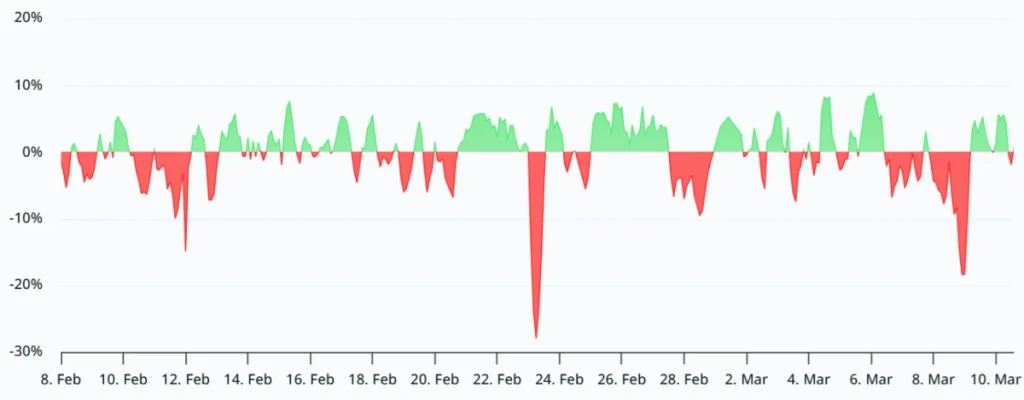
Ethereum’s Funding Rate Turns Negative as Bears Seize Control
Ethereum’s perpetual futures funding rates have plunged into negative territory for the first time in weeks, marking a decisive shift in market sentiment as bearish traders assert dominance. This critical metric indicates that short sellers are now paying longs to maintain their positions, a clear signal that the market is overwhelmingly positioned for further downside.
The funding rate’s descent into negative territory coincides with mounting institutional skepticism, evidenced by a staggering $210 million in net outflows from Ethereum ETFs between March 5 and March 10. This capital exodus comes amid escalating global macroeconomic tensions, creating a perfect storm of bearish pressure on the second-largest cryptocurrency.
Ethereum USD Struggles at Critical Support
ETH is currently battling to defend the psychologically crucial $2,000 level, having suffered a brutal near-60% price correction over the past six months. The cryptocurrency slid another 1.9% overnight, following what had initially appeared to be a positive start to the trading week. This relentless selling pressure has left Ethereum teetering on the edge of a potential breakdown.
Market participants view these negative funding rates as a capitulation signal, historically often preceding short squeezes. However, the current macroeconomic backdrop suggests that legitimate spot selling pressure, rather than speculative positioning, is driving the price action. The fundamental picture appears to be deteriorating faster than technical indicators can adapt.
What Negative Funding Rates Actually Signal for ETH
The flip to negative funding represents more than a temporary market fluctuation—it highlights a structural weakness in Ethereum’s market dynamics. When funding rates turn negative, shorts pay longs, indicating the market is heavily skewed toward betting on lower prices. According to CoinGlass data, while aggregate funding rates are negative, the options market presents a slightly more nuanced picture.
The options risk gauge remains relatively neutral, hovering between -6% and +6%, yet put options are trading at a 7% premium relative to calls. This divergence suggests that while futures traders are aggressively shorting, sophisticated investors are hedging against further downside rather than positioning for a complete collapse.
Furthermore, as on-chain derivatives activity migrates to alternative networks like Hyperliquid, demand for mainnet Ethereum protocols has softened considerably. This migration leaves price action increasingly dependent on speculative flows rather than fundamental utility, creating a fragile market structure vulnerable to rapid shifts in sentiment.
The Levels That Could Change Everything
Technical analysis reveals critical price levels that could determine Ethereum’s trajectory. ETH is currently testing a precarious zone where bulls are desperately attempting to defend the $2,000 support level. However, repeated tests of this level suggest weakening buyer resolve and mounting exhaustion among long holders.
If bears manage to force a daily close below $1,980, the next major liquidity pocket sits at $1,840. A breakdown below this level would leave minimal structural support until $1,760—a zone that could trigger a cascade of long liquidations and accelerate the decline. The absence of significant buyer interest between current levels and $1,760 creates a potential vacuum that could see prices collapse rapidly.
Conversely, for the bearish thesis to be invalidated, ETH needs to reclaim $2,120 on a high-volume breakout. A sustained move above this resistance level would squeeze the aggressive late shorts currently paying funding, potentially sparking a rapid surge toward $2,300. However, until the $2,120 resistance is cleared, the path of least resistance remains firmly downward.
What Traders Are Watching Next
The immediate catalyst for any potential reversal lies in institutional flows. The $210 million ETF outflow needs to stabilize quickly; continued institutional selling will likely force the price through support regardless of derivatives positioning. Traders are closely monitoring these flows as they represent the most significant source of selling pressure currently impacting the market.
Market participants are also scrutinizing the yield spread between Ethereum staking and stablecoin lending. With native ETH staking offering approximately 2.8% annual returns compared to stablecoin yields closer to 3.75% on platforms like Aave, capital efficiency currently favors stablecoins over ETH. This yield differential is encouraging investors to rotate out of Ethereum into more productive assets, further pressuring the price.
Unlike broader market optimism seen in other sectors, the data suggests Ethereum needs a specific catalyst to reverse its downtrend. Whether this comes in the form of a spike in spot buying from large investors or a capitulation wick that flushes remaining leverage from the system, the market appears to be waiting for a clear signal before establishing any meaningful bottom.
Technical Analysis and Market Structure
The current market structure shows Ethereum trapped in a descending channel that has contained price action for the past several months. Each attempted recovery has been met with increasing selling pressure, suggesting that buyers are becoming increasingly reluctant to step in at higher levels. The Relative Strength Index (RSI) has dipped into oversold territory multiple times, yet each bounce has been progressively weaker, indicating declining momentum.
Volume profiles show significant liquidity clustering around the $2,000 level, but with each test, this support appears to be weakening. The lack of substantial volume on recent bounces suggests that any recovery attempts are being met with distribution rather than accumulation, a bearish signal that often precedes further declines.
Institutional Perspective and ETF Flows
The institutional perspective on Ethereum has shifted notably over recent weeks. The $210 million outflow from Ethereum ETFs represents one of the largest single-week withdrawals since these products launched. This capital rotation suggests that institutional investors are either reducing exposure to the broader crypto market or reallocating to other assets they perceive as offering better risk-adjusted returns.
The timing of these outflows is particularly concerning, as they coincide with Ethereum’s price approaching historically significant support levels. Typically, institutional investors would be expected to accumulate at these levels, but the continued selling pressure indicates a lack of confidence in the near-term outlook.
On-Chain Metrics and Network Activity
On-chain metrics provide additional context for the current price action. Active addresses on the Ethereum network have declined steadily over the past quarter, suggesting reduced user engagement and potentially lower demand for ETH. Transaction volumes have also softened, particularly for non-DeFi related activities, indicating that the network’s utility may be declining relative to competing blockchains.
Gas fees, while still elevated compared to historical averages, have shown signs of weakness as users migrate to Layer 2 solutions or alternative networks. This migration reduces the burn mechanism that was expected to provide fundamental support for ETH prices, creating additional headwinds for the cryptocurrency.
Derivatives Market Dynamics
The derivatives market presents a complex picture of current sentiment. While perpetual futures funding rates are negative, options skew remains relatively balanced, suggesting that sophisticated traders are hedging rather than aggressively positioning for further declines. This divergence between futures and options markets often indicates uncertainty about the magnitude of potential moves rather than a clear directional bias.
Open interest in Ethereum futures has declined significantly from recent peaks, suggesting that speculative leverage is being reduced. This deleveraging process, while painful in the short term, could create conditions for a more sustainable recovery once selling pressure abates.
Historical Context and Cycle Analysis
Historical analysis reveals that Ethereum has previously found strong support around the $2,000 level during previous market cycles. However, each cycle has seen progressively lower lows, suggesting that the cryptocurrency may be entering a new phase of its market cycle where traditional support levels are being tested and potentially broken.
The current price action bears similarities to the 2018-2019 bear market, where Ethereum tested and ultimately broke below key psychological levels before establishing a new base. While historical patterns don’t guarantee future outcomes, they provide valuable context for understanding potential scenarios.
Market Sentiment and Social Metrics
Social media sentiment around Ethereum has turned decidedly bearish, with negative mentions and discussions outnumbering positive ones by a significant margin. This shift in sentiment often occurs near market bottoms, but the persistence and intensity of negative sentiment suggest that fear remains the dominant emotion among market participants.
Google search trends for Ethereum-related terms have also declined, indicating reduced retail interest and potentially fewer new buyers entering the market. This lack of fresh capital could make it more difficult for prices to find support without significant institutional participation.
Risk Factors and Potential Catalysts
Several risk factors could exacerbate the current downtrend. Regulatory uncertainty remains a significant concern, particularly regarding the classification of Ethereum as a security. Any negative regulatory developments could trigger additional selling pressure and accelerate the decline.
Conversely, potential catalysts for a reversal include successful Ethereum network upgrades, increased institutional adoption, or broader cryptocurrency market rallies led by Bitcoin. However, these catalysts appear increasingly unlikely given the current market conditions and sentiment.
Technical Targets and Scenario Analysis
Technical analysis suggests several potential price targets depending on how the current situation unfolds. In a bearish scenario where $2,000 support fails, targets around $1,840 and potentially $1,760 become increasingly likely. A break below $1,760 could open the door to further declines toward the $1,500-$1,600 range.
In a more optimistic scenario where buyers defend $2,000 successfully, a recovery toward $2,300 becomes possible, though this would require significant buying pressure and a shift in sentiment. A move above $2,500 would be needed to signal a more substantial trend change, but this appears unlikely without a broader market catalyst.
Conclusion
Ethereum’s descent into negative funding rates represents a significant shift in market dynamics, with bearish traders firmly in control. The combination of institutional outflows, weakening technical support, and deteriorating on-chain metrics creates a challenging environment for ETH bulls. While historical patterns suggest that extreme bearish sentiment often precedes significant reversals, the current market structure and macroeconomic conditions make it difficult to identify a clear catalyst for a sustained recovery.
The $2,000 level remains the critical battleground, with the potential for either a significant bounce or a sharp breakdown depending on how this support holds. Traders and investors should monitor institutional flows, technical levels, and broader market sentiment closely, as these factors will likely determine Ethereum’s trajectory in the coming weeks. Until a clear trend reversal is established, caution remains warranted, and risk management should be prioritized given the elevated uncertainty in the current market environment.
Tags: Ethereum, ETH, cryptocurrency, crypto market, funding rates, negative funding, bearish trend, institutional outflows, ETF flows, technical analysis, support levels, $2000 support, crypto trading, derivatives market, on-chain metrics, market sentiment, risk management
Viral Sentences:
- Ethereum’s funding rate just turned negative – bears are officially in control!
- $210M in outflows from Ethereum ETFs – institutions are running for the exits
- ETH struggling at $2000 – will this critical support hold or break?
- Negative funding rates signal capitulation – is a short squeeze coming?
- Ethereum’s price down nearly 60% – the brutal bear market continues
- Smart money hedging with put options while futures traders short aggressively
- $2000 is the line in the sand for Ethereum bulls
- Institutional skepticism mounting as ETH faces existential pressure
- The migration to Hyperliquid is draining liquidity from mainnet Ethereum
- ETH staking yields can’t compete with stablecoin lending rates
- Technical breakdown imminent if $1980 fails to hold
- Options skew remains neutral despite aggressive futures shorting
- Historical patterns suggest ETH could test $1760 if support breaks
- Retail interest declining as Google searches for Ethereum plummet
- Regulatory uncertainty adds fuel to the bearish fire
- DeFi activity shifting to L2s, reducing demand for base layer ETH
- The perfect storm: macro tensions, outflows, and technical weakness
- Bulls desperately defending $2000 – but for how much longer?
- Ethereum’s network activity showing signs of fatigue and decline
- The $2120 resistance level is the key to invalidating the bearish thesis
- Deleveraging in derivatives market could set up explosive reversal
- Fear and uncertainty dominate social media sentiment around ETH
- Each bounce weaker than the last – momentum is clearly bearish
- Institutional capital rotation away from crypto continues unabated
- The 2018 bear market parallels are becoming increasingly relevant
- ETH needs a miracle catalyst to break the current downtrend
- Short sellers paying longs – a rare and ominous market signal
- The psychological $2000 level is under unprecedented pressure
- Ethereum’s fundamentals deteriorating faster than the price
- Market structure suggests lower lows are likely in the near term
- Technical analysts watching $1840 and $1760 as next major support zones
- The yield differential between ETH and stablecoins favors rotation
- Network utility metrics failing to support current price levels
- Derivatives data shows sophisticated hedging rather than outright bearishness
- Historical support levels being tested with increasing frequency
- The absence of buyer interest between $2000 and $1760 is concerning
- Institutional flows will likely determine the next major move
- Risk management is crucial in this highly uncertain market environment
- The stage is set for either capitulation or a dramatic short squeeze
- Ethereum’s future hangs in the balance at these critical technical levels
,


Leave a Reply
Want to join the discussion?Feel free to contribute!