
Laser Light Rewrites Magnetism in Breakthrough Quantum Material
Laser Light Rewrites Magnetism in Breakthrough Quantum Material
In a landmark achievement that could redefine the future of quantum computing, data storage, and spintronics, an international team of researchers has demonstrated the ability to control magnetism in a topological material using nothing more than laser light. The breakthrough, led by scientists at the University of Basel and ETH Zurich, marks a pivotal step toward ultrafast, energy-efficient magnetic memory and quantum devices.
For decades, controlling magnetic polarity has required external magnetic fields or electric currents, both of which are relatively slow and energy-intensive. But this new research, published in Nature Physics, shows that magnetism in a special class of ferromagnets can be flipped entirely with laser pulses — and crucially, the effect is reversible and repeatable.
The material in question is a topological insulator, a quantum material that conducts electricity on its surface while remaining insulating in its bulk. These materials are prized for their exotic electronic properties, including robust spin-polarized currents that could enable dissipationless electronics. In this study, the researchers used a specific type of ferromagnetic topological insulator where electron spins are inherently aligned, giving rise to a permanent magnetic moment.
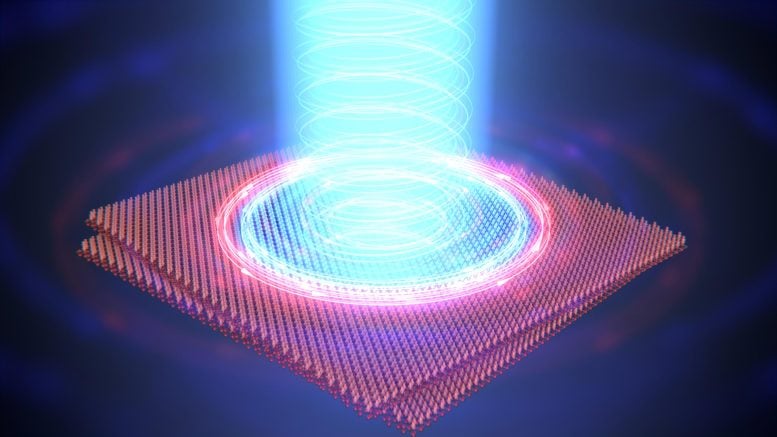
By shining a circularly polarized laser beam onto the material, the team was able to induce a change in the orientation of the magnetic domains — effectively flipping the “north” and “south” poles of the magnet. The process is non-contact, ultra-fast (occurring in picoseconds), and, most importantly, fully reversible. A second pulse of opposite polarization can restore the original magnetic state.
“This is a game-changer,” said Dr. Andrea Blanter, one of the lead researchers. “We’re essentially writing and erasing magnetic information with light. The implications for data storage alone are enormous — imagine hard drives that operate at the speed of light and consume a fraction of the energy.”
The mechanism behind this phenomenon lies in the interaction between the light’s angular momentum and the spin-polarized electrons in the material. Circularly polarized light carries spin angular momentum, which can be transferred to the electrons, causing them to reorient and, in turn, flip the magnetic polarity of the material.
What makes this discovery particularly exciting is its potential scalability. While the experiments were conducted at cryogenic temperatures, the team is optimistic that with further material engineering, similar effects could be achieved at room temperature. This would open the door to practical applications in next-generation memory devices, quantum processors, and even neuromorphic computing systems that mimic the human brain.
“Topological materials are at the forefront of quantum materials research,” said Professor Ming Shi from ETH Zurich. “Combining their unique properties with optical control could lead to entirely new classes of devices that are faster, smaller, and more energy-efficient than anything we have today.”
The research also has implications for the emerging field of valleytronics, where information is encoded in the momentum states of electrons rather than their charge or spin. The ability to optically manipulate both spin and valley degrees of freedom could enable multi-dimensional data storage and processing.
While challenges remain — such as improving the efficiency of the light-matter interaction and integrating these materials into existing semiconductor platforms — the study represents a significant leap forward. It bridges the gap between fundamental quantum physics and practical technology, offering a glimpse into a future where light, not electricity, is the primary tool for controlling magnetic states.
As the world races toward more sustainable and powerful computing technologies, this laser-driven approach to magnetism could be the key to unlocking the next era of the digital revolution.
Tags, Viral Words & Phrases:
laser-controlled magnetism, quantum materials, topological insulators, spintronics breakthrough, ultrafast data storage, energy-efficient memory, light-driven electronics, reversible magnetic switching, next-gen computing, cryogenic quantum tech, spin-polarized currents, valleytronics, dissipationless electronics, photonics meets magnetism, future of hard drives, room-temperature quantum devices, optical manipulation of spins, cutting-edge quantum research, game-changing discovery, nanoscale magnetic control, sustainable computing, photon-based memory, magnetic domain engineering, Nobel-worthy physics, sci-tech revolution, light as a data tool, quantum spin Hall effect, magnetic polarity flipping, laser pulse technology, topological quantum computing, spin angular momentum, circular polarized light, electron spin reorientation, neuromorphic computing potential, semiconductor integration challenges, multi-dimensional data storage, light-matter interaction, quantum material engineering, magnetic memory of the future, physics meets engineering, breakthrough in magnetism, optical control of quantum states, futuristic electronics, energy-saving tech, next-generation memory devices, quantum information science, spin-based computing, light-controlled quantum devices.
,


Leave a Reply
Want to join the discussion?Feel free to contribute!