
Iran-Backed Hackers Claim Wiper Attack on Medtech Firm Stryker – Krebs on Security
Iranian Hacktivist Group Claims Responsibility for Devastating Data-Wiping Attack on Stryker Medical Technology Giant
In a brazen cyber assault that has sent shockwaves through the global healthcare technology sector, an Iranian-linked hacktivist group has claimed responsibility for a massive data-wiping attack against Stryker, one of the world’s leading medical technology companies. The incident has forced the company to shut down operations across multiple countries, sending home thousands of employees and raising serious concerns about potential supply chain disruptions in healthcare systems worldwide.
The Attack Unfolds: A Coordinated Strike Against Global Operations
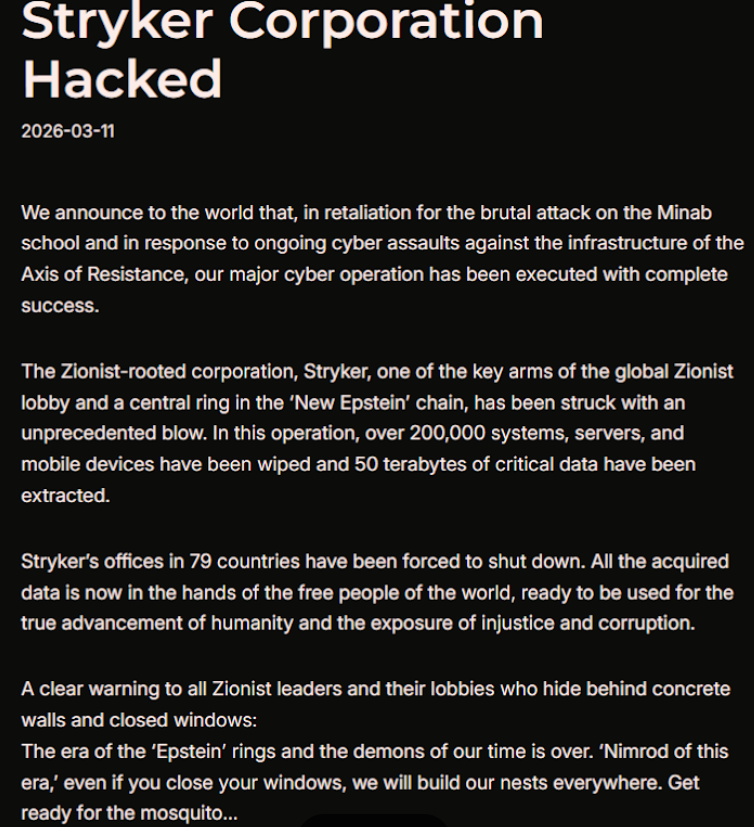
The cyber onslaught, attributed to the Iran-backed group Handala (also known as Handala Hack Team), reportedly affected Stryker’s offices in 79 countries, with the attackers claiming to have erased data from more than 200,000 systems, servers, and mobile devices. The scale of the operation is staggering, representing what cybersecurity experts are calling one of the most comprehensive data-wiping attacks ever documented against a single corporate entity.
News outlets in Ireland, where Stryker maintains its largest hub outside the United States, reported that over 5,000 workers were sent home as the company grappled with the fallout. Meanwhile, calls to Stryker’s Michigan headquarters were met with a voicemail message stating the company was “currently experiencing a building emergency,” adding to the growing sense of crisis surrounding the incident.
Handala’s Manifesto: Political Retaliation or Cyber Warfare?
In a lengthy statement posted to Telegram, Handala justified the attack as retaliation for a February 28 missile strike that killed at least 175 people, most of them children, at an Iranian school. The New York Times has since reported that an ongoing military investigation has determined the United States was responsible for the deadly Tomahawk missile strike, lending credence to the attackers’ stated motivations.
“All the acquired data is now in the hands of the free people of the world, ready to be used for the true advancement of humanity and the exposure of injustice and corruption,” a portion of the Handala statement reads. This rhetoric, combined with the group’s designation of Stryker as a “Zionist-rooted corporation”—likely a reference to Stryker’s 2019 acquisition of the Israeli company OrthoSpace—suggests a politically motivated operation with deep-seated ideological underpinnings.
The Technical Execution: Sophisticated Wipe or Managed Service Exploit?
Initial reports suggested the use of traditional malicious software designed to overwrite existing data on infected devices. However, cybersecurity experts who spoke with KrebsOnSecurity on condition of anonymity revealed a more nuanced picture. The perpetrators appear to have exploited Microsoft’s Intune service, a cloud-based solution that IT teams use to enforce security and data compliance policies across connected devices.
By issuing a “remote wipe” command through Intune’s administrative console, the attackers were able to simultaneously target thousands of devices regardless of their physical location. This method of attack, while devastating in its effectiveness, also points to potential vulnerabilities in how organizations manage and secure their device management infrastructure.
The Intune connection was further supported by discussions on Reddit, where several users claiming to be Stryker employees reported being instructed to urgently uninstall the Intune service from their devices. This rapid response suggests that Stryker’s IT teams recognized the attack vector quickly and were working to contain the damage.
Stryker’s Global Footprint: A Massive Target for Cyber Attackers
Based in Kalamazoo, Michigan, Stryker is a medical and surgical equipment maker that reported $25 billion in global sales last year. With 56,000 employees across 61 countries, the company represents a significant target for cyber attackers. Its website proudly proclaims its status as a global leader in medical technology, making the attack not just a corporate crisis but a potential threat to healthcare systems worldwide.
The Irish Examiner reported that systems in Stryker’s Cork headquarters were “shut down,” and that employee devices had been wiped, with login pages defaced with the Handala logo. This level of disruption in one of Stryker’s key international hubs underscores the global reach of the attack and the challenges facing the company’s incident response teams.
Potential Healthcare Supply Chain Disruption: A Growing Concern
As the attack continues to unfold, healthcare professionals are beginning to feel the ripple effects. One healthcare provider at a major U.S. university medical system reported being unable to order surgical supplies normally sourced through Stryker. “This is a real-world supply chain attack,” the anonymous source told KrebsOnSecurity. “Pretty much every hospital in the U.S. that performs surgeries uses their supplies.”
The potential for widespread disruption in the healthcare supply chain is significant, given Stryker’s role as a major supplier of medical devices. Surgical procedures, emergency room operations, and various medical treatments could be affected if the outage extends for a prolonged period.
John Riggi, national advisor for the American Hospital Association (AHA), acknowledged the situation but noted that as of the latest updates, the AHA was not aware of any direct impacts or disruptions to U.S. hospitals. “We are aware of reports of the cyber attack against Stryker and are actively exchanging information with the hospital field and the federal government to understand the nature of the threat and assess any impact to hospital operations,” Riggi said in an email. However, he cautioned that this could change as hospitals evaluate their services, technology, and supply chain related to Stryker.
The Actors Behind the Attack: Handala and Iran’s Cyber Operations
Palo Alto Networks has profiled Handala as one of several Iran-linked hacker groups, linking it to Iran’s Ministry of Intelligence and Security (MOIS). The group surfaced in late 2023 and is assessed as one of several online personas maintained by Void Manticore, a MOIS-affiliated actor.
The security firm describes Handala’s activities as “opportunistic and ‘quick and dirty,'” with a noticeable focus on supply-chain footholds to reach downstream victims. This modus operandi aligns with the observed attack on Stryker, suggesting a well-planned operation designed to maximize impact and visibility.
Handala’s previous activities have primarily targeted Israel, with occasional operations outside that scope when serving specific agendas. The group has claimed responsibility for attacks against fuel systems in Jordan and an Israeli energy exploration company, demonstrating a pattern of targeting critical infrastructure and high-profile entities.
The Broader Context: Cyber Warfare in an Era of Geopolitical Tensions
This attack on Stryker must be viewed within the broader context of escalating cyber warfare and geopolitical tensions. The use of data-wiping attacks, while not new, represents a particularly destructive form of cyber aggression. Unlike ransomware attacks that seek financial gain, wiper attacks are designed to cause maximum disruption and damage, often with political or ideological motivations.
The targeting of a medical technology company adds another layer of complexity and concern. Healthcare systems are considered critical infrastructure in most countries, and attacks on such entities can have life-threatening consequences. The potential for collateral damage in cyber operations has never been more apparent.
The Road Ahead: Recovery and Implications for Cybersecurity
As Stryker works to recover from this devastating attack, the incident raises serious questions about the cybersecurity practices of major corporations, particularly those in critical sectors like healthcare. The exploitation of legitimate IT management tools like Microsoft Intune highlights the need for robust security measures even around trusted services.
For the healthcare industry, the attack serves as a stark reminder of the interconnected nature of modern supply chains and the vulnerabilities that can arise from heavy reliance on single suppliers. Hospitals and healthcare systems may need to reassess their procurement strategies and develop contingency plans for similar disruptions in the future.
The international community will also be watching closely to see how this incident is handled, both by Stryker and by relevant governmental authorities. The attribution of the attack to an Iranian-linked group, combined with the stated motivation of retaliation for a U.S. military action, creates a complex diplomatic situation that could have far-reaching implications for international relations and cybersecurity policy.
As this story continues to develop, one thing is clear: the Stryker cyber attack represents a new frontier in cyber warfare, where the lines between corporate security, national interests, and critical infrastructure protection are increasingly blurred. The coming weeks and months will likely see significant developments in how this incident is resolved and what lessons are learned for preventing and mitigating similar attacks in the future.
Tags: #CyberAttack #Stryker #Handala #IranHacktivists #DataWiping #HealthcareCybersecurity #SupplyChainAttack #IntuneExploit #MOIS #VoidManticore #MedicalTechnology #CyberWarfare #CriticalInfrastructure
Viral Phrases:
- “Data-wiping attack of unprecedented scale”
- “Healthcare supply chain under cyber siege”
- “When remote wipe commands become weapons”
- “The day 200,000 devices went dark”
- “From missile strikes to data strikes”
- “Medical tech giant brought to its knees”
- “The Zionist-rooted corporation under fire”
- “Children’s blood calls for digital vengeance”
- “Exploiting trust: The Intune vulnerability”
- “Hospitals brace for surgical supply shortages”
- “Critical infrastructure in the crosshairs”
- “Quick and dirty cyber retaliation”
- “The geopolitical cost of a click”
- “When ideology meets information warfare”
- “The new face of state-sponsored hacktivism”
,


Leave a Reply
Want to join the discussion?Feel free to contribute!