
Nuro is testing its autonomous vehicle tech on Tokyo’s streets
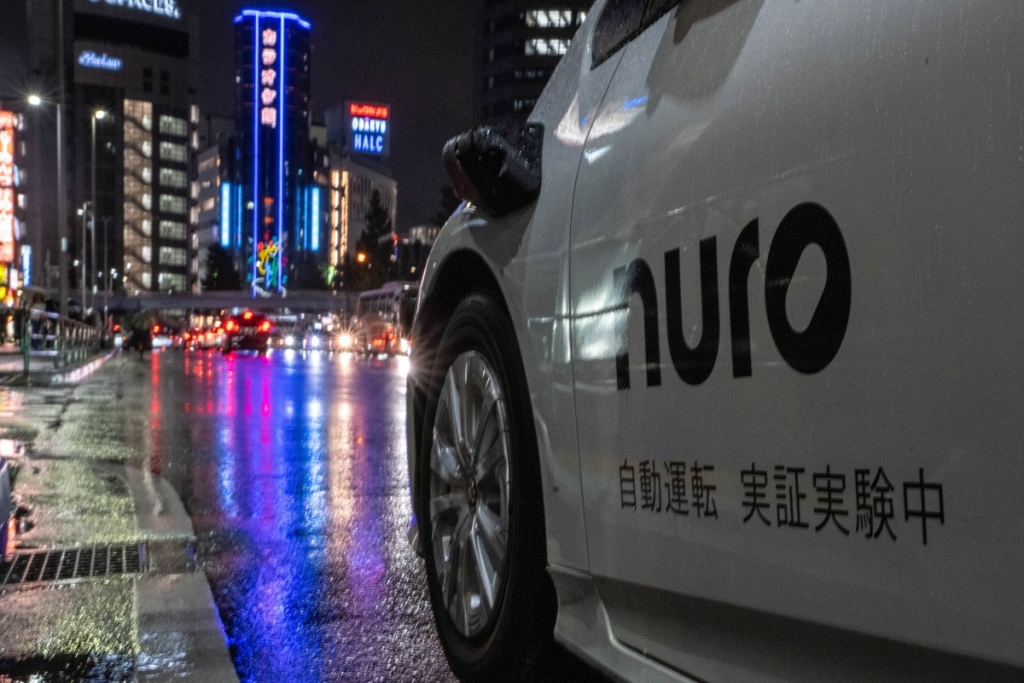
Silicon Valley’s Nuro, the autonomous vehicle startup backed by tech giants Nvidia, Uber, and SoftBank, has officially launched public road testing of its self-driving technology in Tokyo, Japan — marking a major milestone as the company’s first international expansion and a bold step toward global deployment of its AI-powered autonomous systems.
The trials, which began last month, feature Toyota Prius vehicles retrofitted with Nuro’s advanced self-driving software, each accompanied by a human safety operator ready to take control if needed. This cautious yet significant move into Japan’s complex urban environment signals Nuro’s growing confidence in its technology and its ambition to license its autonomous driving stack to automakers and mobility providers worldwide.
Tokyo’s streets present a unique set of challenges for autonomous vehicles. Unlike the wide, grid-like roads common in many U.S. cities, Tokyo’s dense traffic, narrow lanes, left-side driving, distinct road signage, and intricate lane markings require sophisticated navigation capabilities. Nuro acknowledged these hurdles in a blog post, emphasizing that the Tokyo trials are designed to stress-test its system under real-world, high-complexity conditions.
The company, which established a Tokyo office last August, has not disclosed the exact size of its test fleet or a timeline for removing human safety drivers. However, the very fact that it is conducting trials in such a demanding environment underscores its commitment to refining its technology for global markets.
Nuro’s journey to this point has been marked by dramatic pivots and strategic recalibrations. Founded in 2016 by former Google self-driving project engineers Dave Ferguson and Jiajun Zhu, the company initially focused on developing low-speed, autonomous delivery robots designed to transport goods on public roads. This novel approach attracted significant attention and investment, including a landmark $940 million infusion from SoftBank Vision Fund in 2019.
However, the high costs of development, coupled with industry-wide consolidation, forced Nuro to rethink its business model. In 2024, the company made a decisive shift: abandoning its fleet of delivery bots in favor of licensing its autonomous driving technology to automakers and mobility companies such as ride-hailing and delivery services. This pivot positions Nuro as a software provider rather than a hardware manufacturer, a strategy that could accelerate adoption and reduce capital expenditures.
At the heart of Nuro’s technology is an end-to-end AI foundation model that the company calls “zero-shot autonomous driving.” This approach allows the system to learn and adapt as it encounters new environments, without requiring extensive pre-training on specific geographic data. Remarkably, Nuro claims its software was able to autonomously navigate Tokyo’s public roads without any prior exposure to Japanese driving data — a testament to the model’s generalization capabilities.
This AI-driven methodology is not unique to Nuro. U.K.-based startup Wayve, which recently raised $1.2 billion from investors including Nvidia, Uber, and several automakers, employs a similar end-to-end AI approach. Both companies are betting that foundational AI models can outperform traditional, rule-based autonomous driving systems by learning from vast amounts of real-world data.
Despite the advanced AI underpinnings, Nuro emphasizes that safety remains paramount. The company conducts rigorous closed-course testing for each new release of its universal autonomy model, evaluating performance and testing edge cases through simulation. When vehicles are deployed on public roads, they operate in “shadow mode,” meaning the AI produces what it would do, but the commands are not sent to vehicle controls. Human drivers manually operate the vehicles while Nuro monitors the AI’s decisions, comparing them against actual driving behavior to determine readiness for full autonomy.
This methodical, safety-first approach has helped Nuro gain traction with investors and partners. Last year, the company raised $203 million in a Series E funding round that included new investors such as Nvidia, Icehouse Ventures, Kindred Ventures, and Pledge Ventures, alongside existing backer Baillie Gifford. Uber, which has committed to a “multi-hundred-million-dollar” investment in Nuro as part of a broader deal with electric vehicle maker Lucid, also participated. This partnership aims to build a robotaxi service, further expanding Nuro’s footprint in the autonomous mobility ecosystem.
The Tokyo trials represent more than just a technical demonstration; they are a strategic move to validate Nuro’s technology in one of the world’s most challenging driving environments. Success here could pave the way for deployments in other dense, complex cities across Asia and beyond, accelerating the company’s global ambitions.
As Nuro continues to refine its AI models and expand its testing footprint, the autonomous vehicle industry watches closely. The company’s pivot from hardware to software licensing, combined with its cutting-edge AI approach, positions it as a key player in the race to commercialize self-driving technology. If Nuro can prove that its “zero-shot” autonomy works reliably in diverse global settings, it could unlock new opportunities for automakers and mobility providers eager to integrate autonomous capabilities without the burden of developing the technology in-house.
For now, the Tokyo trials are just the beginning. Nuro’s vision of compounding benefits from global deployment is taking shape, one city at a time.
Tags:
Nuro, autonomous vehicles, self-driving cars, Tokyo, Japan, Nvidia, Uber, SoftBank, AI foundation model, zero-shot autonomous driving, mobility technology, robotaxi, Dave Ferguson, Jiajun Zhu, Toyota Prius, autonomous delivery, licensing autonomous tech, global expansion, Silicon Valley startup, closed-course testing, shadow mode, Wayve, end-to-end AI, Series E funding, Lucid, electric vehicles, urban mobility, autonomous driving software, transportation innovation
Viral Sentences:
Nuro’s AI just learned to drive in Tokyo without ever seeing Japanese roads before.
From delivery bots to global AI licensing—Nuro’s pivot could redefine autonomous driving.
Tokyo’s chaos is the ultimate test: Nuro’s self-driving cars are taking on the world’s densest streets.
Nvidia, Uber, and SoftBank bet big on Nuro’s “zero-shot” AI to conquer global roads.
Safety first: Nuro’s cars drive themselves in shadow mode before going fully autonomous.
The future of robotaxis is here—Nuro and Lucid team up with Uber for a driverless revolution.
Can AI really learn to drive anywhere? Nuro’s Tokyo trials say yes.
Silicon Valley’s boldest autonomous gamble is now testing in Japan’s toughest traffic.
Nuro’s pivot from bots to brains could be the smartest move in self-driving tech.
The race for autonomous dominance heats up as Nuro eyes global expansion.
,


Leave a Reply
Want to join the discussion?Feel free to contribute!