
Pragmatic by design: Engineering AI for the real world
AI in Product Engineering: The High-Stakes Race to Scale—With Guardrails
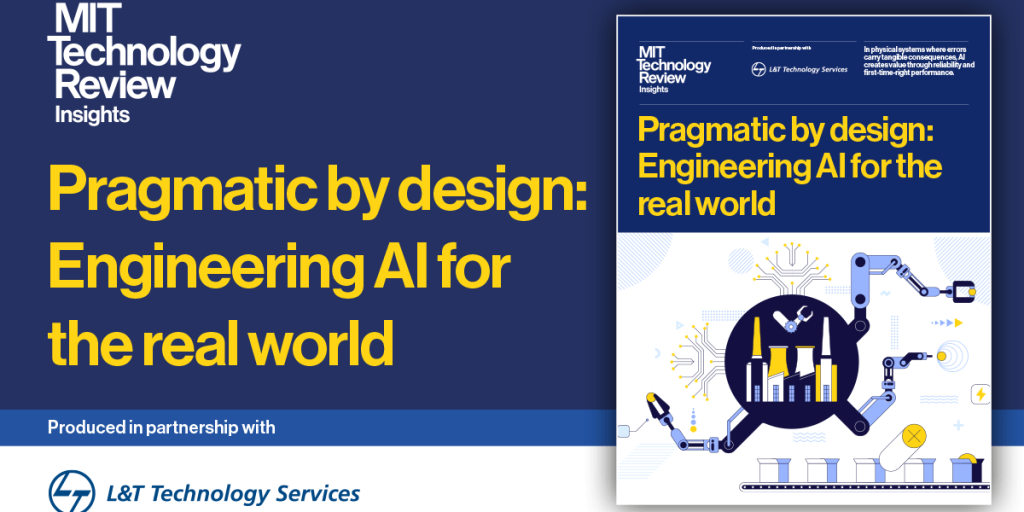
The engineering world is in the midst of an AI transformation, but it’s not the fast-and-loose, “move fast and break things” culture of Silicon Valley software startups. For product engineers—the architects of physical products, embedded systems, and manufacturing lines—the stakes are existential. A bug in an AI-powered design tool isn’t just a line of bad code; it’s a faulty brake system, a collapsing bridge, or a malfunctioning medical device. That’s why the latest MIT Technology Review Insights report, produced in collaboration with LTTS (L&T Technology Services), reveals a sobering truth: AI adoption in product engineering is cautious, deliberate, and deeply governed.
Drawing on a survey of 300 senior technology executives and in-depth interviews with industry leaders, the report paints a picture of an industry walking a tightrope. On one side is the immense promise of AI—predictive analytics, AI-powered simulation, and automated validation that could revolutionize how products are designed, tested, and manufactured. On the other is the reality that when AI touches the physical world, the margin for error is zero.
The Trust Paradox: Why Product Engineers Can’t Afford to “Fail Fast”
In software, an AI hallucination might mean a chatbot gives a bad answer. In product engineering, it could mean a jet engine fails mid-flight. That’s why verification, governance, and explicit human accountability aren’t just best practices—they’re mandatory. The report finds that product engineers are abandoning the idea of “general-purpose” AI deployments in favor of layered AI systems with distinct trust thresholds. Think of it as AI with training wheels: every output is audited, every decision is traceable, and a human engineer always has the final say.
This isn’t about slowing down innovation; it’s about building trust in AI tools before they’re trusted with real-world consequences. As one executive put it, “We’re not deploying AI to be first—we’re deploying it to be right.”
The ROI Roadmap: Predictive Analytics and Simulation Lead the Charge
So where are product engineers investing their AI budgets? The answer is clear: predictive analytics and AI-powered simulation and validation are the top near-term priorities. These aren’t flashy, futuristic use cases—they’re bread-and-butter capabilities that offer clear feedback loops, regulatory approval pathways, and, most importantly, measurable ROI.
Why these two? Because they solve the trust problem. Predictive analytics can forecast equipment failures before they happen, reducing downtime and warranty claims. AI-powered simulation can test thousands of design variations in hours instead of months, catching flaws before they hit the factory floor. Both offer auditable, repeatable results—exactly what regulators and risk-averse executives want to see.
The Modest Growth Curve: Why 90% Plan to Invest, But Not Radically
Here’s a surprising stat: nine in ten product engineering leaders plan to increase AI investment in the next one to two years. But before you imagine a gold rush, consider the fine print. The highest proportion (45%) plan to boost investment by just up to 25%. Nearly a third favor a 26% to 50% increase. And only 15% are going all-in with a 51% to 100% jump.
This isn’t a lack of ambition—it’s pragmatism. Product engineers are optimization-focused, not disruption-focused. They want scalable proof points and near-term ROI, not multi-year moonshots. As the report puts it, the dominant approach is “optimization over innovation,” with companies prioritizing incremental gains over transformative leaps.
What Matters Most: Sustainability and Quality Over Speed
When asked about the most important measurable outcomes for AI in product engineering, the answers were revealing. Sustainability and product quality top the list—not because they’re trendy, but because they’re visible to customers, regulators, and investors. A 10% reduction in emissions or a 20% drop in defect rates is a KPI that boards understand and stakeholders respect.
By contrast, time-to-market and innovation are rated of medium importance, while internal metrics like cost reduction and workforce satisfaction languish at the bottom. The message is clear: product engineers care about real-world signals, not internal dashboards. A product that’s faster to market but fails in the field is a liability, not a win.
The Road Ahead: Cautious Scaling, Not Reckless Growth
The report’s overarching theme is one of cautious scaling. Product engineers aren’t ignoring AI—far from it. They’re investing, experimenting, and building trust. But they’re doing it with their eyes wide open, aware that the consequences of failure are measured in recalls, lawsuits, and, in the worst cases, lives lost.
This is a stark contrast to the software world, where AI is often deployed in a “fail fast, learn fast” mentality. In product engineering, the mantra is more like “test slow, deploy sure.” And that’s not a bug—it’s a feature.
Tags: AI in engineering, product engineering, predictive analytics, AI simulation, sustainability, quality control, governance, human oversight, ROI, manufacturing, embedded systems, risk management, cautious adoption, trust thresholds, regulatory compliance, defect reduction, emissions, workforce satisfaction, time-to-market, innovation, incremental gains, scalable proof points, physical products, AI trust, verification, layered AI systems, MIT Technology Review Insights, LTTS, cautious scaling, real-world outcomes, measurable ROI, human accountability, audit trails, feedback loops, near-term ROI, multi-year transformation, optimization, disruption, software vs hardware, engineering transformation, AI adoption, industry trends, technology adoption, future of engineering, AI governance, product failures, manufacturing decisions, physical designs, regulatory approval, defect rates, emissions profiles, internal engineering dashboards, product quality, sustainability metrics, competitive metrics, operational gains, product engineering leaders, senior technology executives, in-depth interviews, survey data, layered systems, trust thresholds, general-purpose AI, AI hallucinations, software bugs, hardware failures, aerospace, automotive, medical devices, manufacturing lines, factory floor, warranty claims, equipment failures, design variations, repeatable results, incremental investment, gold rush, pragmatism, optimization-focused, disruption-focused, scalable proof points, boards, stakeholders, recalls, lawsuits, lives lost, fail fast, learn fast, test slow, deploy sure, cautious scaling, eyes wide open, consequences of failure, software world, product engineering world, AI transformation, engineering world, physical world, margin for error, zero tolerance, existential stakes, buggy brake system, collapsing bridge, malfunctioning medical device, sobering truth, fast-and-loose, Silicon Valley, software startups, architects, embedded systems, manufacturing lines, existential, faulty brake system, collapsing bridge, malfunctioning medical device, layered AI systems, distinct trust thresholds, general-purpose deployments, trust paradox, fail fast, learn fast, AI with training wheels, every output is audited, every decision is traceable, human engineer, final say, building trust, real-world consequences, AI budgets, predictive analytics, AI-powered simulation, automated validation, bread-and-butter capabilities, feedback loops, regulatory approval pathways, measurable ROI, trust problem, forecast equipment failures, reducing downtime, warranty claims, AI-powered simulation, test thousands of design variations, hours instead of months, catching flaws, factory floor, auditable, repeatable results, regulators, risk-averse executives, surprising stat, product engineering leaders, AI investment, one to two years, fine print, highest proportion, boost investment, just up to 25%, nearly a third, 26% to 50% increase, going all-in, 51% to 100% jump, lack of ambition, pragmatism, optimization-focused, not disruption-focused, scalable proof points, near-term ROI, multi-year moonshots, dominant approach, optimization over innovation, incremental gains, transformative leaps, most important measurable outcomes, AI in product engineering, revealing, sustainability, product quality, top the list, trendy, visible to customers, regulators, investors, 10% reduction in emissions, 20% drop in defect rates, KPI, boards understand, stakeholders respect, time-to-market, innovation, rated of medium importance, internal metrics, cost reduction, workforce satisfaction, languish at the bottom, message is clear, product engineers, real-world signals, internal dashboards, product that’s faster to market, fails in the field, liability, not a win, overarching theme, cautious scaling, product engineers, ignoring AI, far from it, investing, experimenting, building trust, eyes wide open, consequences of failure, recalls, lawsuits, lives lost, stark contrast, software world, fail fast, learn fast mentality, product engineering, test slow, deploy sure, bug, feature.
,


Leave a Reply
Want to join the discussion?Feel free to contribute!