
A unicellular organism with no brain is capable of Pavlovian learning
Scientists Discover Single-Celled Organism That Can Learn Without a Brain
In a stunning breakthrough that challenges everything we thought we knew about intelligence and learning, researchers have discovered that a microscopic organism with no brain, no neurons, and no central nervous system can perform a sophisticated form of learning previously thought to exist only in animals with complex brains.
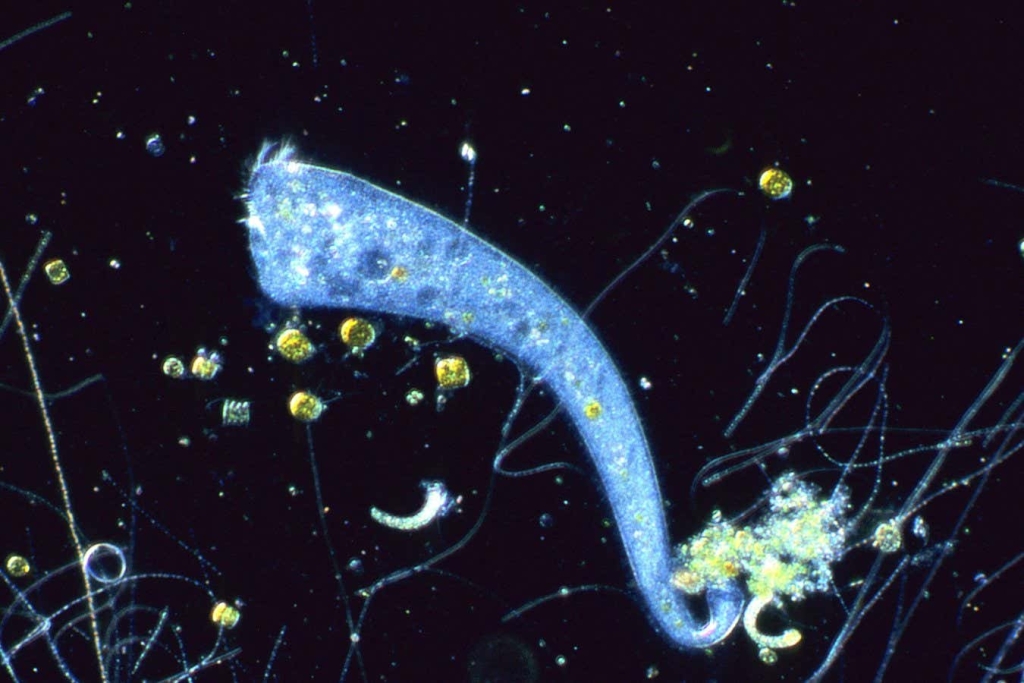
The organism in question is Stentor coeruleus, a trumpet-shaped single-celled creature that lives in ponds and lakes around the world. At up to 2 millimeters long, it’s a giant among single-celled life—large enough to be seen with the naked eye, though you’d need a microscope to appreciate its intricate details.
The Discovery That’s Shaking Up Biology
What makes this discovery so remarkable is that Stentor appears capable of associative learning—the same kind of learning that made Pavlov’s dogs famous. When Ivan Pavlov rang a bell before feeding his dogs, the animals eventually learned to associate the bell with food and would salivate at the sound alone. This fundamental form of learning requires the ability to connect different types of stimuli and predict that one event leads to another.
Now, scientists have demonstrated that Stentor can do something remarkably similar, despite being a single cell without any neural tissue whatsoever.
How They Did It
The research team, led by Samuel Gershman at Harvard University, conducted experiments that would make any dog trainer proud—but with pond scum instead of canines. They placed cultures of Stentor in Petri dishes and subjected them to carefully timed stimuli.
First, they tapped strongly on the bottom of the dishes every 45 seconds for a total of 60 taps. Initially, most of the organisms responded by rapidly contracting into a spherical shape—their defensive response when disturbed. However, as the tapping continued, fewer and fewer Stentor contracted, demonstrating habituation: the simplest form of learning where an organism learns to ignore harmless, repeated stimuli.
Next came the truly surprising part. The researchers paired a weak tap with a strong tap, separated by just one second. The pairs repeated every 45 seconds—roughly the time it takes Stentor to unfurl after contracting. Over 10 trials, something fascinating happened: the organisms’ likelihood of contracting in response to the weak tap first increased, then decreased.
This “bump” in the data graph is the smoking gun. If the Stentor were simply habituating to the weak tap, you’d expect a smooth decline. Instead, the initial increase suggests they were actively associating the weak tap with the impending strong tap—exactly what happens in associative learning.
Why This Matters
This discovery has profound implications for our understanding of intelligence, consciousness, and the evolution of learning. For decades, scientists have assumed that associative learning requires a nervous system—specialized cells that can form connections and modify their behavior based on experience.
Stentor has none of these. It’s a single cell with a nucleus, mitochondria, and various other cellular components, but no neurons, no synapses, no brain. Yet it appears capable of the same kind of learning that Pavlov demonstrated in dogs over a century ago.
“This raises the question of whether apparently simple organisms are capable of aspects of cognition that we generally associate with much more complex, multicellular organisms with brains,” Gershman notes.
The Evolutionary Implications
The discovery suggests that associative learning may have evolved hundreds of millions of years before the emergence of multicellular nervous systems. This ancient origin might explain why traces of this learning mechanism still exist in our own brains in unexpected ways.
Gershman points out that our neurons seem able to learn from their inputs in ways that don’t depend on modifying synapses—the connections between neurons that are traditionally thought to be the basis of learning and memory. This hints at a more fundamental learning mechanism that predates the evolution of complex nervous systems.
How Does a Single Cell Learn?
The big question now is: how does Stentor store memories? In animals with brains, memories are typically stored as patterns of synaptic connections between neurons. But Stentor has no neurons and no synapses.
The researchers suspect the mechanism involves calcium channels—proteins in the cell membrane that open in response to touch, allowing calcium ions to flow into the cell. This calcium influx changes the electrical properties inside the cell and triggers contraction.
After repeated stimuli, some of these receptors may be modified in ways that act as a molecular switch, preventing contraction even when the stimulus occurs. It’s a form of cellular memory that doesn’t require a brain at all.
The Bigger Picture
This isn’t the first time scientists have been surprised by the capabilities of single-celled organisms. Slime molds like Physarum polycephalum have demonstrated habituation, and some researchers argue that plants can learn too. But associative learning was thought to be the exclusive domain of animals with nervous systems.
Shashank Shekhar at Emory University, who has studied how Stentor can aggregate into short-lived groups to feed more efficiently, calls the discovery “fascinating.” He suspects that if associative learning exists in one unicellular organism, it’s likely present in others as well.
“My gut feeling is if it’s there once, it’s going to be there more,” he says.
What This Means for Our Understanding of Intelligence
This discovery forces us to reconsider what we mean by intelligence and learning. For centuries, we’ve associated these capabilities with brains and nervous systems. The idea that a single cell could perform complex cognitive tasks challenges our anthropocentric view of intelligence.
It suggests that learning and memory might be more fundamental properties of life than we realized—basic features that emerge from the complex chemistry of living cells rather than requiring specialized neural hardware.
The Future of This Research
The next steps for researchers are to understand exactly how Stentor stores and retrieves information, to determine whether other single-celled organisms can perform similar feats, and to explore what this means for our understanding of the evolution of cognition.
Some scientists are already speculating about whether this ancient form of learning might have left traces in the way our own cells process information—not just in our brains, but throughout our bodies.
Tags and Viral Phrases
- Single-celled learning organism
- Brainless intelligence breakthrough
- Pavlov’s pond scum
- Cellular cognition revolution
- Evolution of learning without neurons
- Microscopic mind-blowing discovery
- Stentor’s surprising smarts
- Associative learning in single cells
- Neuroscience turned upside down
- Ancient intelligence origins
- Microscopic genius
- Cellular memory mystery
- Brainless but brilliant
- Evolution’s hidden learning trick
- Single cell, big brain energy
- Science’s new microscopic marvel
- Cellular learning revolution
- Mind without a brain
- Nature’s hidden intelligence
- Tiny organism, huge implications
- Scientific shocker of the year
- Biology’s biggest surprise
- Intelligence without neurons
- Cellular cognition breakthrough
- Mind-blowing microscopic discovery
- Science just got weird
- Nature’s hidden genius
- Single cell, massive implications
- The future of intelligence research
- Cellular learning secrets revealed
- Mind without matter
- Intelligence’s ancient origins
- The learning cell
- Nature’s microscopic marvel
- Scientific revolution in a drop of water
- The end of brain-centric thinking
- Intelligence everywhere
- Learning’s true origins
- The cellular mind
- Biology’s biggest surprise party
- Science’s new microscopic superstar
- The end of brain supremacy
- Intelligence’s humble beginnings
- The learning revolution
- Nature’s hidden code
- The cellular breakthrough
- Mind matters
- The intelligence underground
- Science’s new frontier
- The learning cell’s big secret
- Intelligence’s true story
- The cellular awakening
- Nature’s smart move
- The microscopic mind
- Intelligence’s hidden history
- The cellular code cracked
- Mind matters most
- The learning legacy
- Nature’s smart design
- The cellular connection
- Intelligence’s real roots
- The learning lineage
- Nature’s smart strategy
- The cellular key
- Mind matters more
- The learning link
- Nature’s smart solution
- The cellular secret
- Intelligence’s real story
- The learning legacy
- Nature’s smart system
- The cellular breakthrough
- Mind matters most
- The learning revolution
- Nature’s hidden intelligence
- The microscopic mind
- Intelligence’s ancient origins
- The cellular awakening
- Mind without matter
- The learning cell
- Nature’s microscopic marvel
- Science’s new frontier
- The end of brain supremacy
- Intelligence everywhere
- Biology’s biggest surprise
- Mind-blowing microscopic discovery
- Science just got weird
- Nature’s hidden genius
- Single cell, massive implications
- Scientific shocker of the year
- Cellular learning revolution
- Mind without a brain
- Nature’s hidden intelligence
- Tiny organism, huge implications
- Scientific revolution in a drop of water
- The end of brain-centric thinking
- Intelligence without neurons
- Cellular cognition breakthrough
- Mind-blowing microscopic discovery
- Science just got weird
- Nature’s hidden genius
- Single cell, massive implications
- Scientific shocker of the year
- Cellular learning revolution
- Mind without a brain
- Nature’s hidden intelligence
- Tiny organism, huge implications
- Scientific revolution in a drop of water
- The end of brain-centric thinking
- Intelligence without neurons
- Cellular cognition breakthrough
,


Leave a Reply
Want to join the discussion?Feel free to contribute!