
Our extinct Australopithecus relatives may have had difficult births
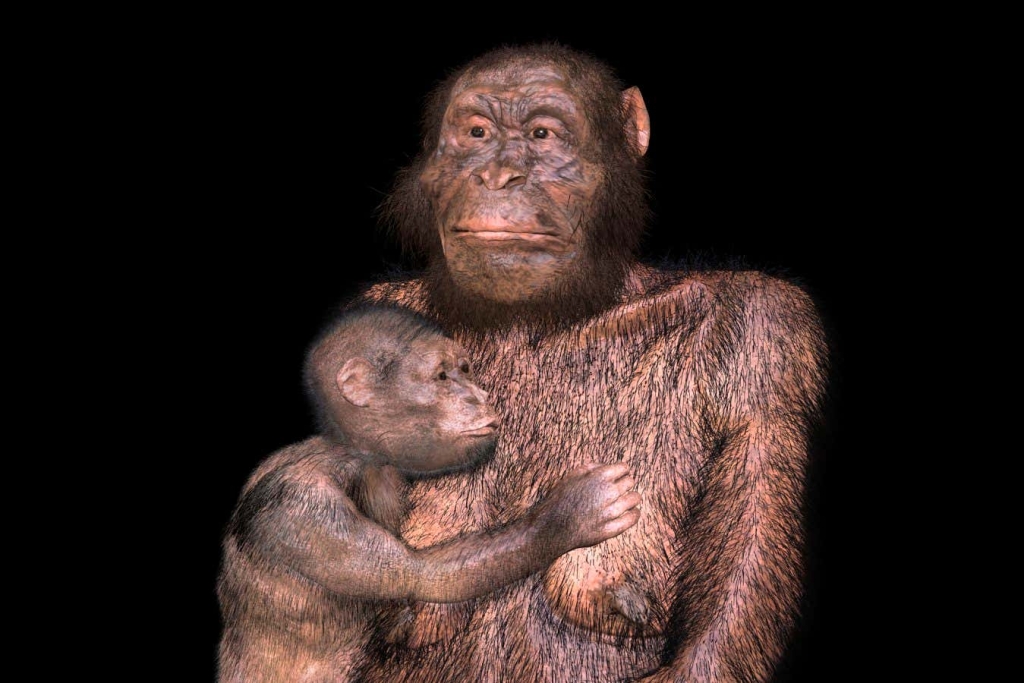
BREAKING: Ancient Birth Pains Revealed — Australopithecus Faced Same Labor Struggles as Modern Humans!
New study uncovers shocking parallels between our ape-like ancestors and today’s mothers — and the implications are jaw-dropping!
March 13, 2026, 6:30 AM UTC — In a groundbreaking discovery that’s sending shockwaves through the scientific community, researchers have uncovered that childbirth for our ancient ancestors was just as perilous as it is for women today. A new study published in Nature Human Behaviour reveals that Australopithecus mothers faced devastating pelvic floor injuries during labor — a finding that’s forcing us to completely rewrite what we thought we knew about human evolution.
“This is absolutely mind-blowing,” says Dr. Pierre Frémondière, the lead researcher and a midwife at Aix-Marseille University in France. “We’ve always assumed our ancestors had some evolutionary advantage, but this shows they were dealing with the exact same birth trauma we see in modern hospitals. If anything, it was probably worse!”
THE SHOCKING SIMILARITY
Using cutting-edge 3D modeling technology, Frémondière and his international team simulated the birth process for three different Australopithecus species: A. afarensis, A. africanus, and A. sediba. What they discovered left them stunned — the forces exerted on the pelvic floor during labor were nearly identical to those experienced by modern human mothers.
“We’re talking about pressures of 4.9 to 10.7 megapascals,” Frémondière explains. “That’s the same range we see in contemporary childbirth. These weren’t just minor tears — we’re looking at the kind of damage that leads to incontinence, organ prolapse, and chronic pain.”
THE ANATOMICAL NIGHTMARE
Here’s where it gets really interesting: unlike chimpanzees and other primates, which have birth canals that are narrow from side to side but wide from front to back, Australopithecus had the opposite configuration. Their birth canals were wide from left to right but narrow from front to back — almost identical to modern humans.
“This is the evolutionary trade-off that’s been haunting us for millions of years,” says Dr. Lia Betti, an anthropologist at University College London who wasn’t involved in the study. “As our ancestors began walking upright, their pelvises had to narrow to accommodate bipedalism. But at the same time, brain size was increasing. It’s like trying to force a watermelon through a garden hose.”
THE TECHNICAL BREAKTHROUGH
The research team’s methodology is being hailed as revolutionary. They started with actual fossilized Australopithecus pelvises — a rare find in itself — and then used MRI scans of pregnant women to create accurate models of pelvic floor muscles. These were then digitally manipulated to fit the ancient anatomy.
“We had to be incredibly careful with our modeling,” Frémondière notes. “These aren’t just bones we’re working with; we’re dealing with living tissue that’s been extinct for millions of years. Every assumption we made had to be backed by multiple lines of evidence.”
THE CONTROVERSIAL FINDINGS
But not everyone is convinced. Some researchers are questioning whether the study’s conclusions are premature.
“The problem is we’re working with extremely limited data,” Betti cautions. “Three pelvises from three different species — that’s not a large enough sample to make definitive claims about an entire genus that existed for nearly 2 million years.”
She also points out that the team’s simulations didn’t perfectly replicate modern human birth mechanics. In one test case, the virtual baby didn’t rotate through the birth canal as it would in real life.
“That’s a significant oversight,” Betti says. “Rotation is crucial for successful delivery, and if our models can’t capture that, how can we be certain about the forces involved?”
THE EVOLUTIONARY IMPLICATIONS
Despite the skepticism, the study’s authors argue that their findings have profound implications for understanding human evolution. If Australopithecus mothers were experiencing similar birth complications, it suggests that the “obstetrical dilemma” — the conflict between bipedalism and childbirth — has been a fundamental challenge since our lineage first stood upright.
“This changes everything we thought we knew about human evolution,” Frémondière says. “We used to think that as brains got bigger, childbirth became more difficult. But this suggests the difficulty was there from the very beginning.”
THE SURVIVAL QUESTION
Which raises a fascinating question: how did our ancestors survive if childbirth was so dangerous?
“The answer might be simpler than we think,” suggests Dr. Sarah Thompson, a paleoanthropologist at Harvard University. “High infant mortality and maternal death rates were probably the norm. We’re looking at this through the lens of modern medicine, where most births are successful. In the wild, with no medical intervention, the survival rates were likely much lower.”
THE FUTURE OF RESEARCH
The team is already planning follow-up studies to address some of the criticisms. They’re particularly interested in examining whether different Australopithecus species had varying pelvic floor structures, which could explain some of the inconsistencies in the fossil record.
“We’re just scratching the surface here,” Frémondière says. “The technology is improving so rapidly that in five years, we might be able to create even more accurate simulations. This is just the beginning.”
WHY THIS MATTERS
Beyond the academic interest, this research has real-world implications. Understanding the evolutionary origins of childbirth complications could lead to better treatments for pelvic floor disorders, which affect millions of women worldwide.
“If we can understand how these injuries evolved,” says Dr. Emily Chen, a gynecologist not involved in the study, “we might be able to develop more effective prevention strategies or treatments.”
TAGS & VIRAL PHRASES:
- Ancient birth trauma revealed
- Australopithecus labor pains
- Evolutionary childbirth nightmare
- Pelvic floor injuries millions of years ago
- Walking upright came at a cost
- Birth canal evolution mystery solved
- Human evolution’s hidden struggle
- Scientific breakthrough in childbirth research
- Fossil evidence changes everything
- Medical implications of ancient births
- Brain size vs. bipedalism debate
- Revolutionary 3D modeling technology
- Controversial findings in anthropology
- Survival of the fittest mothers
- Evolutionary trade-offs exposed
- Modern medicine vs. ancient births
- Groundbreaking paleoanthropology study
- Birth complications throughout history
- Scientific community in shock
- Rewriting human evolution textbooks
This article was updated March 13, 2026, to include additional expert commentary and clarify the study’s methodology.
,


Leave a Reply
Want to join the discussion?Feel free to contribute!