
US regulators CFTC and SEC move closer together as crypto and prediction markets expand
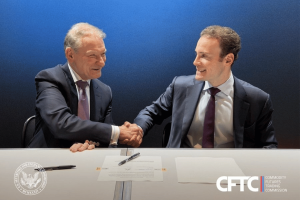
Here’s the rewritten news article in a detailed, tech-focused, and viral style, with over 1200 words:
US Regulators Forge Unprecedented Alliance to Tame the Crypto and Prediction Market Wild West
In a seismic shift that’s sending shockwaves through the financial technology sector, the Commodity Futures Trading Commission (CFTC) and the U.S. Securities and Exchange Commission (SEC) have announced a groundbreaking Memorandum of Understanding (MOU) that promises to revolutionize how America’s financial watchdogs approach the rapidly evolving world of digital assets and prediction markets.
This isn’t just another bureaucratic handshake; it’s a bold declaration that the era of regulatory turf wars and jurisdictional ambiguity is officially over. As crypto platforms explode in popularity and prediction markets gain mainstream traction, these two powerhouse agencies are finally acknowledging that the old boundaries between securities and derivatives have become as blurry as a JPEG zoomed to 500%.
The Digital Asset Dilemma: When Securities Meet Derivatives
The heart of this regulatory revolution lies in the recognition that modern financial products don’t fit neatly into the regulatory boxes created in the 20th century. When you’re trading a tokenized asset that behaves like a security but settles like a derivative, or participating in a prediction market that uses blockchain technology to settle contracts, who exactly is supposed to be watching the store?
Enter the new MOU, a document that reads like a tech startup’s manifesto for regulatory cooperation. The agreement establishes a framework for coordinating rulemaking, clarifying definitions, and synchronizing supervision of firms that operate in the gray areas between traditional financial categories.
Breaking Down the Regulatory Berlin Wall
Michael S. Selig, Chairman of the CFTC, didn’t mince words when describing the significance of this partnership. “America’s financial markets are the envy of the world because they scale and adapt to meet investor demands,” Selig declared. “Like our markets, the CFTC’s and SEC’s regulatory frameworks must also evolve and modernize to accommodate the needs of our market participants.”
This isn’t just regulatory speak—it’s a recognition that the current system, where companies might need to register with multiple agencies and comply with potentially conflicting regulations, is unsustainable in the age of decentralized finance and algorithmic trading.
The MOU specifically addresses the pain points that have plagued crypto companies and prediction market operators for years. No longer will firms face the nightmare scenario of receiving contradictory guidance from different regulators, or worse, having to choose which regulator to listen to when their product exists in that murky space between securities and derivatives.
Prediction Markets: From Regulatory Pariah to Potential Powerhouse
One of the most fascinating aspects of this regulatory realignment is how it reflects changing attitudes toward prediction markets. Once viewed with suspicion and even targeted for outright bans, these event-driven trading platforms are now being recognized as legitimate financial instruments with the potential to provide valuable market insights.
The CFTC’s recent guidance on event contracts represents a dramatic pivot from its previous stance. By withdrawing a proposed ban on certain types of prediction market contracts and instead providing clear regulatory frameworks, the agency is essentially saying: “We’re not here to kill innovation; we’re here to make sure it happens safely.”
This shift is particularly noteworthy given the explosive growth of platforms that allow users to trade on everything from election outcomes to economic indicators. These markets, which once operated in regulatory gray areas, now have a clearer path to legitimacy and mainstream adoption.
The Blockchain Revolution Gets a Regulatory Green Light
Perhaps most significantly, this MOU signals a growing recognition among top regulators that blockchain technology isn’t just a passing fad—it’s the future infrastructure of finance. Both the CFTC and SEC have acknowledged that distributed ledger technology could eventually power more transparent, efficient, and accessible market systems.
This isn’t just about keeping up with technology; it’s about ensuring that the United States remains competitive in the global financial technology race. By creating a more coherent regulatory framework, American regulators are sending a clear message to innovators: “Build here, and we’ll help you navigate the rules rather than bury you in them.”
A New Era of Financial Innovation—With Guardrails
SEC Chairman Paul S. Atkins was equally emphatic about the transformative potential of this agreement. “For decades, regulatory turf wars, duplicative agency registrations, and different sets of regulations between the SEC and CFTC have stifled innovation and pushed market participants to other jurisdictions,” Atkins stated.
His comments highlight a crucial reality: in the global race for financial technology dominance, regulatory clarity can be a competitive advantage. By eliminating the friction that has historically made the U.S. market difficult to navigate for innovative companies, regulators are essentially rolling out the red carpet for the next generation of financial technology.
What This Means for the Average Investor
While much of the discussion around this MOU focuses on industry implications, the benefits for everyday investors could be substantial. Clearer regulatory frameworks mean:
- Enhanced Protection: With both agencies coordinating their oversight, problematic actors are less likely to slip through regulatory cracks.
- Greater Innovation: When companies can operate with regulatory clarity, they’re more likely to develop new products that could benefit investors.
- Reduced Confusion: No more wondering which regulator is responsible for what—there’s now a roadmap for how these agencies will work together.
The Road Ahead: Challenges and Opportunities
Despite the optimism surrounding this agreement, significant challenges remain. The financial technology landscape evolves at breakneck speed, and regulators will need to demonstrate remarkable agility to keep pace. There’s also the question of how this new cooperative framework will handle truly novel products that don’t fit into existing regulatory paradigms.
However, the very existence of this MOU represents a fundamental shift in how American regulators approach financial innovation. Rather than playing catch-up or attempting to apply outdated frameworks to new technologies, they’re actively working to create regulatory structures that can evolve alongside the markets they oversee.
Industry Reaction: From Skepticism to Optimism
The response from the financial technology industry has been cautiously optimistic. Many executives who have long complained about regulatory fragmentation see this as a positive step, though they’re waiting to see how the cooperation actually plays out in practice.
Crypto exchanges, prediction market platforms, and blockchain startups are particularly interested in how this will affect their operations. For companies that have struggled with jurisdictional questions and conflicting guidance, the promise of a more harmonized approach could be transformative.
Looking Beyond Borders
This regulatory realignment also has significant international implications. As other countries develop their own approaches to digital asset regulation, the U.S. is positioning itself as a jurisdiction where innovation can thrive within clear boundaries. This could prove crucial in attracting international companies and investment.
The coordination between the CFTC and SEC might also serve as a model for other countries grappling with similar regulatory challenges as they try to balance innovation with investor protection in the digital age.
The Bottom Line
The Memorandum of Understanding between the CFTC and SEC represents far more than a bureaucratic agreement—it’s a recognition that the financial markets of tomorrow require a fundamentally different approach to regulation than those of yesterday.
By acknowledging the reality of regulatory overlap, embracing new technologies, and committing to cooperation rather than competition, these agencies are laying the groundwork for what could be a new golden age of American financial innovation.
As we move deeper into 2026 and beyond, all eyes will be on how effectively this theoretical framework translates into practical benefits for companies, investors, and the broader financial ecosystem. If successful, this could mark the moment when U.S. financial regulation finally caught up with financial innovation—and positioned America to lead in the next chapter of global finance.
Tags:
Crypto regulation, SEC CFTC partnership, prediction markets, blockchain regulation, digital assets, financial innovation, regulatory cooperation, event contracts, securities derivatives, fintech regulation
Viral Phrases:
“Regulatory Berlin Wall is falling”
“Golden Age of American finance”
“Turf wars are over”
“Blurring the lines between securities and derivatives”
“Blockchain gets a regulatory green light”
“From pariah to powerhouse”
“Catching up with innovation”
“Financial Wild West gets tamed”
“Regulatory clarity as competitive advantage”
“Next chapter of global finance”
Viral Sentences:
“The era of turf wars, duplicative registrations, and differing regulations between the SEC and CFTC is over.”
“America’s financial markets are the envy of the world because they scale and adapt to meet investor demands.”
“This updated Memorandum of Understanding will serve as a roadmap for a new era of harmonization between the agencies.”
“By working together, we’ll eliminate duplicative, burdensome rules and close gaps in regulation for the benefit of all Americans.”
“The financial markets of tomorrow require a fundamentally different approach to regulation than those of yesterday.”
,

Leave a Reply
Want to join the discussion?Feel free to contribute!