
Magnetars drag spacetime to power superluminous supernovae
Astronomers Witness a Cosmic “Chirp” That Defies All Expectations
In a discovery that has stunned the astrophysics community, astronomers have detected a mysterious “chirping” signal from a dying star—a phenomenon so unusual it’s forcing scientists to completely rewrite their understanding of how magnetars behave.
The story begins on December 12, 2024, when the Liverpool Gravitational Wave Optical Transient Observer collaboration spotted something extraordinary: an object designated SN 2024afav. At first glance, it appeared to be just another superluminous supernova—those incredibly bright stellar explosions that briefly outshine entire galaxies. But as telescopes kept their watchful eyes trained on this cosmic spectacle, SN 2024afav began doing something no astronomer had ever seen before.
“It was as bright and it had bumps in the light curve like many other objects of this kind,” explains Dr. Farah, lead researcher on the project. But then something unprecedented happened: the star started to chirp.
In physics, a chirp refers to a signal where frequency steadily increases over time. For SN 2024afav, this manifested as rhythmic pulses that weren’t just repeating—they were accelerating. The emission bumps appeared at regular intervals, but the time between them was shrinking at an astonishing rate.
The team watched as a second and third bump appeared, each separated by roughly 35 percent less time than the previous interval. This wasn’t random noise or chaotic stellar behavior—it was a pattern. Armed with this insight, Farah and his colleagues calculated when the next bump should appear, adjusted their observation schedules, and pointed their instruments back at the mysterious object.
The fourth bump appeared exactly when predicted.
The fifth bump allowed them to refine their measurements further, narrowing down the period reduction to approximately 29 percent. This level of predictability sent shockwaves through the astrophysics community because it delivered a devastating blow to our existing magnetar models.
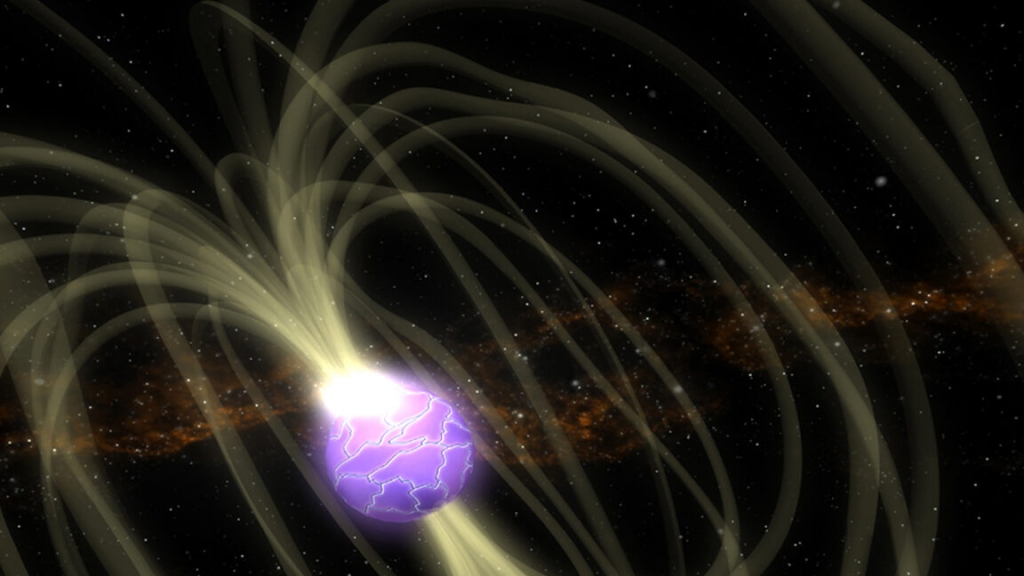
Here’s why this matters: magnetars are neutron stars with extraordinarily powerful magnetic fields—the strongest in the known universe. When they die in spectacular supernova explosions, they can produce these superluminous events. But the behavior of SN 2024afav simply couldn’t be explained by our current understanding.
Sure, a few irregular bumps might be explained away by the supernova’s debris crashing into clouds of interstellar gas. Random space rubble colliding with stellar remnants can create irregular light patterns. But perfectly timed, cleanly sinusoidal modulations with a steadily decaying period? That’s not how random collisions work. Space doesn’t produce metronomes.
“So, we came up with the new model to describe this behavior,” Farah explains. The team proposed a radical new physical mechanism that relied on something called the Lense-Thirring effect, also known as frame-dragging.
Frame-dragging is one of the most mind-bending predictions of Einstein’s General Relativity. It describes how a massive spinning object actually drags the very fabric of spacetime around with it as it rotates. Imagine a bowling ball spinning in molasses—the molasses gets pulled along with the ball’s rotation. Now scale that up to a stellar object warping the four-dimensional structure of the universe itself.
“We didn’t try this mechanism before because it had never been seen around a magnetar before,” Farah admits. But when his team applied frame-dragging theory to their observations, it fit perfectly. The mathematical models aligned with the observed chirping pattern with uncanny precision.
This discovery represents more than just an interesting astronomical curiosity—it’s a fundamental shift in how we understand extreme cosmic phenomena. The fact that frame-dragging effects are observable around magnetars opens up entirely new avenues for research into gravity, spacetime, and the behavior of matter under the most extreme conditions in the universe.
The implications extend far beyond just understanding dying stars. If we can detect and measure frame-dragging effects in these systems, it provides a new laboratory for testing General Relativity in conditions we can’t replicate on Earth. It also suggests that magnetars might be far more complex and dynamic than we ever imagined.
What makes this discovery particularly exciting is how it demonstrates the power of patient observation and mathematical prediction in astronomy. The team didn’t just stumble upon this phenomenon—they recognized the pattern, made predictions, and confirmed their hypotheses through careful observation. This methodical approach led them to uncover a cosmic secret that was hiding in plain sight.
As telescopes continue to monitor SN 2024afav and similar objects, astronomers are eager to see whether this chirping behavior is unique or if it might be more common than we realized. The universe often surprises us by revealing that phenomena we thought were rare are actually just waiting for us to develop the right tools and theories to recognize them.
For now, SN 2024afav stands as a testament to the fact that even in well-studied areas of astrophysics, nature still has the capacity to surprise us with behaviors we never anticipated. It’s a reminder that the cosmos is far more creative and complex than our models suggest—and that sometimes, the stars really do sing to us in frequencies we’re only just beginning to understand.
Tags:
magnetar, supernova, frame-dragging, Lense-Thirring effect, chirping star, SN 2024afav, Liverpool Gravitational Wave Optical Transient Observer, superluminous supernova, General Relativity, spacetime, astrophysics breakthrough, cosmic mystery, stellar evolution, neutron star, magnetic fields, astronomical discovery
Viral Phrases:
- “The star started to chirp”
- “Perfectly timed, cleanly sinusoidal modulations”
- “Space doesn’t produce metronomes”
- “Mind-bending predictions of Einstein’s General Relativity”
- “Cosmic secret hiding in plain sight”
- “The cosmos is far more creative than our models suggest”
- “Sometimes, the stars really do sing to us”
- “Fundamental shift in how we understand extreme cosmic phenomena”
- “Nature still has the capacity to surprise us”
- “Rewriting our understanding of magnetars”
,


Leave a Reply
Want to join the discussion?Feel free to contribute!