
Stunning Image Reveals The Heart of Our Galaxy Like Never Before : ScienceAlert
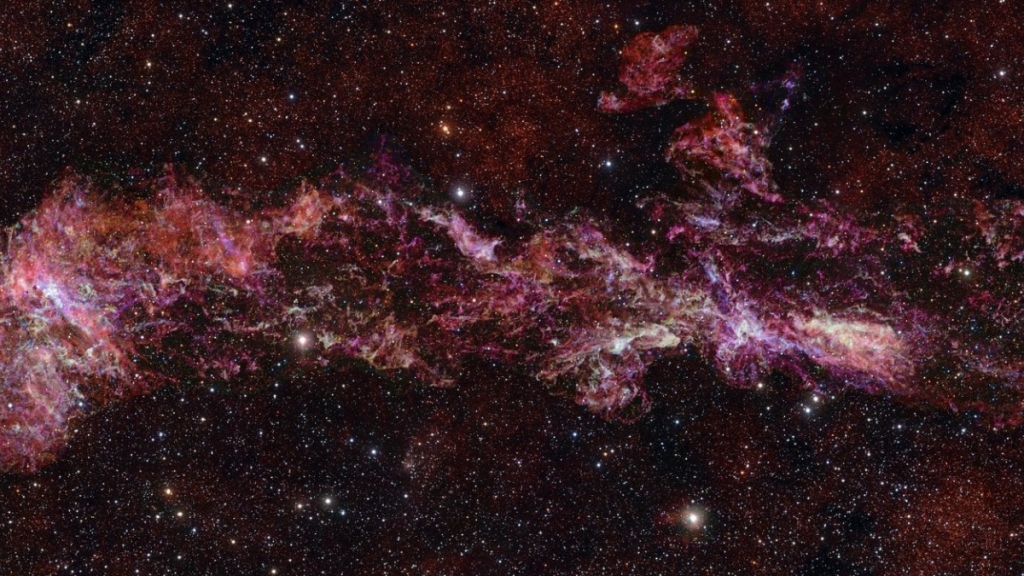
Astronomers Capture Unprecedented View of Milky Way’s Galactic Core
In a groundbreaking astronomical achievement, an international team has unveiled the most detailed image ever taken of our galaxy’s central region, revealing a chaotic cosmic landscape that could rewrite our understanding of star formation in extreme environments.
A Window Into Galactic Chaos
The newly released image captures a 650-light-year-wide section of the Milky Way’s heart, revealing the Central Molecular Zone (CMZ) in stunning detail. This region, previously shrouded in mystery, now appears as a complex tapestry of dense gas clouds and intricate filaments stretching across the galactic core.
What makes this achievement remarkable isn’t just the breathtaking detail—it’s the scale. This represents the largest image ever captured using the Atacama Large Millimeter/submillimeter Array (ALMA), a radio telescope facility that peers through cosmic dust to reveal structures invisible to optical telescopes.
The Science Behind the Spectacle
The research, conducted by the ALMA CMZ Exploration Survey (ACES) collaboration, represents an unprecedented international effort. More than 160 scientists from over 70 institutions across six continents pooled their expertise to tackle this cosmic puzzle. Their findings, published in a series of papers in the Monthly Notices of the Royal Astronomical Society, mark a quantum leap in our galactic understanding.
Principal Investigator Steven Longmore and his team weren’t just hoping to capture pretty pictures. They aimed to understand how stars form in one of the universe’s most extreme environments—a region dominated by intense radiation, powerful magnetic fields, and the supermassive black hole Sagittarius A*.
The Central Molecular Zone: A Stellar Nursery Like No Other
The CMZ isn’t just another galactic feature—it’s the largest reservoir of molecular gas in our entire galaxy. This cosmic cloud factory contains enough raw material to birth millions of stars, yet something mysterious is happening here. Stars in the CMZ appear to form differently than those in the galaxy’s spiral arms, and astronomers are desperate to understand why.
Ashley Barnes, an astronomer at the European Southern Observatory, describes the region as “a place of extremes, invisible to our eyes, but now revealed in extraordinary detail.” The new observations provide humanity’s first comprehensive view of cold gas throughout this entire region, from massive structures dozens of light-years across down to tiny clouds surrounding individual stars.
Beyond Beautiful Images: Scientific Goldmine
While the visual impact is undeniable, the real treasure lies in the data’s scientific potential. The rich chemical signatures captured in these observations will allow astronomers to trace the lifecycle of matter in extreme conditions—information crucial for understanding how galaxies evolve throughout cosmic history.
Longmore emphasizes the broader implications: “The CMZ hosts some of the most massive stars known in our galaxy, many of which live fast and die young, ending their lives in powerful supernova explosions, and even hypernovae.” By studying stellar birth in this extreme environment, astronomers can better understand galactic evolution across the universe’s 13.8-billion-year history.
Surprises and Mysteries
The team discovered the CMZ is even more complex than theoretical models predicted. The intricate network of filaments feeding gas into star-forming clumps reveals a dynamic system far more chaotic than our relatively calm galactic suburbs. This complexity suggests our current understanding of star formation may need significant revision when applied to extreme environments.
The Future of Galactic Exploration
This achievement represents just the beginning. The upcoming ALMA Wideband Sensitivity Upgrade, combined with the future European Southern Observatory’s Extremely Large Telescope, promises to push our observational capabilities even further. These next-generation instruments will resolve finer structures, trace more complex chemistry, and explore the intricate dance between stars, gas, and black holes with unprecedented clarity.
As Barnes notes, “In many ways, this is just the beginning.” The data already collected will keep astronomers busy for years, and the promise of even more detailed future observations means our understanding of galactic cores will continue to evolve dramatically.
Why This Matters
This isn’t just academic curiosity—understanding extreme environments helps us comprehend the universe’s fundamental processes. The CMZ shares many characteristics with galaxies in the early universe, where stars formed in similarly chaotic conditions. By studying our galactic backyard, we gain insights into cosmic evolution across billions of years and light-years.
The achievement also demonstrates the power of international scientific collaboration. In an era of global challenges, the ACES project shows how scientists worldwide can unite to tackle fundamental questions about our cosmic origins.
This detailed survey of the Milky Way’s heart represents a milestone in astronomy, offering humanity its clearest view yet of the extreme processes that shape galaxies and birth stars. As our observational capabilities continue to advance, we can only imagine what other cosmic secrets await discovery in the swirling chaos at the center of our galaxy.
Tags:
MilkyWay #Astronomy #ALMA #GalacticCore #StarFormation #SpaceScience #CosmicDiscovery #CMZ #SupermassiveBlackHole #Astrophysics #Universe #GalacticCenter #SpaceTelescope #ScientificBreakthrough #InternationalCollaboration
ViralSentences:
“Behold the heart of our galaxy like never before”
“Scientists capture the largest image of the Milky Way’s core”
“Unveiling the cosmic chaos at the center of our galaxy”
“A window into extreme stellar nurseries”
“Data that could rewrite our understanding of star formation”
“The raw material of stars revealed in stunning detail”
“International collaboration unlocks galactic secrets”
“From massive structures to tiny clouds: unprecedented detail”
“Living fast and dying young in galactic extremes”
“Just the beginning of galactic exploration”
,


Leave a Reply
Want to join the discussion?Feel free to contribute!