
Why Security Validation Is Becoming Agentic
The Next Evolution of Security Validation: How Agentic AI is Rewriting the Rules of Cybersecurity
In today’s hyper-connected digital landscape, security teams face an unprecedented challenge: defending against sophisticated adversaries who operate with coordinated precision while managing validation tools that remain stubbornly siloed. The gap between how attackers work and how defenders validate their defenses has become a critical vulnerability in itself.
The Current State of Security Validation: A Fragmented Landscape
If you’re responsible for security at any organization of meaningful complexity, you’re likely juggling multiple validation tools that barely communicate with each other. Your Security Operations Center probably features a Building Automation System (BAS) tool in one corner, pentest results from a third-party engagement in another, and vulnerability scanner outputs feeding into an attack surface management platform somewhere else.
Each tool provides valuable insights, but none offer a complete picture. They’re like individual instruments playing different songs, creating more noise than harmony.
Meanwhile, adversaries have evolved their tactics. A sophisticated intrusion today might chain together an exposed identity credential, a cloud misconfiguration, a missed detection opportunity, and an unpatched vulnerability—all executed as a single, coordinated operation. Attackers understand that modern environments are interconnected systems. Unfortunately, most validation programs are still treating them as disconnected components.
This fragmentation isn’t just inefficient—it’s dangerous. It represents a structural blind spot that has persisted for years because the market has treated every validation discipline as a separate category, each with its own vendors, consoles, and limited risk assessments.
The Three Pillars of Modern Security Validation
The evolution of security validation requires understanding three distinct but interconnected perspectives:
The Adversarial Perspective asks the fundamental question: “How can an attacker actually breach our defenses?” This involves automated penetration testing and attack path validation, focusing on identifying exploitable vulnerabilities and mapping the most efficient routes to critical assets. It’s about thinking like an attacker to understand their potential entry points.
The Defensive Perspective shifts the focus inward: “Can we actually stop them once they’re inside?” This encompasses security control validation and detection stack validation, ensuring that your firewalls, endpoint detection and response (EDR) systems, intrusion prevention systems (IPS), web application firewalls (WAF), SIEM rules, and alerting mechanisms perform as expected against real-world threats.
The Risk Perspective cuts through the noise to ask: “Does this exposure actually matter to our business?” This involves exposure prioritization guided by compensating controls, which filter out theoretical risks and focus remediation efforts on vulnerabilities that are genuinely exploitable in your specific environment.
Any single perspective leaves dangerous gaps. The future of security validation lies in the convergence of these three viewpoints into a unified, comprehensive approach.
Agentic AI: The Game-Changer Security Teams Have Been Waiting For
The cybersecurity industry has been flooded with “AI-powered” solutions, but most of these are simply language models added to dashboards for summarizing findings or generating reports. While AI-assisted tools can be useful, they’re not transformative—they’re incremental improvements at best.
Agentic AI represents a fundamentally different proposition. Here’s the crucial distinction:
An AI wrapper is essentially a simple application that calls an AI model and presents the output. It might format, summarize, or repackage the response, but it doesn’t actually manage the task itself. Agentic AI, conversely, takes complete ownership of tasks from start to finish. It determines what needs to be done, executes the steps, evaluates results, and adjusts its approach without requiring human direction at each stage.
In security validation, this difference is both massive and immediate. Consider the traditional response to a critical threat disclosure. A security team member reads the advisory, determines which systems might be exposed, builds or adapts test scenarios, runs them, reviews results, and decides on remediation steps. Even in well-resourced teams, this process can take days—or weeks for complex threats.
Agentic AI can compress this entire workflow into minutes. Not because someone wrote a faster script, but because an autonomous agent handled the complete sequence: analyzing the threat, mapping it to the environment, selecting relevant assets and controls, running appropriate validation workflows, interpreting results, and surfacing what matters most.
This is how agentic AI balances the scales between attackers and defenders. It’s not just about speed—it’s about replacing disconnected, human-driven validation steps with autonomous, coordinated, end-to-end reasoning.
The Critical Role of Data: Why Context Matters More Than Models
Here’s where much of the AI discussion goes wrong: Agentic systems are only as strong as the environment they can reason over. An autonomous agent running generic attack simulations against a generic model will produce generic results. That might look impressive in a demo, but it doesn’t help security teams make confident decisions in production environments.
The real differentiator is context. This is why the underlying data architecture matters more than the model alone. To make agentic validation genuinely useful, organizations need a unified security data layer that continuously reflects what exists, what’s exposed, and what’s actually working.
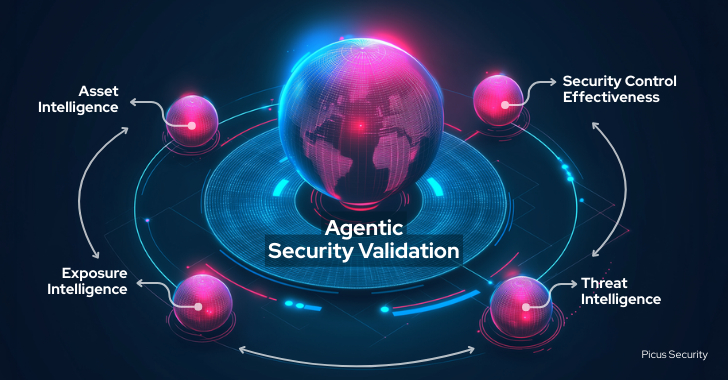
Think of this as a Security Data Fabric built from three essential dimensions:
Asset Intelligence covers the complete inventory of your environment: servers, endpoints, users, cloud resources, applications, and containers, along with their relationships. You cannot validate what you cannot see.
Exposure Intelligence encompasses vulnerabilities, misconfigurations, identity risks, and other weaknesses across your attack surface. This represents the raw material that attackers work with.
Security Control Effectiveness is the dimension most organizations are missing entirely. It’s not enough to know you’ve deployed a firewall or EDR agent—you need evidence of whether these controls will actually block the specific threats targeting your specific assets.
When these dimensions come together, the result is more than an asset database or vulnerability feed. It becomes a living model of your organization’s minute-to-minute security reality, continuously updated as the environment changes, new assets appear, vulnerabilities are disclosed, controls are reconfigured, and new threats emerge.
This is exactly the context agentic AI needs. With a rich security data fabric behind it, an agentic AI is no longer running one-size-fits-all tests. It can tailor validation to your actual topology, your organization’s actual crown jewels, your actual control coverage, and actual attack paths.
That’s the difference between hearing “this CVE is critical” and learning “this CVE is critical on this specific server, your controls don’t block exploitation, and there’s a validated path to one of your most sensitive business systems.”
The Future of Security Validation: Continuous, Autonomous, Unified
The trajectory of security validation is clear: periodic testing is becoming continuous validation, manual effort is evolving into autonomous operation, point products are consolidating into unified platforms, and reporting problems is morphing into enabling better security decisions.
Agentic AI is the catalyst, but it only works with the right foundation. Autonomous agents need real context—an accurate, connected view of the environment, not a fragmented set of tools and findings.
When agentic workflows, rich context, and unified validation come together, the result is a fundamentally different model. Instead of waiting for someone to ask whether the organization is protected, the system continuously answers that question with evidence grounded in how actual attacks are happening.
The market is already validating this shift. In Frost & Sullivan’s Frost Radar: Automated Security Validation, 2026, Picus Security was named the Innovation Index Leader, with its agentic capabilities and CTEM-native architecture highlighted as key differentiators.
The Bottom Line
The fragmentation that has characterized security validation for years is no longer acceptable when attackers operate with coordinated sophistication. Agentic AI, powered by unified security data fabrics, offers a path forward—but only for organizations willing to invest in the infrastructure that makes autonomous validation truly effective.
The question isn’t whether agentic AI will transform security validation. The question is whether your organization will be ready when it does.
AgenticAI #SecurityValidation #Cybersecurity #AI #ThreatDetection #SecurityOperations #CyberDefense #RiskManagement #AutonomousSecurity #SecurityAutomation #CTEM #ExposureValidation #SecurityAnalytics #CyberThreats #SecurityInnovation #FutureOfSecurity #SecurityTechnology #AIinSecurity #CyberResilience #SecurityTransformation #DigitalDefense #SecurityStrategy #ThreatIntelligence #SecurityLeadership #CyberAwareness
Agentic AI is revolutionizing security validation
Fragmented security tools are creating dangerous blind spots
The future of cybersecurity is autonomous and continuous
Security teams need unified data fabrics to leverage AI effectively
Traditional validation methods can’t keep pace with modern threats
Agentic AI compresses days of work into minutes
Context matters more than model sophistication in AI security
Three perspectives—adversarial, defensive, and risk—must converge
Security control effectiveness is the missing dimension in most programs
The market is already shifting toward unified validation platforms
Continuous validation beats periodic testing every time
Autonomous agents need living models of security reality
Agentic AI balances the scales between attackers and defenders
Security validation is evolving from reporting to decision enablement
Organizations must invest in infrastructure before AI delivers value
The gap between how attackers work and how we validate is critical
Agentic AI handles complete workflows without human direction
Unified security data is the foundation of effective AI validation
The future is continuous, autonomous, and unified security validation
,


Leave a Reply
Want to join the discussion?Feel free to contribute!