
Bitcoin Price Holds $73,500 as March FOMC Looms — Will Jerome Powell Trigger the Next Big Move?
Bitcoin Holds Critical $73,500 Support as March FOMC Meeting Looms — Will Jerome Powell Trigger the Next Big Move?
By Sarah Mitchell | Tech & Crypto Correspondent
The final months of Jerome Powell’s tenure as Federal Reserve Chair are proving anything but smooth sailing, with a perfect storm of geopolitical tensions, stubborn inflation, and market volatility converging to create what traders are calling a “make-or-break” moment for risk assets.
Bitcoin is currently trading near $73,500, having just endured a 15% correction throughout February that marked its fifth consecutive monthly decline. The cryptocurrency market is now facing a critical juncture as the March FOMC meeting approaches, with investors bracing for potentially hawkish signals from the central bank.
Adding fuel to the fire, the Strait of Hormuz—the world’s most crucial oil chokepoint—has been effectively closed, cutting off approximately 20% of global oil production. Crude oil prices have surged past $100 per barrel, creating a fresh inflationary pressure that’s already showing up in economic data. February’s Consumer Price Index (CPI) came in at 2.4% before the full impact of the oil shock hit the numbers.
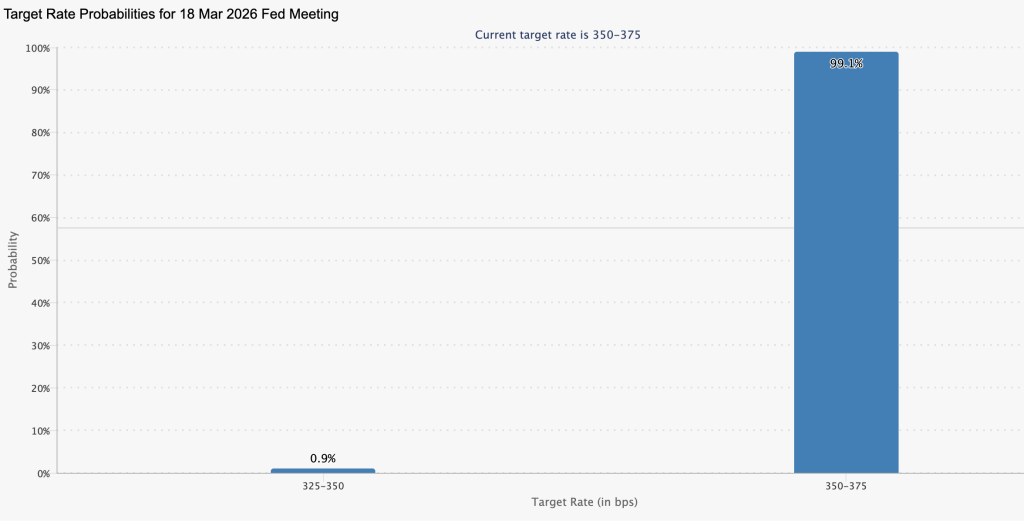
The Federal Open Market Committee is widely expected to maintain current interest rates when they announce their decision on Wednesday. However, as any seasoned trader knows, it’s not about what they do—it’s about what they say. With inflation creeping back toward the Fed’s 2% target, markets are preparing for Powell to adopt a more hawkish tone, potentially signaling fewer rate cuts than previously anticipated.
“Markets absolutely despise uncertainty,” notes Marcus Chen, chief strategist at Apex Capital. “We’re seeing institutional investors pulling back from risk assets, but interestingly, on-chain data reveals a completely different narrative emerging from retail and speculative traders.”
The divergence is stark: while traditional institutional capital is retreating, on-chain analytics show sophisticated retail traders quietly rotating into high-beta, small-cap plays. Specifically, the meme coin sector is experiencing a resurgence, with traders betting that a Fed hold could trigger a relief rally in lower-cap tokens that have been battered over the past six months.
This creates a fascinating dichotomy in the current market structure—two completely different trades happening simultaneously, with vastly different risk profiles and time horizons.
Can Bitcoin Price Hold the Critical $73,500 Support Level as the March FOMC Nears?
Bitcoin’s recent price action tells a story of repeated frustration. The cryptocurrency broke above a rising wedge pattern, briefly touched $75,000, and was immediately rejected back inside the channel. This pattern mirrors exactly what occurred in late February before the subsequent 15% flush down to $64,000.
A detailed analysis of Bitcoin’s price chart reveals a concerning repetition of patterns. The cryptocurrency appears to be running the same playbook for the third time, creating a sense of déjà vu among technical analysts. The critical question remains: will this time be different, or are we simply watching history repeat itself?
The $72,000 level has emerged as the first major support to watch on any pullback. This represents the line between a healthy retest of recent lows and a full-scale breakdown. A decisive break below $72,000 would likely target the $64,000 area, with $60,000 serving as the last significant floor before more severe technical damage occurs.
Conversely, the bull case remains straightforward: a daily close above the upper channel trendline, accompanied by follow-through buying, could open the door to a rapid ascent toward $80,000, with intermediate targets at $84,000 and $90,000.
“Right now, the market is running the same play for the third time,” explains Elena Rodriguez, a senior technical analyst at CryptoQuant. “Eventually, this pattern will resolve one way or another. The tension is building, and the March FOMC meeting could be the catalyst that finally breaks the stalemate.”
Maxi Doge Targets 1000x Leverage Narrative as Traders Pivot
As Bitcoin grapples with macroeconomic headwinds, degen capital continues its relentless search for the next big opportunity. Traders exhausted by the low volatility in large-cap cryptocurrencies are increasingly rotating into micro-cap plays, seeking the kind of explosive returns that characterized earlier market cycles.
This rotation has found a particularly enthusiastic reception in the meme coin space, with one project standing out from the crowd: Maxi Doge. The project is positioning itself as the “Leverage King” of the current meme cycle, targeting traders who embrace high-risk, high-reward narratives.
The pitch is unapologetically specific and culturally targeted. Maxi Doge presents itself as “high-leverage gym bro culture” personified—a 240-pound canine juggernaut built for traders who never skip leg day and never skip a pump. The branding is intentionally over-the-top, featuring muscle-bound Shiba Inu imagery and fitness-themed tokenomics.
The project’s ecosystem includes several innovative features designed to appeal to its target demographic:
Holder-only trading competitions: Exclusive trading contests where only Maxi Doge token holders can participate, with substantial prizes for top performers.
Maxi Fund treasury: A dedicated treasury designed to sustain liquidity and provide price support during market downturns, addressing one of the most common criticisms of meme coins.
Dynamic staking APY: Variable annual percentage yields that reward early holders while discouraging quick flipping, creating a more sustainable token economy.
The presale has raised $4,683,322.46 to date, with the current token price sitting at $0.0002809. This level of capital raised, while modest compared to major cryptocurrency projects, demonstrates genuine retail interest in the meme coin narrative.
However, the risks are substantial and transparent. Post-launch success will depend entirely on community retention and broader market risk appetite. The project’s team acknowledges that without sustained community engagement and favorable market conditions, the token could quickly lose value.
For traders who understand and accept these risks, Maxi Doge is positioning itself as the ultimate high-beta play in a market desperate for volatility and narrative-driven momentum.
As the March FOMC meeting approaches and Bitcoin tests critical support levels, the cryptocurrency market finds itself at a fascinating crossroads. Will Powell’s tone trigger a broader risk-off move that sends Bitcoin tumbling toward $60,000? Or will a dovish hold spark the relief rally that meme coin traders are desperately hoping for?
The answer could determine whether the current market structure holds together or fractures completely, potentially setting the stage for the next major crypto market cycle.
The post Bitcoin Price Holds $73,500 as March FOMC Looms — Will Jerome Powell Trigger the Next Big Move? appeared first on Cryptonews.
Tags:
Bitcoin, Jerome Powell, FOMC, Federal Reserve, inflation, oil prices, Strait of Hormuz, crypto market, Maxi Doge, meme coins, $73,500 support, $64,000 floor, $60,000 support, March FOMC, hawkish Fed, on-chain data, institutional capital, retail traders, degen capital, high-beta plays, micro-caps, leverage trading, gym bro culture, Shiba Inu, crypto volatility, market uncertainty, technical analysis, trading patterns, relief rally, risk assets, commodity prices, CPI data, interest rates, monetary policy, crypto ecosystem, tokenomics, staking APY, liquidity provision, community retention, market cycles, crypto narrative, price action, support levels, resistance levels, breakout patterns, wedge patterns, channel trading, daily closes, follow-through buying, intermediate targets, apex capital, cryptoquant, apex strategies, degen culture, muscle-bound crypto, fitness-themed tokens, treasury management, liquidity sustainability, post-launch risks, market sentiment, macroeconomic factors, geopolitical tensions, energy markets, commodity shock, inflation targeting, rate cut expectations, risk-off trading, risk-on trading, crypto rotation, altcoin season, meme coin season, speculative capital, smart money flows, whale watching, retail FOMO, crypto gambling, 1000x potential, moonshot narratives, community-driven projects, decentralized finance, DeFi summer, crypto winter, market bottom, capitulation, accumulation phase, distribution phase, market structure, order flow, volume analysis, open interest, funding rates, perpetual swaps, leverage liquidations, stop-loss hunting, market manipulation, pump and dump, rug pulls, due diligence, DYOR, crypto education, trading psychology, fear and greed index, market timing, dollar-cost averaging, HODL culture, crypto Twitter, trading communities, Discord groups, Telegram channels, alpha leaks, insider trading, regulatory concerns, SEC scrutiny, compliance issues, market manipulation, wash trading, spoofing, front-running, dark pools, OTC trading, market makers, liquidity providers, arbitrage opportunities, cross-exchange trading, triangular arbitrage, statistical arbitrage, mean reversion, momentum trading, trend following, contrarian investing, value investing, growth investing, income investing, passive investing, active trading, day trading, swing trading, position trading, scalping, algorithmic trading, quantitative trading, machine learning in trading, AI trading bots, sentiment analysis, social media metrics, Google Trends, search volume, trading volume, market depth, bid-ask spread, slippage, transaction costs, tax implications, capital gains, portfolio management, risk management, position sizing, stop-loss orders, take-profit orders, trailing stops, options strategies, futures contracts, perpetual swaps, margin trading, leverage ratios, liquidation prices, funding rates, basis trading, cash and carry, arbitrage trading, statistical arbitrage, pairs trading, sector rotation, market timing, economic indicators, leading indicators, lagging indicators, coincident indicators, business cycle, expansion phase, peak phase, contraction phase, trough phase, recession indicators, yield curve analysis, unemployment rates, GDP growth, industrial production, retail sales, consumer confidence, business confidence, purchasing managers’ index, ISM manufacturing index, ISM services index, factory orders, durable goods orders, building permits, housing starts, new home sales, existing home sales, mortgage applications, refinance activity, consumer credit, personal income, personal spending, savings rate, inflation expectations, breakeven inflation rates, TIPS spreads, commodity prices, energy prices, food prices, core inflation, headline inflation, trimmed mean inflation, median inflation, super core inflation, wage growth, unit labor costs, productivity growth, capacity utilization, industrial capacity, manufacturing capacity, service sector capacity, transportation capacity, shipping rates, freight indices, supply chain indices, inventory levels, inventory-to-sales ratios, order backlogs, delivery times, supplier delivery times, commodity inventories, strategic petroleum reserves, strategic metal reserves, rare earth elements, critical minerals, battery metals, semiconductor supply, chip shortages, automotive production, electronics production, consumer electronics, durable goods production, capital goods production, infrastructure spending, government spending, fiscal policy, monetary policy, quantitative easing, quantitative tightening, yield curve control, forward guidance, dot plot, federal funds rate, discount rate, reserve requirements, open market operations, repo markets, reverse repo markets, commercial paper, commercial mortgage-backed securities, asset-backed securities, collateralized loan obligations, leveraged loans, high-yield bonds, investment-grade bonds, municipal bonds, sovereign bonds, treasury yields, corporate bond yields, credit spreads, default rates, recovery rates, bankruptcy filings, restructuring activity, distressed assets, vulture funds, private equity, venture capital, growth equity, buyout funds, fund of funds, family offices, sovereign wealth funds, pension funds, endowments, foundations, insurance companies, asset managers, wealth managers, financial advisors, robo-advisors, fintech, blockchain, distributed ledger technology, smart contracts, decentralized applications, Web3, metaverse, non-fungible tokens, NFTs, digital art, virtual real estate, play-to-earn, move-to-earn, learn-to-earn, create-to-earn, contribute-to-earn, governance tokens, utility tokens, security tokens, stablecoins, central bank digital currencies, CBDCs, cross-border payments, remittances, international trade, foreign exchange, currency markets, forex trading, carry trades, currency hedging, currency risk, exchange rate risk, translation risk, transaction risk, economic exposure, political risk, sovereign risk, country risk, emerging markets, developed markets, frontier markets, market access, capital controls, trade restrictions, sanctions, tariffs, quotas, non-tariff barriers, trade agreements, free trade agreements, regional trade blocs, economic integration, supply chain reconfiguration, nearshoring, reshoring, friend-shoring, decoupling, deglobalization, localization, regionalization, balkanization, multipolarity, great power competition, US-China relations, US-Russia relations, EU-China relations, EU-US relations, Japan-China relations, India-China relations, South Korea-China relations, Australia-China relations, Canada-China relations, Mexico-US relations, Brazil-China relations, South Africa-China relations, Turkey-China relations, Iran-China relations, Saudi Arabia-China relations, UAE-China relations, Israel-China relations, Singapore-China relations, Indonesia-China relations, Philippines-China relations, Vietnam-China relations, cybersecurity, data privacy, information warfare, cyber espionage, cyber attacks, ransomware, malware, phishing, social engineering, zero-trust architecture, encryption, quantum computing, artificial intelligence, machine learning, deep learning, neural networks, natural language processing, computer vision, robotics, automation, internet of things, smart cities, 5G networks, 6G networks, satellite internet, low-earth orbit satellites, space exploration, asteroid mining, lunar mining, Mars colonization, space tourism, space debris, Kessler syndrome, space sustainability, space law, outer space treaty, moon agreements, space mining rights, space resource utilization, in-situ resource utilization, space manufacturing, space logistics, space habitats, life support systems, radiation shielding, artificial gravity, hibernation, suspended animation, cryogenics, terraforming, planetary protection, astrobiology, extremophiles, synthetic biology, genetic engineering, CRISPR technology, gene editing, designer babies, human enhancement, transhumanism, life extension, anti-aging research, regenerative medicine, stem cell therapy, organ regeneration, 3D bioprinting, tissue engineering, personalized medicine, precision medicine, pharmacogenomics, nutrigenomics, exposomics, microbiome research, gut-brain axis, psychobiotics, nootropics, cognitive enhancement, brain-computer interfaces, neural implants, mind uploading, digital consciousness, artificial general intelligence, artificial superintelligence, technological singularity, existential risk, AI alignment, AI safety, AI ethics, AI governance, AI regulation, AI bias, AI transparency, AI explainability, AI interpretability, AI robustness, AI security, AI privacy, AI fairness, AI accountability, AI liability, AI insurance, AI auditing, AI certification, AI standards, AI best practices, AI frameworks, AI principles, AI guidelines, AI policies, AI strategies, AI roadmaps, AI investment, AI startups, AI unicorns, AI acquisitions, AI IPOs, AI valuations, AI market size, AI adoption rates, AI implementation challenges, AI talent shortage, AI education, AI training, AI certification programs, AI bootcamps, AI online courses, AI degrees, AI research, AI publications, AI citations, AI patents, AI inventions, AI discoveries, AI breakthroughs, AI milestones, AI achievements, AI awards, AI competitions, AI challenges, AI hackathons, AI conferences, AI meetups, AI communities, AI forums, AI blogs, AI newsletters, AI podcasts, AI YouTube channels, AI social media, AI influencers, AI thought leaders, AI experts, AI researchers, AI engineers, AI developers, AI architects, AI consultants, AI analysts, AI strategists, AI product managers, AI project managers, AI program managers, AI portfolio managers, AI risk managers, AI compliance officers, AI legal experts, AI ethicists, AI philosophers, AI psychologists, AI sociologists, AI anthropologists, AI historians, AI futurists, AI science fiction, AI in popular culture, AI in movies, AI in TV shows, AI in books, AI in video games, AI in music, AI in art, AI in literature, AI in poetry, AI in drama, AI in comedy, AI in satire, AI in journalism, AI in reporting, AI in writing, AI in editing, AI in publishing, AI in marketing, AI in advertising, AI in sales, AI in customer service, AI in support, AI in chatbots, AI in virtual assistants, AI in voice assistants, AI in natural language understanding, AI in natural language generation, AI in machine translation, AI in speech recognition, AI in speech synthesis, AI in text-to-speech, AI in speech-to-text, AI in optical character recognition, AI in handwriting recognition, AI in image recognition, AI in object detection, AI in facial recognition, AI in emotion recognition, AI in gesture recognition, AI in biometric authentication, AI in fraud detection, AI in anomaly detection, AI in intrusion detection, AI in threat detection, AI in risk assessment, AI in credit scoring, AI in loan underwriting, AI in insurance underwriting, AI in claims processing, AI in fraud prevention, AI in compliance monitoring, AI in regulatory reporting, AI in audit automation, AI in financial planning, AI in investment advice, AI in portfolio optimization, AI in asset allocation, AI in risk management, AI in trading strategies, AI in market making, AI in liquidity provision, AI in price discovery, AI in order matching, AI in clearing and settlement, AI in custody services, AI in wealth management, AI in private banking, AI in retail banking, AI in commercial banking, AI in investment banking, AI in corporate banking, AI in merchant banking, AI in transaction banking, AI in cash management, AI in trade finance, AI in supply chain finance, AI in working capital management, AI in foreign exchange, AI in treasury management, AI in capital markets, AI in derivatives markets, AI in commodity markets, AI in real estate markets, AI in art markets, AI in collectibles markets, AI in insurance markets, AI in reinsurance markets, AI in pension markets, AI in annuity markets, AI in structured products, AI in securitization, AI in asset-backed securities, AI in mortgage-backed securities, AI in collateralized debt obligations, AI in collateralized loan obligations, AI in high-yield bonds, AI in investment-grade bonds, AI in municipal bonds, AI in sovereign bonds, AI in corporate bonds, AI in emerging market bonds, AI in frontier market bonds, AI in green bonds, AI in social bonds, AI in sustainability bonds, AI in transition bonds, AI in blue bonds, AI in catastrophe bonds, AI in weather derivatives, AI in energy derivatives, AI in agricultural derivatives, AI in metal derivatives, AI in livestock derivatives, AI in freight derivatives, AI in emissions derivatives, AI in inflation derivatives, AI in volatility derivatives, AI in correlation derivatives, AI in basket derivatives, AI in rainbow options, AI in exotic options, AI in structured notes, AI in principal-protected notes, AI in equity-linked notes, AI in interest rate-linked notes, AI in FX-linked notes, AI in commodity-linked notes, AI in hybrid notes, AI in callable notes, AI in putable notes, AI in convertible notes, AI in exchangeable notes, AI in warrant-linked notes, AI in equity derivatives, AI in index derivatives, AI in ETF derivatives, AI in sector derivatives, AI in factor derivatives, AI in smart beta derivatives, AI in alternative beta derivatives, AI in multi-asset derivatives, AI in cross-asset derivatives, AI in portfolio derivatives, AI in fund derivatives, AI in hedge fund derivatives, AI in private equity derivatives, AI in venture capital derivatives, AI in real estate derivatives, AI in art derivatives, AI in collectibles derivatives, AI in insurance derivatives, AI in pension derivatives, AI in annuity derivatives, AI in structured product derivatives, AI in securitization derivatives, AI in mortgage derivatives, AI in asset-backed derivatives, AI in collateralized derivatives, AI in leveraged derivatives, AI in inverse derivatives, AI in leveraged inverse derivatives, AI in volatility derivatives, AI in variance derivatives, AI in correlation derivatives, AI in basket derivatives, AI in rainbow options, AI in exotic options, AI in structured notes, AI in principal-protected notes, AI in equity-linked notes, AI in interest rate-linked notes, AI in FX-linked notes, AI in commodity-linked notes, AI in hybrid notes, AI in callable notes, AI in putable notes, AI in convertible notes, AI in exchangeable notes, AI in warrant-linked notes.
,


Leave a Reply
Want to join the discussion?Feel free to contribute!