
A Japanese Glossary of Chopsticks Faux Pas
The Hidden World of Chopstick Etiquette: A Comprehensive Guide to Avoiding Dining Faux Pas in Japan
In the intricate tapestry of Japanese culture, few elements are as deeply woven into daily life as the humble pair of chopsticks. These simple utensils, known as “hashi” in Japanese, are far more than mere eating tools; they are symbols of tradition, respect, and social harmony. However, for the uninitiated, the world of chopstick etiquette can be a minefield of potential gaffes and faux pas. This comprehensive guide delves into the fascinating realm of “kiraibashi” – the various ways of using chopsticks that are considered bad manners or even taboo in Japanese dining culture.
The Origins of Chopstick Etiquette
Before we explore the specific dos and don’ts, it’s essential to understand the cultural context that has shaped these practices. Japan’s culinary traditions have evolved over centuries, influenced by Buddhism, Shintoism, and the country’s unique social structure. The concept of “mottainai” – a sense of regret concerning waste – and the importance of showing respect to both the food and fellow diners have given rise to a complex set of rules governing chopstick use.
The List of Taboos: A Comprehensive Guide
Let’s embark on a journey through the alphabet of chopstick etiquette, exploring each “kiraibashi” in detail:
1. Agebashi (あげ箸): The High-Rise Faux Pas
Raising your chopsticks above mouth level might seem like a natural gesture, but in Japan, it’s considered poor form. This practice, known as “Agebashi,” can be seen as aggressive or overly eager, disrupting the harmonious flow of a meal.
2. Araibashi (洗い箸): The Unhygienic Habit
Cleaning your chopsticks in soup or beverages is a definite no-no. Not only is it unhygienic, but it also shows a lack of respect for the food and the effort that went into preparing it.
3. Awasebashi (合わせ箸): The Funeral Association
Perhaps the most serious taboo in chopstick etiquette, “Awasebashi” refers to passing food from one pair of chopsticks to another. This act mimics a funeral ritual where bones are passed between chopsticks after cremation, making it deeply offensive in a dining context.
4. Ukebashi (受け箸): The Impatient Gesture
Holding out your bowl while still holding chopsticks shows impatience and can be seen as demanding. It’s best to finish your current mouthful before reaching for seconds.
5. Utsuribashi (移り箸): The Wandering Sticks
Constantly switching between dishes without a proper order is considered bad manners. The correct approach is to eat rice, then a side dish, then rice again, and so on.
6. Urabashi (うら箸): The Hesitant Pick
Picking up food with your chopsticks only to put it back is seen as wasteful and indecisive. Once you touch it, you should eat it.
7. Ogamibashi (拝み箸): The Praying Pose
Holding chopsticks between both hands while expressing thanks is considered rude, as it’s inappropriate to hold objects while in a prayer-like gesture.
8. Oshikomibashi (押し込み箸): The Deep Dive
Using chopsticks to push food deep into your mouth is seen as greedy and impolite.
9. Otoshibashi (落とし箸): The Clumsy Drop
Dropping your chopsticks during a meal is not just embarrassing but also considered very bad manners.
10. Kaeshibashi (返し箸): The Reverse Service
Turning your chopsticks around to serve others might seem polite, but it’s actually incorrect. Use serving utensils instead.
11. Kakibashi (かき箸): The Shoveling Motion
Placing your mouth against the side of a dish and pushing food in with chopsticks is considered rude and unhygienic.
12. Kamibashi (かみ箸): The Nervous Bite
Biting your chopsticks is a nervous habit that’s considered very bad manners in Japan.
13. Kuwaebashi (くわえ箸): The Mouthful Mishap
Taking the tips of your chopsticks in your mouth is seen as childish and impolite.
14. Kojibashi (こじ箸): The Deep Digging
Using chopsticks to pick things from the bottom of a dish is considered greedy and impolite.
15. Kosuribashi (こすり箸): The Splinter Solution
Rubbing disposable chopsticks together to remove splinters is seen as an insult to the restaurant, implying their utensils are cheap.
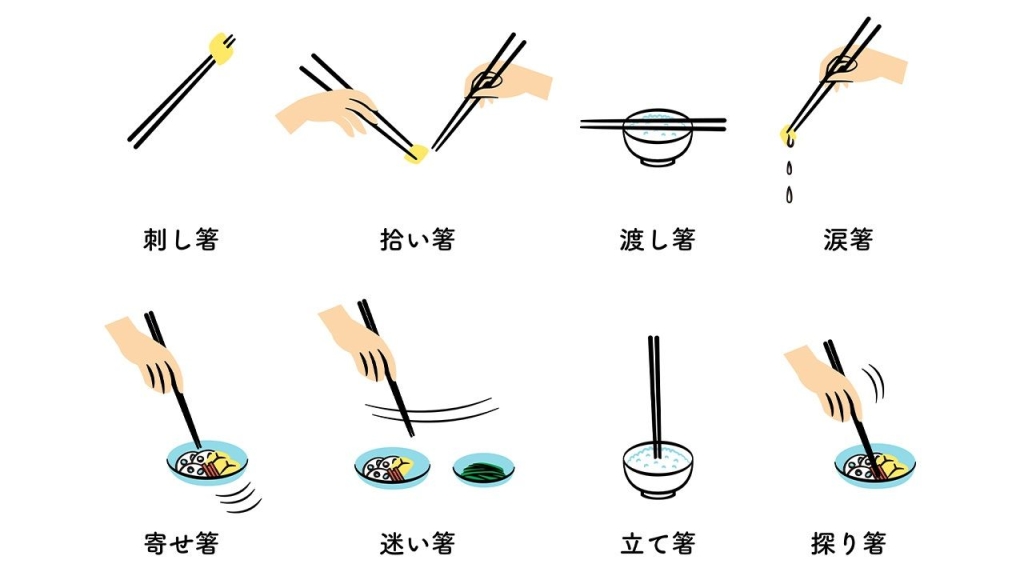
16. Saguribashi (探り箸): The Stirring Search
Using chopsticks to stir food around to find something is considered greedy and impatient.
17. Sashibashi (刺し箸): The Skewering Sin
Stabbing food with chopsticks instead of picking it up is seen as very rude and childish.
18. Sashibashi (指し箸): The Pointing Problem
Using chopsticks to point at people or things is considered very rude, much like pointing with your finger in Western cultures.
19. Jikabashi (じか箸): The Direct Approach
Using your own chopsticks instead of serving chopsticks to take food from a large dish is seen as unhygienic.
20. Sukashibashi (透かし箸): The Bone Picker
Poking between fish bones instead of removing them is considered lazy and impolite.
21. Seseribashi (せせり箸): The Poking Problem
Continually poking at food with your chopsticks is seen as indecisive and annoying.
22. Soroebashi (そろえ箸): The Tapping Trouble
Holding chopsticks together and tapping them on dishes or tables to align the tips is considered noisy and rude.
23. Tatakibashi (たたき箸): The Drumming Don’t
Tapping chopsticks on a dish to make noise is seen as childish and annoying.
24. Tatebashi (立て箸): The Funeral Faux Pas
Standing chopsticks upright in a bowl of rice is perhaps the most serious taboo, as it mimics a funeral offering.
25. Chigaibashi (違い箸): The Mismatched Pair
Using chopsticks made of different materials is seen as careless and inauspicious.
26. Chigiribashi (ちぎり箸): The Fork Substitute
Holding one chopstick in each hand to tear or cut food is considered very rude and is reminiscent of using a fork.
27. Chōbukubashi (調伏箸): The Directional Dilemma
Placing chopsticks on the table with tips pointing to the right is associated with cursing rituals and should be avoided.
28. Namidabashi (涙箸): The Dripping Disaster
Allowing sauce or soup to drip from chopstick tips is seen as messy and inconsiderate.
29. Nigiribashi (握り箸): The Fisted Grip
Gripping both chopsticks in a fist is considered very rude and aggressive.
30. Neburibashi (ねぶり箸): The Licking Lapse
Licking your chopsticks is seen as childish and unhygienic.
31. Hashibashi (橋箸): The Bridge Blunder
Placing chopsticks like a bridge across the top of a dish to show you’re finished is incorrect. Use a chopstick rest instead.
32. Hanebashi (はね箸): The Pushing Problem
Using chopsticks to push aside food you don’t want to eat is considered wasteful and rude.
33. Furiagebashi (振り上げ箸): The High Raise
Raising the tips of your chopsticks higher than the back of your hand is seen as aggressive and impolite.
34. Furibashi (振り箸): The Shaking Slip
Shaking off soup, sauce, or small bits of food from chopstick tips is considered messy and rude.
35. Madoibashi (惑い箸): The Hesitant Hover
Keeping your chopsticks hovering over dishes, unable to decide what to eat, is seen as indecisive and annoying to other diners.
36. Mawashibashi (回し箸): The Stirring Sin
Stirring soup with chopsticks is considered rude and can cool the soup too quickly.
37. Mogikuwae (もぎくわえ): The Sideways Slip
Putting chopsticks sideways in your mouth instead of placing them on the table when moving a dish is seen as careless.
38. Mogibashi (もぎ箸): The Grain Grab
Biting off and eating grains of rice stuck to chopsticks is considered very rude and unhygienic.
39. Mochibashi (持ち箸): The Multitasking Mistake
Holding both chopsticks and a dish in one hand at the same time is seen as clumsy and potentially dangerous.
40. Yōjibashi (楊枝箸): The Toothpick Trick
Using a chopstick like a toothpick is considered very rude and unhygienic.
41. Yokobashi (横箸): The Spoon Substitute
Lining up chopsticks together and using them like a spoon to scoop up food is seen as childish and incorrect.
42. Yosebashi (寄せ箸): The Pulling Problem
Pulling a dish toward yourself using chopsticks is considered rude and potentially dangerous.
The Importance of Proper Chopstick Etiquette
Understanding and adhering to these rules of chopstick etiquette is crucial for anyone dining in Japan or with Japanese people. These practices are deeply rooted in Japanese culture and reflect values of respect, consideration for others, and harmony. By following these guidelines, you not only show respect for Japanese culture but also ensure a more enjoyable and seamless dining experience for everyone involved.
Learning chopstick etiquette is more than just memorizing a list of dos and don’ts; it’s about understanding the underlying principles of Japanese dining culture. It’s about showing respect for the food, the people who prepared it, and your fellow diners. It’s about being mindful of your actions and their impact on the shared dining experience.
As you navigate the world of Japanese dining, remember that these rules are not meant to be restrictive but rather to enhance the dining experience for everyone. With practice and mindfulness, using chopsticks correctly will become second nature, allowing you to fully immerse yourself in the rich culinary traditions of Japan.
So, the next time you find yourself with a pair of chopsticks in hand, take a moment to reflect on these guidelines. Your efforts to respect Japanese dining etiquette will not go unnoticed and will surely be appreciated by your hosts and fellow diners alike. Happy dining!
#ChopstickEtiquette #JapaneseCulture #DiningManners #TravelTipsJapan #CulturalInsights #FoodEtiquette #JapaneseDining #ChopstickRules #TravelJapan #CulturalSensitivity
Remember, mastering chopstick etiquette is a journey, not a destination. Don’t be too hard on yourself if you make mistakes – most Japanese people will appreciate your efforts to respect their culture. With time and practice, you’ll be navigating the world of Japanese dining with grace and confidence.
“Chopstick faux pas? Not on my watch!” 🍱🥢 #ChopstickChampion
“Navigating Japanese dining like a pro! Sayonara, chopstick gaffes!” 🇯🇵🥢 #EtiquetteExpert
“From chopstick chaos to dining diva! Mastering Japanese manners one bite at a time.” 🍣🥢 #CulturalConqueror
“Who knew two sticks could cause so much trouble? Chopstick etiquette: decoded!” 🤯🥢 #DiningDecoded
“Slurping noodles? Totally cool. Standing chopsticks in rice? Big no-no! Japanese dining 101.” 🍜❌🥢 #FoodFacts
“Chopstick calamities averted! My journey to becoming a Japanese dining diplomat.” 🕊️🥢 #CulturalAmbassador
“Warning: Improper chopstick use may lead to cultural confusion! Stay tuned for etiquette enlightenment.” ⚠️🥢 #DiningDanger
“Chopstick chaos to chopstick champ! Transforming dining disasters into etiquette excellence.” 🏆🥢 #MasteryMoment
“Japanese dining decoded: One chopstick rule at a time. No more dining dilemmas!” 🔍🥢 #EtiquetteExplained
“From chopstick zero to hero! Navigating the nuanced world of Japanese dining etiquette.” 🦸♂️🥢 #CulturalSuperhero,


Leave a Reply
Want to join the discussion?Feel free to contribute!