
A peek inside Physical Intelligence, the startup building Silicon Valley’s buzziest robot brains
Physical Intelligence: The Billion-Dollar Bet on Robots That Think Like Humans
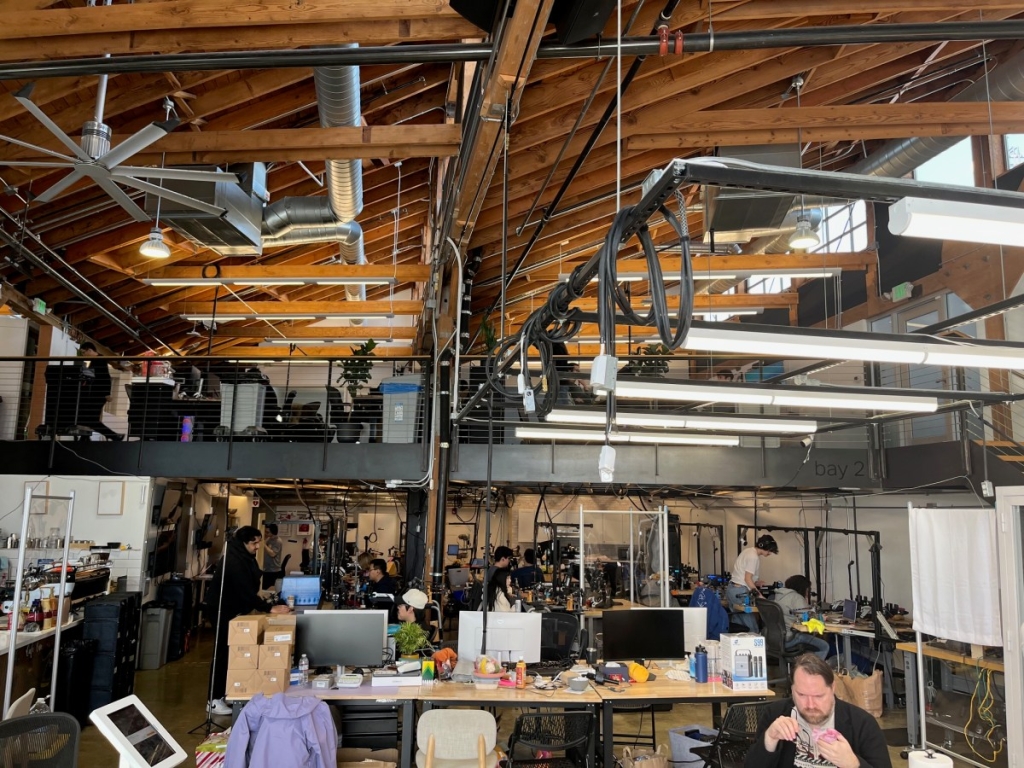
In a nondescript San Francisco warehouse, behind a door marked only by a slightly different shade of paint, a revolution in robotics is quietly unfolding. Inside Physical Intelligence’s headquarters, the air hums with the sound of robotic arms attempting to master humanity’s most mundane tasks – folding pants, turning shirts inside out, and peeling vegetables with varying degrees of success.
The scene resembles a high-tech laboratory crossed with a chaotic workshop. Long blonde-wood tables stretch across the concrete space, some cluttered with Girl Scout cookies and Vegemite jars (a telltale sign of Australian co-founder Lachy Groom), while others support an array of monitors, robotic components, and partially assembled mechanical arms engaged in their daily practice routines.
“Think of it like ChatGPT, but for robots,” explains Sergey Levine, associate professor at UC Berkeley and one of Physical Intelligence’s co-founders. The company is building what they call “general-purpose robotic foundation models” – artificial intelligence systems that could theoretically control any robot to perform any task, much like large language models can generate any kind of text.
The Continuous Learning Loop
What visitors witness is the testing phase of an ambitious continuous loop. Data flows in from robot stations across various locations – warehouses, homes, test kitchens – training the foundation models. When researchers develop new models, they return to evaluation stations like these to assess performance. A robotic arm struggling with pants folding represents someone’s experiment. Another’s persistent attempts to turn shirts inside out demonstrates the iterative nature of the learning process. A third arm successfully peeling zucchini might be testing whether the model can generalize across different vegetables, learning fundamental peeling motions applicable to apples or potatoes it has never encountered.
The company operates a sophisticated test kitchen in the same building, using off-the-shelf hardware to expose robots to diverse environments and challenges. An expensive espresso machine sits nearby, not for employee perks but for robots to learn coffee-making – every foamed latte becomes valuable training data.
The Billion-Dollar Vision
Physical Intelligence has raised over $1 billion in funding, achieving a $5.6 billion valuation from investors including Khosla Ventures, Sequoia Capital, and Thrive Capital. The company employs approximately 80 people and plans to grow, though co-founder Groom emphasizes “as slowly as possible.”
What makes this arrangement unusual is what Groom doesn’t promise his backers: a timeline for commercialization. “I don’t give investors answers on commercialization,” he states plainly. “That’s sort of a weird thing, that people tolerate that.” Yet tolerate it they do, and may not always, which is why the company prioritizes being well-capitalized now.
Most of Physical Intelligence’s spending goes toward compute power. “There’s no limit to how much money we can really put to work,” Groom explains. “There’s always more compute you can throw at the problem.”
The Team Behind the Dream
Groom, at 31, embodies Silicon Valley’s boy wonder archetype. He sold his first company nine months after starting it at age 13 in Australia – explaining the Vegemite in the office kitchen. After leaving Stripe as an early employee, he spent five years as an angel investor, making early bets on companies like Figma, Notion, Ramp, and Lattice while searching for the right company to start or join himself.
His robotics investment in Standard Bots in 2021 reintroduced him to a field he’d loved as a child building Lego Mindstorms. “I was looking for five years for the company to go start post-Stripe,” Groom says. “Good ideas at a good time with a good team — [that’s] extremely rare.”
The team includes Karol Hausman from Google DeepMind and Chelsea Finn, a Stanford professor who previously studied under Levine at Berkeley. Their academic credentials and research output made them attractive targets for Groom, who tracked Hausman down when rumors of their collaboration surfaced.
The Hardware Philosophy
Physical Intelligence deliberately uses unglamorous hardware. The robotic arms they employ sell for about $3,500, representing “an enormous markup” from the vendor. If manufactured in-house, material costs would drop below $1,000. A few years ago, Levine notes, roboticists would have been shocked these arms could accomplish anything meaningful. But that’s precisely the point – superior intelligence can compensate for modest hardware.
The Competition Heats Up
Physical Intelligence isn’t alone in pursuing general-purpose robotic intelligence. Pittsburgh-based Skild AI, founded in 2023, recently raised $1.4 billion at a $14 billion valuation. While Physical Intelligence remains focused on pure research, Skild AI has already deployed its “omni-bodied” Skild Brain commercially, claiming $30 million in revenue within months across security, warehouses, and manufacturing applications.
The companies represent different philosophies in the robotics race. Skild AI argues that commercial deployment creates a data flywheel that improves the model with each real-world use case. Physical Intelligence bets that resisting near-term commercialization pressure will enable superior general intelligence development.
Skild AI has taken public shots at competitors, arguing on its blog that most “robotics foundation models” are merely vision-language models “in disguise” lacking “true physical common sense” because they rely too heavily on internet-scale pretraining rather than physics-based simulation and real robotics data.
The Road Ahead
Physical Intelligence operates with unusual clarity, according to Groom. “It’s such a pure company. A researcher has a need, we go and collect data to support that need — or new hardware or whatever it is — and then we do it. It’s not externally driven.”
The company had a 5- to 10-year roadmap of what the team thought would be possible. By month 18, they’d blown through it, Groom says. They’re already working with a small number of companies in different verticals – logistics, grocery, a chocolate maker across the street – to test whether their systems are ready for real-world automation. Vuong claims that in some cases, they already are.
The most challenging aspect, Groom notes, is hardware. “Hardware is just really hard. Everything we do is so much harder than a software company.” Hardware breaks. It arrives slowly, delaying tests. Safety considerations complicate everything.
The Bigger Questions
As the robots continue their practice – pants still not quite folded, shirts stubbornly right-side-out, zucchini shavings piling up nicely – obvious questions emerge. Does anyone actually want a robot in their kitchen peeling vegetables? What about safety concerns? Will dogs go crazy at mechanical intruders in their homes? Are the problems being solved big enough, or are new ones being created?
Outsiders question the company’s progress, whether its vision is achievable, and if betting on general intelligence rather than specific applications makes strategic sense.
If Groom has doubts, he doesn’t show them. He’s working with people who’ve been working on this problem for decades and who believe the timing is finally right, which is all he needs to know.
Silicon Valley has been backing people like Groom and giving them considerable latitude since the industry’s beginning, knowing there’s a good chance that even without a clear path to commercialization, even without a timeline, even without certainty about what the market will look like when they get there, they’ll figure it out. It doesn’t always work out. But when it does, it tends to justify a lot of the times it didn’t.
Tags: robotics, artificial intelligence, Physical Intelligence, Lachy Groom, Sergey Levine, Chelsea Finn, Karol Hausman, Skild AI, general-purpose robots, foundation models, robotics revolution, Silicon Valley, automation, venture capital, AI funding
Viral Phrases: “ChatGPT but for robots,” “billion-dollar bet on thinking machines,” “the pants-folder experiment,” “zucchini-peeling robots,” “pure company, pure vision,” “hardware is just really hard,” “the continuous learning loop,” “any platform, any task,” “the timing is finally right,” “figuring it out without a timeline”
Viral Sentences: “The pants are still not quite folded. The shirt remains stubbornly right-side-out. The zucchini shavings are piling up nicely.” “Good ideas at a good time with a good team — [that’s] extremely rare.” “There’s no limit to how much money we can really put to work.” “Hardware is just really hard. Everything we do is so much harder than a software company.” “Silicon Valley has been backing people like Groom and giving them a lot of rope since the beginning of the industry.”
,


Leave a Reply
Want to join the discussion?Feel free to contribute!