
GeekWire rides the world’s first floating-bridge train — Seattle tech commutes will never be the same
Seattle’s Floating Bridge Train Revolution: A Game-Changer for Tech Commuters
The dawn of a new era in Pacific Northwest transportation has arrived, and it’s floating. Sound Transit’s groundbreaking Crosslake Connection Link light rail line has officially begun service, marking a world-first achievement that’s set to transform the daily lives of thousands of tech workers across Seattle’s Eastside and beyond.
A Smooth Ride Over Water
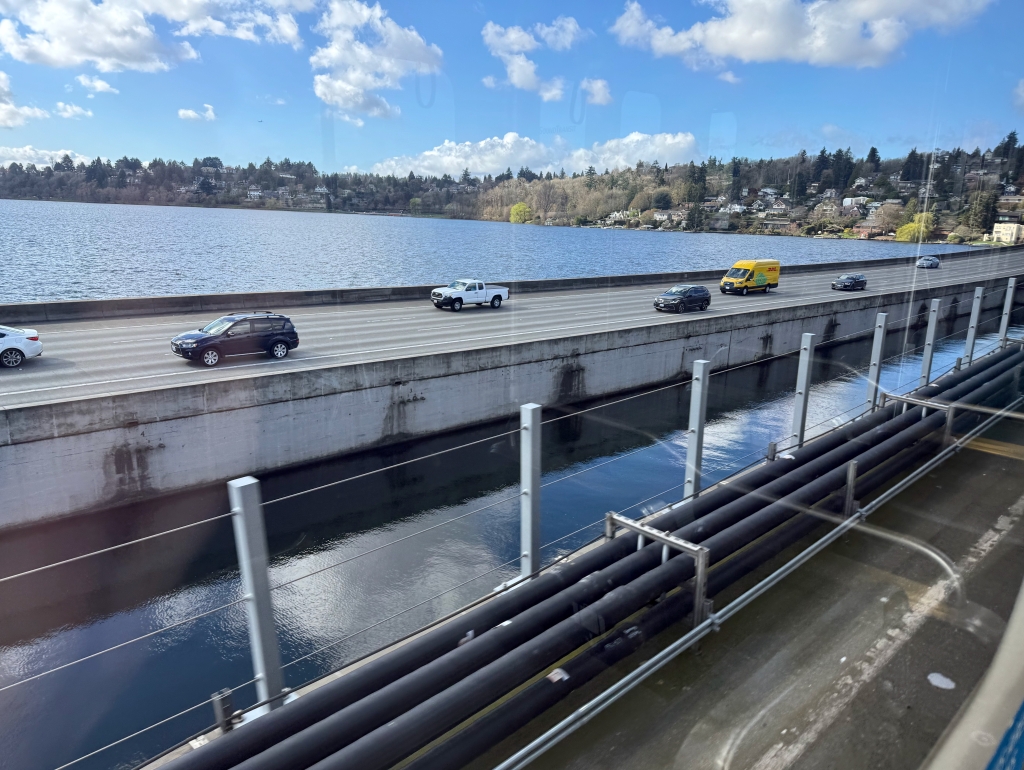
As our media preview train glided across Lake Washington on Thursday morning, the experience was nothing short of surreal. The 1.2-mile journey across the floating bridge felt remarkably stable – no swaying, no unsettling movements, just a quiet, smooth ride at 55 mph that made it nearly impossible to tell you were traveling over water rather than solid ground.
Sound Transit CEO Dow Constantine, gripping a train strap and watching the Lake Washington vista unfold, summed it up perfectly: “Look at this. Look. At. This.” He continued, “You come out of the tunnel and see this, it’s just incredible.”
The Tech Industry’s Commuting Nightmare Solved
For years, the 13-mile drive between Seattle and Microsoft’s Redmond headquarters has been a source of endless frustration for tech workers. What should be a 20-minute journey often stretched to two hours or more during peak traffic, creating a productivity black hole that drained both time and morale.
King County Councilmember Claudia Balducci, whose district includes Bellevue, Kirkland, Mercer Island, and Redmond, emphasized the transformation this represents: “Sitting behind the wheel is completely lost, unproductive, stressful time. Sitting in a train you can read, you can do work. I think it just is going to be a game changer.”
Tech Hubs Connected Like Never Before
The 2 Line’s impact extends far beyond Microsoft. With Amazon establishing a major presence in Bellevue – planning to house 25,000 corporate workers across various buildings – and tens of thousands more employed throughout the region’s tech ecosystem, this rail connection creates unprecedented mobility between major employment centers.
Constantine’s message to tech workers is clear: prepare for a “significant upgrade in your quality of life.” He explains that the line will allow people to “easily get back and forth between home and office, whichever side of the lake you’re on, without having to plan ahead for traffic, without having to fear that you’re going to get stuck in a traffic jam, in a predictable, reliable amount of time, every time.”
Economic Transformation Beyond Transportation
The ripple effects of this infrastructure investment extend well beyond commuter convenience. Companies are enthusiastic about how it makes it easier for people to return to the office or how they can recruit someone who lives in a Seattle neighborhood to come work on the Eastside, or vice versa.
Balducci notes that people make conscious decisions about where to locate their businesses and their homes based on fixed transit. “A bus stop is not going to make you build your new tower if you’re Amazon, but you can see the Amazons, the Microsofts and tech companies generally are building around these [train] hubs.”
Light rail and the associated stations are not only attractive to tech companies. Housing development and small businesses also follow, along with riders coming and going to easily visit different parts of the region.
“I think it’s going to really shift the feel and the economy in ways that we may not be able to even predict today,” Balducci said.
Engineering Marvel Meets Daily Commute
While passengers may never notice the complexity beneath their feet, the engineering achievement here is staggering. Train infrastructure had to be built onto the highway infrastructure that’s part of the westbound Homer M. Hadley Memorial Bridge, which opened in 1989. Tracks have to transition smoothly over the joints between fixed and floating segments of the bridge, allowing for flexing of the rails as the bridge moves.
Craig Delalla, a longtime systems engineer with Sound Transit, explains the complexity: “Once you introduce repurposing roadways and tunnels and floating bridges, there’s just more integration, more complexity. All of the systems — power, control, structural — they all have to work together.”
“It is a big deal going over the water,” he added.
Ridership Projections and Service Details
Sound Transit projects the fully integrated 2 Line will serve about 43,000 to 52,000 daily riders in 2026, with trains running every 10 minutes from approximately 5 a.m. to midnight seven days a week. This represents a significant increase from the 10,000 people already using the previously completed rail line between downtown Bellevue and the Redmond Technology Station next to Microsoft’s headquarters campus.
Artistic Touches Along the Journey
The new stations aren’t just functional – they’re cultural destinations in their own right. At the Mercer Island station, “Stroke” by Belize Brother features suspended paddles that create dynamic visual interest. The Judkins Park station in Seattle’s Central District showcases “A Walk in the Neighborhood” by Barbara Earl Thomas, featuring cut-paper-style images of people, pets, and more in laminated glass windscreens.
Looking Forward
As trains begin regular service this weekend, the Pacific Northwest is witnessing more than just a new transit option – it’s experiencing a fundamental shift in how the region connects, works, and lives. For tech workers who have spent years battling traffic between Seattle and its Eastside neighbors, the Crosslake Connection represents freedom: freedom from unpredictable commute times, freedom to use travel time productively, and freedom to choose where to live and work without being constrained by traffic patterns.
The floating bridge train may look like just another light rail line to the casual observer, but for the tens of thousands of people whose daily lives it will transform, it represents nothing less than a revolution in regional mobility.
Tags: floating bridge train, Seattle light rail, Crosslake Connection, tech commuting, Lake Washington transit, Sound Transit 2 Line, Eastside transportation, Microsoft commute, Amazon Bellevue, floating bridge engineering, Pacific Northwest transit, world-first rail project
Viral Sentences:
- World’s first floating bridge train makes commuting a breeze
- Tech workers rejoice: Seattle-Eastside commute just got revolutionary
- The engineering marvel you’ll never notice on your daily ride
- From 2-hour nightmare to 20-minute dream: the floating bridge train changes everything
- Silicon Valley who? Seattle’s floating bridge train is next-level innovation
- The quiet revolution transforming Pacific Northwest tech commutes
- How a floating train could reshape Seattle’s entire economy
- The 55 mph journey over water that feels like solid ground
- Why Amazon and Microsoft are betting big on Seattle’s floating rail future
- The game-changing transit solution tech workers have been waiting for
- From traffic jam to productivity boost: the floating bridge train’s secret superpower
- Engineering meets artistry: Seattle’s new rail line is both functional and beautiful
- The floating bridge train: where world-class engineering meets daily convenience
- How Seattle’s floating train could become the new standard for water crossings worldwide
- The tech industry’s best-kept secret: Seattle’s floating bridge light rail
,


Leave a Reply
Want to join the discussion?Feel free to contribute!