
Steam On Linux Use Skyrocketed In March – More Than Double The macOS Gaming Marketshare
Steam on Linux Surges Past 5% Market Share in Record-Breaking March 2026
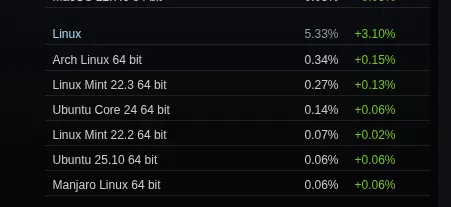
In a stunning turn of events that has the Linux gaming community buzzing, Valve’s latest Steam Hardware Survey reveals that Steam on Linux has shattered all previous records by climbing to an unprecedented 5.33% market share in March 2026. This milestone represents not just a statistical blip, but potentially a seismic shift in the landscape of PC gaming platforms.
The journey to this historic moment has been anything but linear. Throughout 2025, Linux gaming maintained a respectable but modest presence on Steam, hovering around 3.5% by year’s end. The new year began with a slight dip in January, followed by a concerning drop to just 2.23% in February. These fluctuations, while notable, still represented significant progress compared to the pre-Steam Deck era when Linux struggled to break the 1% barrier.
However, March 2026 has rewritten the narrative entirely. The 5.33% figure isn’t merely a new high-water mark—it’s a quantum leap that sees Linux gaming more than doubling the market share of its closest competitor, macOS, which sits at 2.35%. To put this achievement in perspective, Linux gaming now commands a larger slice of the Steam ecosystem than it has at any point in the platform’s history, both in relative and absolute terms.
The numbers tell a dramatic story of platform migration. Windows, long the undisputed king of PC gaming, experienced a substantial 4.28% drop in March, falling to 92.33% of the total Steam user base. This represents millions of users potentially switching platforms or, at minimum, adding Linux gaming to their repertoire.
Valve’s Steam Survey methodology has occasionally raised eyebrows due to periodic adjustments in how they account for regional variations, particularly concerning Steam China. March’s data shows a dramatic 31.85% decrease in Simplified Chinese language usage, accompanied by a 16.82% increase in English language usage to 39.09%. While this adjustment likely explains part of Linux’s surge, the magnitude of the gain suggests deeper underlying trends at work.
The hardware landscape within the Linux gaming community remains heavily influenced by Valve’s own Steam Deck. Approximately 25% of Linux gamers are now running Steam OS, underscoring the handheld’s role as a gateway device for Linux gaming adoption. This figure is particularly significant given that the Steam Deck has only been on the market for a few years, yet it already accounts for a substantial portion of the Linux gaming ecosystem.
Processor preferences among Linux gamers continue to favor AMD hardware, with just under 70% of users running AMD CPUs. This dominance can be attributed to several factors, including the Steam Deck’s custom AMD APU, the superior open-source driver support that AMD provides compared to NVIDIA, and the general performance-per-dollar proposition that AMD has offered in recent years. The synergy between AMD hardware and Linux gaming appears to be a self-reinforcing cycle, with each element strengthening the other.
The implications of this milestone extend far beyond mere statistics. A 5.33% market share represents a critical mass that developers cannot afford to ignore. Game studios that previously viewed Linux as a niche platform may now reconsider their porting strategies, potentially leading to a virtuous cycle of increased Linux game availability, which in turn attracts more users to the platform.
Industry analysts are already speculating about the long-term ramifications. Some suggest that this could mark the beginning of a “Linux gaming renaissance,” while others caution that monthly survey fluctuations can be volatile and that sustained growth will be the true measure of success. Regardless of the interpretation, the data represents an inflection point that warrants serious attention from all stakeholders in the PC gaming ecosystem.
The timing of this surge is particularly noteworthy given the current state of the broader technology landscape. With increasing concerns about platform lock-in, digital rights management, and the centralization of gaming ecosystems, many users appear to be seeking alternatives that offer greater control and openness. Linux, with its open-source philosophy and growing gaming capabilities, seems to be benefiting from this shift in user sentiment.
Valve’s continued investment in Linux gaming infrastructure, including their Proton compatibility layer and ongoing improvements to the Steam client on Linux, appears to be paying dividends. The company’s strategy of treating Linux as a first-class citizen rather than an afterthought seems to be resonating with users who value platform diversity and choice.
The March 2026 Steam Survey results are available in full detail on SteamPowered.com, where users can explore the granular data behind these headline figures. As the gaming community digests this information, one thing is clear: Linux gaming has reached a milestone that once seemed like a distant dream, and the trajectory suggests that this may be just the beginning of a new chapter in PC gaming history.
Tags: Linux gaming breakthrough, Steam market share explosion, Valve gaming revolution, Linux gaming milestone, Steam Deck success story, AMD Linux dominance, Windows gaming decline, open source gaming future, PC gaming platform shift, Linux gaming adoption surge, Steam survey record breaker, gaming ecosystem diversification, Proton compatibility success, Steam OS growth, gaming hardware trends
Viral Phrases: “Linux gaming crosses the Rubicon,” “The 5% threshold nobody saw coming,” “Windows’ worst nightmare becomes reality,” “Steam Deck’s secret weapon revealed,” “AMD’s open-source advantage pays off,” “The great gaming platform migration begins,” “Linux goes from niche to mainstream overnight,” “Valve’s master plan unfolds,” “Gaming’s open-source revolution,” “The numbers don’t lie: Linux is here to stay”
,


Leave a Reply
Want to join the discussion?Feel free to contribute!