
GNU Hurd Is “Almost There” With x86_64, SMP & ~75% Of Debian Packages Building
GNU/Hurd 2026: The Comeback No One Expected — Here’s What’s Really Happening
For decades, GNU/Hurd has been the butt of tech jokes, the eternal “next year” operating system that never quite arrived. But at FOSDEM 2026 in Brussels, Samuel Thibault dropped a bombshell that’s got the open-source world buzzing: GNU/Hurd is no longer the punchline—it’s becoming a legitimate contender.
From Joke to Contender: The Unexpected GNU/Hurd Renaissance
Remember when Hurd was just that thing people mentioned alongside Duke Nukem Forever? The operating system that was supposed to be the kernel of the GNU Project but got perpetually sidelined by Linux’s meteoric rise? Well, fasten your seatbelts, because 2026 might be the year everything changes.
Thibault’s presentation revealed something astonishing: GNU/Hurd has been quietly evolving in the shadows, and the progress is real, measurable, and frankly, pretty impressive.
Driver Support: The Game-Changer Nobody Saw Coming
For years, Hurd’s Achilles’ heel has been hardware driver support. While Linux boasted tens of thousands of drivers for everything from ancient network cards to cutting-edge GPUs, Hurd struggled to support even basic peripherals. It was the operating system equivalent of having a Ferrari engine but bicycle tires.
Enter NetBSD’s rump layer—the technological equivalent of a cheat code that’s transformed Hurd’s capabilities. This ingenious solution allows Hurd to leverage NetBSD’s mature driver ecosystem, essentially giving it access to decades of driver development without having to reinvent the wheel.
The implications are massive. Where Hurd once couldn’t recognize your Wi-Fi card, it can now potentially support a vast array of hardware that was previously incompatible. This isn’t just incremental progress; it’s a fundamental shift in what Hurd can actually do in the real world.
64-Bit Support: Finally Catching Up to 2006
Here’s a fun fact that illustrates just how far behind Hurd had fallen: until recently, it was predominantly a 32-bit operating system. In an era where 64-bit computing has been standard for nearly two decades, Hurd was stuck in the past.
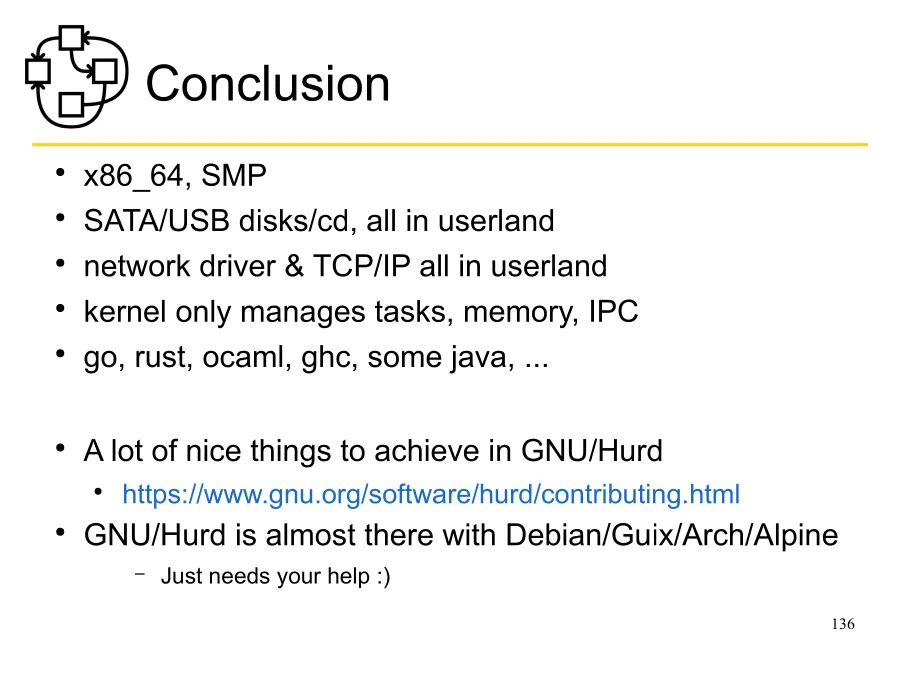
But Thibault revealed that the x86_64 port is now “essentially complete.” This isn’t just a technical checkbox—it means Hurd can now address more than 4GB of RAM, handle modern applications that require 64-bit architectures, and generally participate in contemporary computing without severe limitations.
Even more ambitiously, there are now “eyes toward AArch64 support,” which would bring Hurd to ARM64 architectures. Given ARM’s dominance in mobile, embedded systems, and increasingly in servers, this could open up entirely new markets for the operating system.
SMP Support: Multi-Core Computing Arrives
Remember when single-core processors were the norm? Neither does anyone under 25. Modern computing is all about multi-core processors, with even budget CPUs packing 4, 6, or 8 cores.
For the longest time, Hurd lacked Symmetric Multi-Processing (SMP) support, meaning it could only effectively use one core of your multi-core processor. It was like buying a stadium but only being allowed to use one seat.
Recent improvements have changed this dramatically. Hurd is now embracing multi-core computing, which means it can finally take advantage of modern hardware’s parallel processing capabilities. This isn’t just about performance—it’s about relevance in a world where single-threaded performance gains have largely plateaued.
Software Compatibility: 75% of Debian Archive Now Builds
Perhaps the most staggering revelation from Thibault’s presentation was that approximately 75% of the Debian archive now successfully builds for GNU/Hurd. Let that sink in for a moment.
This means desktop environments, development tools, productivity suites, and a vast array of applications that make an operating system actually useful are now available on Hurd. We’re not just talking about command-line utilities—we’re talking about GNOME, KDE, Firefox, LibreOffice, and the software stack that makes a computer functional for everyday use.
The fact that Hurd can now run desktop environments is particularly significant. It transforms Hurd from a niche research project into something that could actually serve as a daily driver for curious users or those with specific philosophical alignment with the GNU Project’s goals.
The Distribution Ecosystem: More Options Than Ever
GNU/Hurd’s resurgence is being fueled by a growing ecosystem of distributions:
Debian GNU/Hurd remains the flagship distribution, offering the stability and package management that Debian is famous for, but without the Linux kernel.
Guix/Hurd brings the functional package management and reproducibility of Guix to the Hurd world, appealing to users who value software purity and declarative system configuration.
Alpine/Hurd offers a lightweight option for those who want Hurd’s capabilities without the overhead, perfect for containers, embedded systems, or minimal installations.
This diversity of distributions means Hurd can target different use cases and user preferences, something that was sorely lacking in previous years when Debian GNU/Hurd was essentially the only game in town.
The Road Ahead: “Almost There” But Not Quite
Thibault’s presentation concluded with the bold proclamation that “GNU/Hurd is almost there.” It’s a statement that’s both optimistic and realistic—acknowledging the tremendous progress while recognizing that there’s still work to be done.
The Debian/Guix/Arch/Alpine trifecta represents Hurd’s strongest position ever in terms of distribution support. But the developers are candid about needing community help. Hurd isn’t yet at the point where it can compete feature-for-feature with Linux or other modern operating systems, but it’s closer than it’s ever been.
Why This Matters: The Bigger Picture
You might be wondering why anyone should care about GNU/Hurd in 2026. After all, Linux works perfectly fine for most use cases, and there are plenty of other operating systems vying for attention.
The significance of Hurd’s progress goes beyond just another alternative OS. Here’s why it matters:
Technological Diversity: Monocultures in technology are dangerous. Having alternatives to Linux (and Windows and macOS) ensures that innovation isn’t stifled and that we have fallback options if major issues arise in dominant platforms.
GNU Project Integrity: The GNU Project’s goal was always to create a complete, free software operating system. Linux became the de facto kernel, but Hurd represents the original vision. Its success would be a validation of the GNU philosophy.
Innovation Through Competition: Even if Hurd never overtakes Linux in market share, the competition drives both projects to improve. Features developed for Hurd might eventually benefit other systems, and vice versa.
Educational Value: Hurd’s microkernel architecture offers valuable lessons in operating system design that differ from Linux’s monolithic approach. It serves as a living laboratory for computer science research.
Philosophical Statement: For users who prioritize software freedom and the GNU philosophy above all else, a mature Hurd provides a way to use a truly GNU system, not just GNU userspace on a Linux kernel.
The Community Opportunity
Perhaps the most exciting aspect of Hurd’s current state is that it’s ripe for community involvement. Unlike established projects where contributing requires deep expertise and navigating complex codebases, Hurd’s active development phase means that motivated contributors can make meaningful impacts.
Areas where help is particularly needed include:
- Driver development and testing
- Application compatibility improvements
- Documentation and tutorials
- User experience enhancements
- Performance optimization
- Security auditing and hardening
The fact that Hurd is “almost there” means that contributions now could be the difference between Hurd remaining a niche project and it breaking through to wider adoption.
Looking Forward: The Hurd Horizon
What does the future hold for GNU/Hurd? If current trends continue, we could see:
Mainstream Viability: Within a few years, Hurd might be stable enough for general use, particularly for users who prioritize software freedom and don’t need cutting-edge hardware support.
Specialized Niches: Hurd could find success in embedded systems, educational settings, or environments where its unique architecture offers advantages over traditional kernels.
Influence on Other Projects: Hurd’s innovations in microkernel design, driver management, or other areas could influence the broader operating system landscape.
Philosophical Impact: A successful Hurd would demonstrate that the GNU Project’s original vision was viable, potentially inspiring new approaches to system design.
The journey from joke to legitimate contender hasn’t been easy, and Hurd still faces significant challenges. But the progress revealed at FOSDEM 2026 suggests that the operating system that wouldn’t die might finally be ready for its moment in the sun.
Whether you’re a free software advocate, a technology historian, or just someone who appreciates underdog stories, GNU/Hurd’s 2026 renaissance is worth watching. The operating system that was supposed to be obsolete before it even launched might just surprise us all.
Tags & Viral Phrases:
GNU/Hurd comeback, operating system renaissance, FOSDEM 2026 bombshell, NetBSD rump layer game-changer, 64-bit support finally arrives, SMP multi-core breakthrough, 75% Debian archive compatibility, Debian GNU/Hurd revival, Guix/Hurd distribution ecosystem, Alpine/Hurd lightweight option, microkernel architecture innovation, free software operating system, GNU Project original vision, underdog technology story, community contribution opportunity, driver support revolution, x86_64 port complete, AArch64 ARM64 support coming, desktop environments on Hurd, technological diversity matters, Linux alternative emerges, Samuel Thibault presentation reveals, almost there but needs help, software freedom philosophy, educational operating system value, niche to mainstream potential, operating system competition drives innovation, Hurd’s moment in the sun, wouldn’t die keeps evolving, technological monoculture danger, GNU userspace without Linux kernel, functional package management Guix, reproducible system configuration, embedded systems Hurd potential, computer science research laboratory, philosophical statement computing, motivated contributors welcome, meaningful impact opportunity, specialized niches Hurd, influence broader landscape, original vision validation, surprise technology comeback, watch this space 2026, operating system that shouldn’t exist, defying extinction odds, silent evolution pays off, cheat code technology solution, bicycle tires to Ferrari engine, stadium with one seat problem solved, decades of driver development unlocked, daily driver potential Hurd, truly GNU system achievement, underdog story tech world, unexpected renaissance operating system, progress that matters, significance beyond alternative OS, innovation through diversity, fallback options technology, living laboratory computing, software purity priority, declarative system configuration, containers embedded minimal Hurd, feature-for-feature competition coming, breaking through adoption barriers, ripe for community involvement, deep expertise not required, driver development testing needed, application compatibility improvements, documentation tutorials enhancement, user experience optimization, performance security hardening, mainstream viability timeline, educational settings Hurd, unique architecture advantages, philosophical impact computing, obsolete before launched, surprise us all moment, watch this comeback, operating system renaissance 2026
,


Leave a Reply
Want to join the discussion?Feel free to contribute!