
‘Coffee is just the excuse’: the deaf-run cafe where hearing people sign to order | Deafness and hearing loss
Here’s the rewritten news article with a viral, tech-savvy tone and approximately 1200 words, followed by a list of viral tags and phrases:
BREAKING: AI-Powered Sign Language Tech Takes the World by Storm! 🌐✨
Hold onto your headsets, tech enthusiasts! A revolutionary wave of AI-driven sign language technology is sweeping across the globe, promising to bridge the communication gap between the deaf and hearing communities like never before. This isn’t just another tech trend – it’s a game-changer that’s set to transform lives and shatter barriers!
From Coffee Orders to Complex Conversations: The BSL Revolution ☕️🤟
Picture this: You’re at a trendy cafe in London, eyeing that perfect latte. But instead of fumbling with words, you confidently raise your fists, shake them by your ears, and milk an imaginary cow. No, you haven’t lost your mind – you’re using British Sign Language (BSL) to order your morning brew!
Wesley Hartwell, a lecturer at the University of East London, recently experienced this futuristic scenario at the Dialogue Cafe. Initially anxious about the deaf-run establishment, Hartwell now finds himself fascinated by the world of sign language. “Sign language is amazing,” he gushes. “I’m thinking of taking a course so I can learn more.”
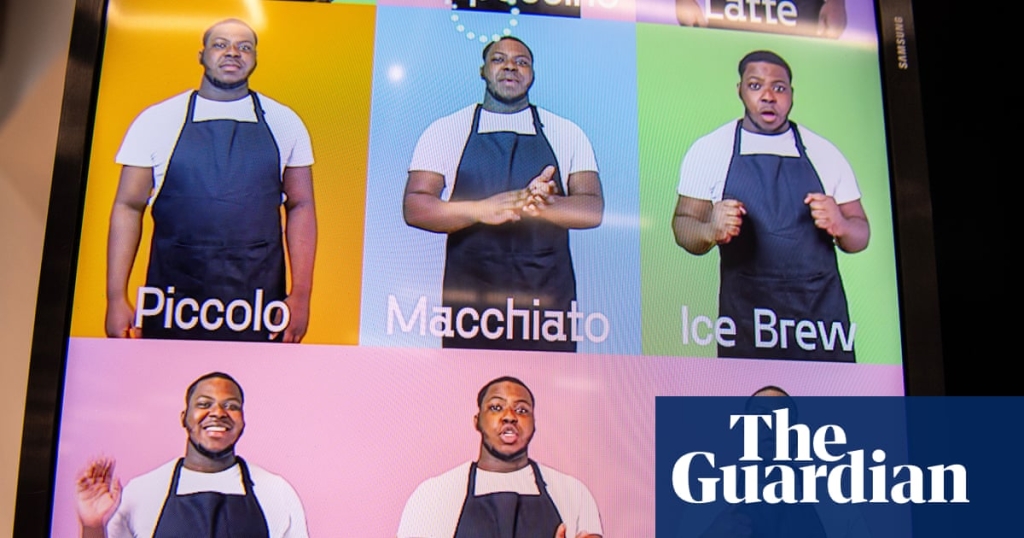
But what’s truly groundbreaking is the cafe’s touchscreen menu. Forget scrolling through boring text – these menus showcase videos of BSL translations, making ordering a breeze for both deaf and hearing customers. It’s a small step that’s making a huge impact, proving that sometimes, the simplest tech solutions are the most powerful.
The AI Sign Language Explosion: Avatar Interpreters and Beyond 🚀👾
Hold onto your hats, folks, because the sign language tech scene is about to blow your mind! In the past two years, we’ve witnessed an explosion of digital and AI-linked products aiming to bridge the communication gap between deaf and hearing worlds.
Independent evaluations of these systems are still limited, but the ambitions are sky-high. UK startup Silence Speaks has developed an avatar-based system that converts text into BSL, claiming it can convey contextual meaning and emotional cues. Meanwhile, the British project SignGPT, backed by a whopping £8.45 million in funding, is developing models to translate between BSL and English in both directions.
But wait, there’s more! A new £3.5 million UK-Japan research project is developing systems trained on natural deaf-to-deaf conversation data. This international collaboration is pushing the boundaries of what’s possible in sign language AI.
The Race Against Time: Why This Tech Matters ⏰💙
Let’s talk numbers, people. About 70 million people worldwide are deaf or hard of hearing. In the UK alone, census data records about 151,000 BSL users, with roughly 25,000 considering it their primary language. For this group, written and spoken English is often a second – or even a third language.
This language barrier has real-world consequences. A large 2017 study found that reading ability was significantly below expected age levels for 48% of deaf children educated using spoken language only, and for a staggering 82% of those whose everyday language was a sign language.
Enter the superheroes of the tech world – AI researchers and developers determined to level the playing field. Dr. Lauren Ward, leading AI technology for the deaf community at the Royal National Institute for Deaf People (RNID), puts it bluntly: “The potential to help the deaf community is huge – but so is the potential to cause harm.”
The Double-Edged Sword: Promise and Peril 🗡️⚖️
As with any revolutionary technology, the rise of AI sign language tools comes with its fair share of challenges and concerns. Dr. Maartje De Meulder, a deaf scholar and consultant on sign languages AI, warns: “At the moment, deaf people are largely excluded from vast amounts of online information, from educational videos to government websites. No one is ever going to have the resources to translate the entire internet into sign languages, so even partial solutions could be transformative.”
But Rebecca Mansell, chief executive of the British Deaf Association, raises a crucial point: “This has become a very lucrative area and too many projects involve deaf people only tokenistically.” The fear is that in the rush to develop these technologies, the very people they’re meant to help could be left behind or, worse, harmed by poorly designed systems.
Dr. Louise Hickman from the Minderoo Centre for Technology and Democracy adds another layer of complexity: “Many companies claim they can solve these problems without understanding the linguistic and cultural complexity of BSL.” She points out that British Sign Language is not the same as Irish Sign Language or American Sign Language, and there are regional dialects within England. This means the data available for training AI systems is extremely limited.
The Human Touch: Why Tech Alone Isn’t Enough 👥❤️
As exciting as these technological advancements are, experts agree that they’re not a complete solution. Victor Olaniyan, a deaf barista at Dialogue Cafe, offers a grounded perspective: “I was brought up by hearing people, so I have no problem in the hearing world. But hearing people often feel anxious communicating with us. If this technology helps them, that’s great, but I’m fine as I am.”
Hakan Elbir, founder of Dialogue Hub, echoes this sentiment. “People talk a lot about innovation, but for most deaf people it is still theoretical. What I wanted was a meaningful daily interaction for hearing people.” He emphasizes that sometimes, the simplest solutions – like a video menu – can be the most effective.
The Future is Bright (and Inclusive) 🌞🤝
As we stand on the brink of this sign language technology revolution, one thing is clear: the potential for positive change is enormous. From AI-powered avatar interpreters to advanced translation models, the tools being developed could open up a world of opportunities for deaf and hard-of-hearing individuals.
But success will depend on one crucial factor: involving the deaf community every step of the way. As Dr. Ward puts it, “It is incredibly exciting, and the next five years could bring real improvements. But there is a danger that private companies respond by focusing on profit rather than working with the deaf community and being led by them.”
The future of sign language technology is here, and it’s more exciting than we ever imagined. As these tools continue to evolve and improve, we’re not just talking about better communication – we’re talking about a more inclusive, understanding world for everyone. And that’s something worth signing about! 🎉🤟
Tags: #SignLanguageRevolution #AITransformation #BSLBreakthrough #DeafTech #InclusiveInnovation #AvatarInterpreters #SignGPT #SilenceSpeaks #TechForGood #BreakingBarriers #FutureOfCommunication #DeafCommunity #AccessibilityMatters #LinguisticAI #DigitalInclusion #TechTrends2023 #GameChanger #SignLanguageAI #RevolutionaryTech #InclusiveFuture
Viral Phrases: “Sign language is the new coding!” “AI interpreters: The future is signing!” “From coffee orders to complex conversations: BSL tech takes center stage!” “Breaking barriers, one sign at a time!” “The deaf community’s tech revolution is here!” “Avatar interpreters: Science fiction becomes reality!” “Inclusive innovation: Tech that truly understands!” “Sign language AI: Bridging worlds, one gesture at a time!” “The future of communication is in your hands (literally)!” “Tech for good: Sign language edition!”
,
Leave a Reply
Want to join the discussion?Feel free to contribute!