
Atomic Chains Turn Electric Fields into Measurable Quantum Signals
Atomic Chains Turn Electric Fields into Measurable Quantum Signals
In a groundbreaking development that could reshape the landscape of precision sensing, scientists have unveiled a revolutionary approach to measuring low-frequency electric fields using Rydberg atom systems. This innovative technique, which leverages the unique properties of highly excited atoms, promises to overcome the longstanding limitations of existing sensing technologies by delivering unprecedented accuracy, compact design, and the ability to detect field direction—all within a single system.
Rydberg atoms, named after the Swedish physicist Johannes Rydberg, are atoms in which one or more electrons are excited to extremely high energy levels. These atoms exhibit extraordinary sensitivity to external electric fields, making them ideal candidates for precision measurements. The new method, developed by a team of researchers, harnesses the collective behavior of chains of Rydberg atoms to convert electric fields into measurable quantum signals. This approach not only enhances sensitivity but also enables the detection of field vectors, providing a more comprehensive understanding of the electromagnetic environment.
The significance of this breakthrough cannot be overstated. Traditional methods for measuring low-frequency electric fields often struggle with issues such as limited traceability, bulky instrumentation, and an inability to determine field direction. These shortcomings have hindered advancements in fields ranging from telecommunications to medical diagnostics. By contrast, the Rydberg-based system offers a compact, scalable solution that could revolutionize industries reliant on precise electromagnetic measurements.
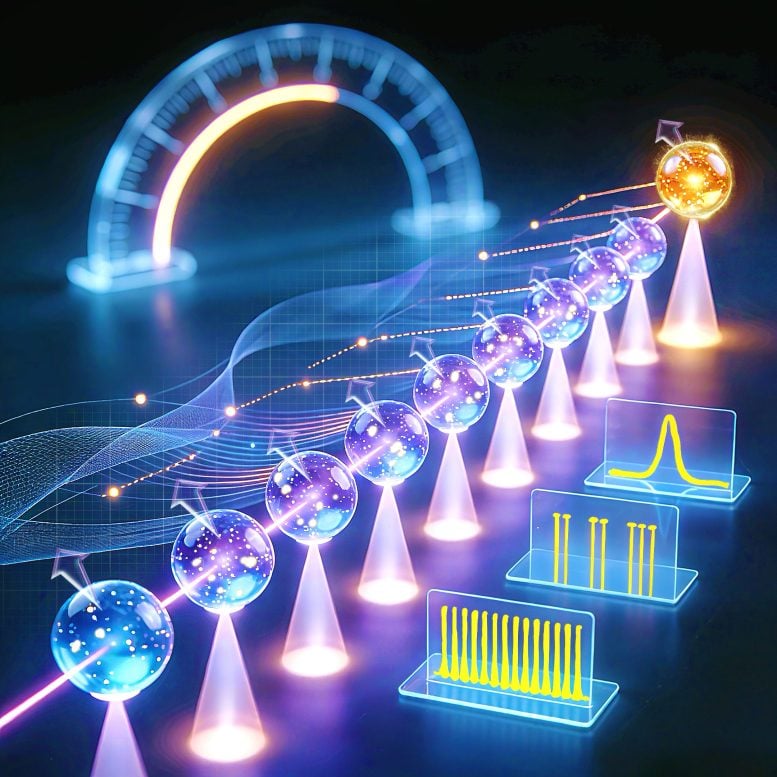
At the heart of this innovation lies the concept of a Rydberg dipolar chain. In this configuration, atoms are arranged in a linear chain, with each atom interacting with its neighbors through dipole-dipole forces. When an external electric field is applied, it induces shifts in the energy levels of the atoms, which can be detected and analyzed to reconstruct the field’s properties. The collective nature of the chain amplifies these shifts, making even the faintest signals detectable.
One of the most exciting aspects of this technology is its potential for miniaturization. Unlike traditional sensors, which often require large, complex setups, the Rydberg-based system can be implemented on a chip-scale platform. This opens the door to portable, field-deployable devices that could be used in a wide range of applications, from environmental monitoring to space exploration.
The implications of this research extend far beyond the laboratory. In the realm of telecommunications, for instance, the ability to measure low-frequency electric fields with high precision could lead to more efficient signal processing and improved data transmission. In healthcare, the technology could enable the development of advanced diagnostic tools for monitoring neural activity or detecting subtle changes in biological tissues. Even in the field of fundamental physics, the Rydberg-based system could provide new insights into the behavior of electromagnetic fields at the quantum level.
As the scientific community continues to explore the potential of Rydberg atoms, the future of electric field sensing looks brighter than ever. This breakthrough not only addresses the limitations of existing technologies but also paves the way for a new era of precision measurement. With further development, the Rydberg dipolar chain could become a cornerstone of next-generation sensing systems, transforming the way we interact with and understand the electromagnetic world.
Tags and Viral Phrases:
Rydberg atoms, quantum sensing, electric field measurement, low-frequency detection, compact design, field direction, dipole-dipole forces, chip-scale platform, precision measurement, electromagnetic fields, next-generation sensors, scientific breakthrough, portable devices, telecommunications, healthcare diagnostics, space exploration, environmental monitoring, quantum signals, atomic chains, innovation, technology, research, scientific discovery, electromagnetic environment, scalable solution, miniaturization, advanced diagnostics, neural activity, biological tissues, fundamental physics, electromagnetic behavior, quantum level, transformative technology, future of sensing, groundbreaking development, revolutionary approach, unprecedented accuracy, scientific community, electromagnetic world, cornerstone of sensing, next-generation systems, brighter future, laboratory research, data transmission, signal processing, environmental monitoring, space exploration, healthcare, telecommunications, scientific breakthrough, quantum sensing, Rydberg atoms, electric field measurement, low-frequency detection, compact design, field direction, dipole-dipole forces, chip-scale platform, precision measurement, electromagnetic fields, next-generation sensors, innovation, technology, research, scientific discovery, electromagnetic environment, scalable solution, miniaturization, advanced diagnostics, neural activity, biological tissues, fundamental physics, electromagnetic behavior, quantum level, transformative technology, future of sensing, groundbreaking development, revolutionary approach, unprecedented accuracy, scientific community, electromagnetic world, cornerstone of sensing, next-generation systems, brighter future, laboratory research, data transmission, signal processing.
,


Leave a Reply
Want to join the discussion?Feel free to contribute!