
Wikipedia signs major AI firms to new priority data access deals
The Cost of Free Knowledge: Wikipedia’s Billion-Dollar Battle Against AI Scrapers
In a seismic shift that could reshape the internet’s information landscape, Wikipedia is preparing to charge tech giants billions for access to its treasure trove of human-curated knowledge. The Wikimedia Foundation, the nonprofit guardian of the world’s largest free encyclopedia, is negotiating landmark deals with AI powerhouses like Google, OpenAI, and Apple that could generate up to $2.5 billion over the next decade.
This dramatic pivot from free access to premium pricing marks a watershed moment in the ongoing struggle between open knowledge and commercial exploitation. For years, Wikipedia has operated as the internet’s public library, offering its vast repository of articles to anyone with an internet connection. Now, as artificial intelligence companies voraciously consume this content to train their models, the foundation finds itself at a crossroads: continue providing free access and risk financial collapse, or monetize its most valuable asset and potentially compromise its founding principles.
The Perfect Storm: AI Scraping Meets Infrastructure Crisis
The timing couldn’t be more critical. Wikimedia’s infrastructure is buckling under unprecedented strain as AI bots systematically scrape Wikipedia’s 6.7 million English articles and billions of words across hundreds of languages. The numbers tell a stark story of unsustainable growth: bandwidth usage for multimedia downloads has surged 50% since January 2024, with bots accounting for a staggering 65% of the most expensive infrastructure requests despite representing only 35% of total pageviews.
This isn’t just about bandwidth costs. The foundation’s servers, which once hummed along serving curious readers and dedicated editors, now face a relentless barrage of automated requests that mimic human behavior to evade detection. In October 2025, Wikimedia revealed a shocking truth: what appeared to be declining human engagement was actually sophisticated bot activity. After updating their detection systems, they discovered that human traffic to Wikipedia had fallen approximately 8% year over year, while bot activity continued to accelerate.
The financial implications are staggering. Maintaining Wikipedia’s infrastructure costs tens of millions annually, and the foundation has watched helplessly as AI companies built billion-dollar businesses on content they provide for free. The math is brutal: if every AI company paid just $50 million annually for API access, Wikipedia could generate $500 million per year—enough to secure its future for generations.
The Death Spiral of Open Knowledge
The crisis extends beyond infrastructure costs. Wikipedia’s entire ecosystem depends on a delicate feedback loop that’s now under threat. Readers visit articles, some become inspired to contribute as editors, others donate to support the mission, and the cycle continues. But AI-powered search engines and chatbots are breaking this chain by answering questions using Wikipedia content without sending users to the site itself.
When you ask ChatGPT about the French Revolution or query Google’s AI Overviews about quantum physics, you’re likely getting information distilled from Wikipedia articles—without ever visiting the site. This creates a perverse incentive: the more valuable Wikipedia becomes to AI companies, the less human engagement it receives, potentially degrading the very quality that makes it valuable.
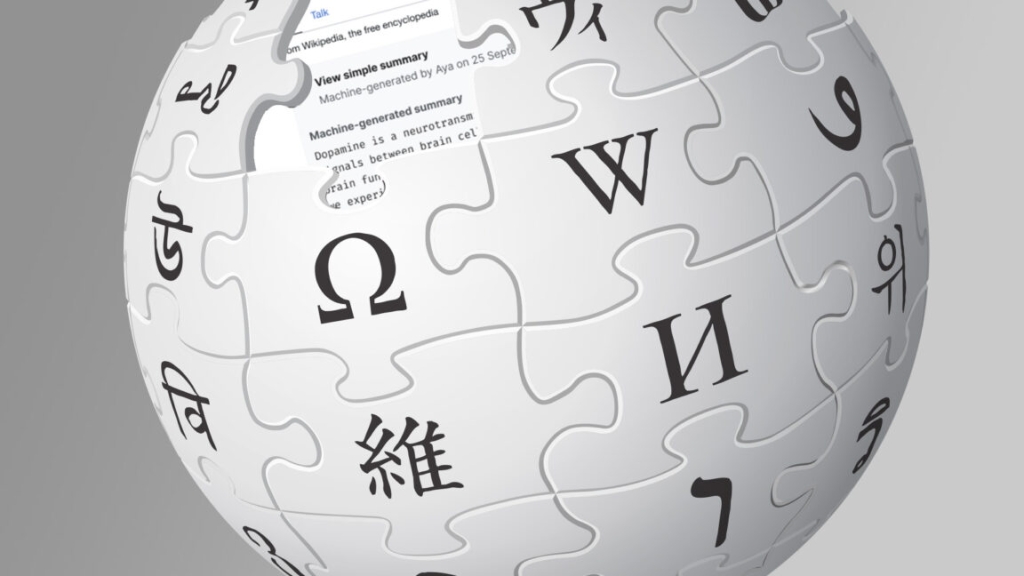
The foundation’s own experiments with AI have revealed the depth of community resistance to automated solutions. In June 2025, Wikipedia was forced to pause a pilot program for AI-generated article summaries after editors revolted, calling the feature a “ghastly idea” that could undermine trust in the platform. The incident highlighted a fundamental tension: Wikipedia’s strength lies in human curation and verification, yet it faces pressure to automate just to survive.
Jimmy Wales’ Delicate Balancing Act
Wikipedia founder Jimmy Wales finds himself navigating treacherous waters, trying to preserve the encyclopedia’s mission while acknowledging harsh economic realities. In interviews with The Associated Press, Wales struck a nuanced position that reflects the complexity of the situation.
“I’m very happy personally that AI models are training on Wikipedia data because it’s human curated,” Wales stated, emphasizing the critical distinction between Wikipedia and other data sources. “I wouldn’t really want to use an AI that’s trained only on X, you know, like a very angry AI.” His point is profound: Wikipedia’s human moderation and verification processes create a quality baseline that pure web scraping cannot match.
Yet Wales draws a clear line when it comes to free access. “You should probably chip in and pay for your fair share of the cost that you’re putting on us,” he told the AP, acknowledging that AI companies are essentially getting a free ride on infrastructure they’re straining to capacity. This isn’t about licensing Wikipedia’s content—which remains freely available under Creative Commons licenses—but about paying for the enterprise-grade API access that allows companies to systematically harvest data at scale.
The Billion-Dollar Question: Can Wikipedia Stay True to Its Mission?
The proposed deals raise fundamental questions about the future of open knowledge. Wikipedia’s mission has always been to provide free access to the sum of all human knowledge. Charging for API access doesn’t directly contradict this mission—the content remains freely available to human readers through web browsers. But it does create a two-tiered system where commercial entities pay for efficient access while individuals continue to browse for free.
Critics argue this could create dangerous precedents. If Wikipedia, the gold standard of free knowledge, starts charging for access, what stops other nonprofits and open-source projects from following suit? The fear is that we could see the gradual enclosure of the digital commons, where every valuable dataset comes with a price tag.
Supporters counter that Wikipedia faces an existential threat that requires radical solutions. The foundation can’t continue operating at a loss while AI companies profit from its content. They argue that these deals represent a pragmatic compromise: maintaining free access for individual users while ensuring the platform’s financial sustainability through commercial partnerships.
The Technical Reality: Enterprise APIs vs. Web Scraping
The distinction between free web access and paid API access is crucial but often misunderstood. When you visit Wikipedia through your browser, you’re accessing the public website, which will remain free. The API deals involve enterprise-grade access that allows companies to systematically download and process massive amounts of data efficiently.
This is about more than just convenience. Web scraping Wikipedia at scale is technically challenging and resource-intensive. Companies need sophisticated infrastructure to handle rate limiting, parse complex page structures, and manage the sheer volume of data. The API provides a streamlined, efficient alternative that reduces the load on Wikipedia’s servers while giving companies the structured data they need.
The $2.5 billion figure represents the cumulative value of these API deals over ten years, not a lump sum payment. It’s based on projected usage and pricing models that would charge companies based on the volume and type of data they access. This approach ensures that heavy users pay proportionally more, while smaller organizations and researchers could potentially access the API at reduced rates or even for free.
What This Means for the Future of AI and Knowledge
The Wikipedia-AI partnership saga reflects broader tensions in the tech industry as artificial intelligence matures from a research curiosity to a trillion-dollar industry. AI companies need high-quality training data, and Wikipedia represents one of the largest curated datasets available. But as these companies grow more powerful, they’re encountering resistance from the communities and organizations that created the very resources they depend on.
This conflict extends far beyond Wikipedia. News organizations are suing OpenAI for using their articles without compensation. Stock photo sites are demanding payment for images used in training. Artists and writers are organizing against what they see as the uncompensated appropriation of their work. Wikipedia’s situation is unique because it’s a nonprofit with a mission of free knowledge, but the underlying tension is the same: who owns the data that fuels the AI revolution?
The outcome of these negotiations could set precedents that shape how AI companies access and compensate for data for years to come. If Wikipedia succeeds in securing billions in API revenue while maintaining its commitment to free knowledge, it could provide a model for other organizations facing similar challenges. If it fails, it could signal that the current paradigm of free data for AI training is unsustainable.
The Human Cost: Volunteers and the Future of Editing
Perhaps the most poignant aspect of this crisis is its impact on Wikipedia’s volunteer community. The site survives because of hundreds of thousands of dedicated editors who contribute their time and expertise without compensation. These volunteers are now grappling with the knowledge that their work is being monetized by some of the world’s most valuable companies, while the platform they love struggles to stay afloat.
The foundation has tried to involve the community in these decisions, but the technical and financial complexities make it difficult for volunteers to fully grasp the implications. Many editors worry that commercialization, even in the form of API fees, could compromise Wikipedia’s neutrality and independence. Others recognize the practical necessity but fear the slippery slope toward more aggressive monetization.
The June 2025 revolt over AI-generated summaries revealed deep-seated anxieties about automation replacing human judgment. Wikipedia’s strength lies in its human-curated content, verified by volunteer editors who care deeply about accuracy and neutrality. Any move toward automation, even if driven by financial necessity, risks alienating the very community that makes Wikipedia possible.
Looking Ahead: A New Era for Free Knowledge
As negotiations continue and the foundation prepares to announce its first major API deals, the tech world watches with bated breath. The outcome will likely influence how other organizations balance open access with financial sustainability in the AI era.
For Wikipedia, the stakes couldn’t be higher. The platform has survived for 24 years on donations, grants, and the passion of its volunteer community. But the AI revolution has created pressures that donations alone cannot address. The foundation must find a way to secure its future without betraying its mission—a challenge that would test even the most skilled negotiators.
The irony is rich: Wikipedia, created to democratize access to knowledge, now finds itself in the position of potentially charging the world’s most powerful AI companies billions for access to that same knowledge. Yet this may be the only way to ensure that knowledge remains free for the humans who need it most.
As Jimmy Wales navigates this complex landscape, he carries the weight of a quarter-century of idealism and the practical realities of running a massive digital infrastructure. His vision of human-curated AI training data represents a middle path between the chaos of the open web and the walled gardens of proprietary knowledge bases.
The next few months will reveal whether this vision can become reality, or whether the cost of free knowledge has finally become too high to bear. One thing is certain: the outcome will shape not just Wikipedia’s future, but the future of how we create, share, and consume knowledge in the age of artificial intelligence.
Tags
Wikipedia AI deals, Wikimedia Foundation, AI training data, API monetization, free knowledge crisis, bot traffic Wikipedia, Jimmy Wales interview, enterprise API access, AI scraping costs, digital commons enclosure, volunteer editor revolt, knowledge economy, artificial intelligence training, open data monetization, infrastructure costs AI, content licensing AI, human-curated data, tech industry negotiations, nonprofit sustainability, information access future
Viral Sentences
Wikipedia is about to make AI companies pay billions for the knowledge they’ve been stealing for free.
The internet’s library is charging admission, and Google, OpenAI, and Apple are the first customers.
Wikipedia’s servers are drowning in bot traffic while human readers disappear into AI summaries.
Jimmy Wales says he welcomes AI training on Wikipedia, but you better pay your fair share.
The feedback loop that sustained free knowledge for 24 years is breaking under AI pressure.
Wikipedia editors called AI summaries a “ghastly idea” and forced the foundation to hit pause.
AI companies built billion-dollar businesses on Wikipedia’s free content—now the bill is due.
The line between free access and paid API access could reshape the entire digital commons.
Wikipedia’s human-curated data is too valuable to give away, but charging feels like betrayal.
The nonprofit that democratized knowledge now faces the ultimate test: can it survive its own success?
When AI answers your questions using Wikipedia, are you still visiting the site that made it possible?
The cost of keeping knowledge free might be charging the richest companies on Earth.
Wikipedia’s infrastructure crisis reveals the hidden costs of the AI revolution.
Volunteer editors are watching their life’s work monetize AI while the platform struggles to survive.
The $2.5 billion question: can Wikipedia stay true to its mission while charging for API access?
AI scraping has pushed Wikipedia to the brink—now it’s negotiating from a position of strength.
The digital commons is under siege, and Wikipedia’s API fees could be the first breach.
Human-curated data versus AI-generated everything: the battle for the soul of the internet.
Wikipedia’s dilemma reflects a larger truth: free content has a price, and AI companies are finally paying.
The encyclopedia that changed the world now must change itself to survive the AI age.
,


Leave a Reply
Want to join the discussion?Feel free to contribute!