
NASA Begins Practice Countdown For First Human Moon Mission Since 1972 : ScienceAlert
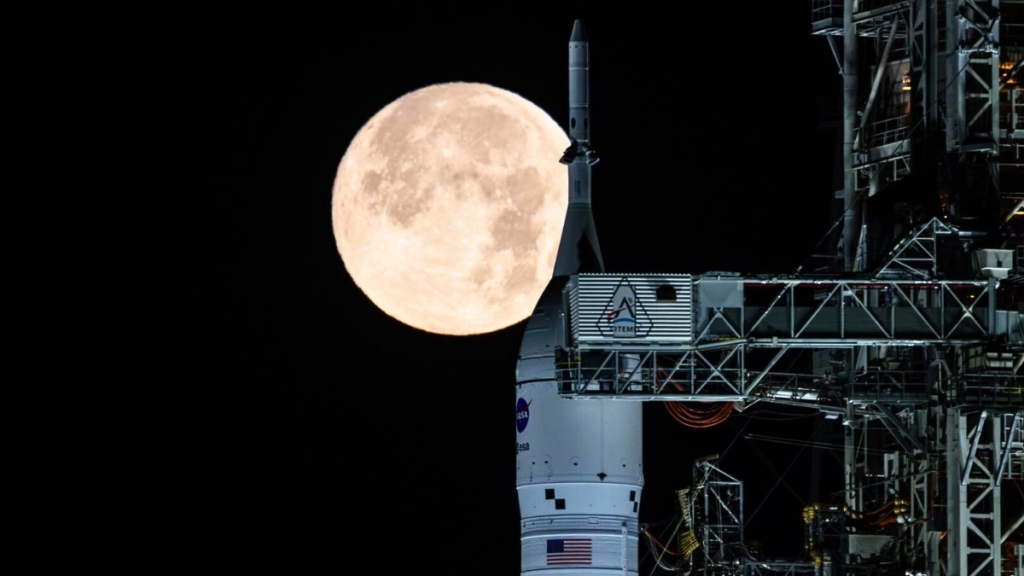
NASA Prepares for Historic Lunar Mission as Artemis Astronauts Gear Up for Moon Flyby
CAPE CANAVERAL, Fla. — In a momentous step toward humanity’s return to the lunar surface, NASA has commenced a critical two-day practice countdown as the agency prepares to fuel its massive Space Launch System (SLS) rocket. This crucial test will determine whether four astronauts can soon embark on a historic lunar flyby mission, marking the first human journey to the moon since the final Apollo mission in 1972.
The Artemis program, NASA’s ambitious plan to return humans to the moon and eventually establish a sustainable presence there, has reached a pivotal moment. Commander Reid Wiseman and his crew, already in strict quarantine to prevent any potential contamination, stand ready to make history as the first people to venture beyond low Earth orbit in over five decades.
“We’re not just going back to the moon; we’re going there to stay,” said NASA Administrator Bill Nelson during a recent press conference. “This mission represents the culmination of years of hard work, innovation, and unwavering dedication from thousands of individuals across NASA and our partner organizations.”
The 322-foot (98-meter) SLS rocket, a marvel of modern engineering, was moved to Launch Pad 39B at Kennedy Space Center two weeks ago. If Monday’s fueling test proceeds without complications, NASA could attempt launch as early as next week, setting the stage for a mission that will captivate the world.
During the test, teams will fill the rocket’s tanks with over 700,000 gallons of super-cold liquid hydrogen and oxygen propellants. The process will stop just half a minute short of when the engines would ignite, allowing engineers to assess the rocket’s performance under simulated launch conditions.
A 24/7 live stream of the rocket at the pad continues to draw millions of viewers worldwide, testament to the global interest in this historic endeavor. The stream captures every detail of the rocket’s preparation, from the intricate fueling procedures to the final checks before launch.
Originally scheduled for an earlier date, the fueling demonstration and subsequent launch were delayed by two days due to a bitter cold spell that swept through Florida. February 8 now stands as the earliest possible launch date, with teams working tirelessly to ensure all systems are ready for the mission.
NASA officials have assured the public that measures are in place to protect the Orion capsule and its sensitive instruments from the cold. Heaters are keeping the capsule warm atop the rocket, while rocket-purging systems have been adapted to function in the chilly conditions.
The mission itself promises to be nothing short of extraordinary. Riding in the Orion capsule atop the SLS rocket, the US and Canadian astronauts will hurtle around the moon, venturing farther from Earth than any human has gone before. The journey will take them on a figure-eight trajectory around the lunar body, allowing for unprecedented views of both the near and far sides of the moon.
“This mission is about more than just circling the moon,” explained Dr. Sarah Johnson, lead scientist for the Artemis program. “We’ll be conducting critical experiments, testing new technologies, and gathering data that will inform future missions, including our planned lunar landing later this decade.”
The 10-day mission will see the crew traveling approximately 230,000 miles from Earth at its farthest point. During their journey, they’ll deploy several small satellites, known as CubeSats, which will conduct independent scientific investigations ranging from studying the moon’s surface to testing new propulsion technologies.
NASA’s Apollo program sent 24 astronauts to the moon between 1968 and 1972, with 12 of them walking on its surface. The Artemis program aims to build on this legacy, with plans to land the first woman and the first person of color on the moon by 2025.
However, the path to this historic launch is not without its challenges. NASA has only a handful of days each month when conditions are optimal for a lunar mission. Complicating matters further is the need to launch a fresh crew to the International Space Station (ISS) as soon as possible.
The ISS mission was accelerated due to the early return of the previous crew for medical reasons, creating a delicate scheduling dance between the two high-profile missions. If the Artemis launch can proceed by February 11, the last possible date for this launch window, it will take priority over the ISS mission.
“It’s a testament to the skill and dedication of our teams that we’re able to manage these complex operations simultaneously,” said Kathy Lueders, associate administrator for NASA’s Space Operations Mission Directorate. “The fact that both crews are in quarantine adds an extra layer of complexity, but also a sense of shared purpose.”
Jack Hathaway, an astronaut slated for the next ISS crew, expressed his excitement about the concurrent missions. “It couldn’t be cooler that they’re in quarantine and we’re in quarantine, and we’re trying to launch two rockets roughly around the same time,” he said. “It’s a pretty exciting time to be part of NASA.”
As the world watches with bated breath, NASA stands on the cusp of a new era in space exploration. The success of this mission will pave the way for future lunar landings, the establishment of a lunar gateway station, and ultimately, human missions to Mars.
The eyes of the world will be on Cape Canaveral as NASA prepares to once again push the boundaries of human exploration. With the Artemis program, we’re not just returning to the moon; we’re taking the first steps toward becoming a truly spacefaring civilization.
Tags: NASA, Artemis, Moon mission, Space Launch System, SLS, Orion capsule, lunar flyby, space exploration, Kennedy Space Center, astronauts, Reid Wiseman, lunar landing, Apollo program, International Space Station, ISS, Mars missions, space technology, rocket launch, space quarantine, CubeSats, lunar gateway
Viral Phrases: “Humanity’s return to the moon,” “Historic lunar flyby,” “First woman and person of color on the moon,” “Pushing the boundaries of space exploration,” “A new era in space travel,” “The moon mission that will captivate the world,” “NASA’s giant leap forward,” “The rocket that will take us back to the moon,” “Quarantine for space: The ultimate isolation,” “From the moon to Mars: NASA’s ambitious plans”
,


Leave a Reply
Want to join the discussion?Feel free to contribute!