
What Memento reveals about human nature, 25 years later
Christopher Nolan’s Memento at 25: The Cerebral Thriller That Rewrote Hollywood’s Rules
Twenty-five years ago, a modestly budgeted neo-noir thriller premiered in the United States and quietly detonated a seismic shift in modern cinema. Memento, directed by Christopher Nolan, wasn’t just another indie darling—it was a masterclass in narrative innovation, psychological depth, and stylistic audacity that announced the arrival of a filmmaker who would go on to redefine blockbuster filmmaking.
Shot on a lean $4.5 million budget, Memento grossed over $39 million worldwide, a remarkable return that belied its unconventional structure. But more than its financial success, the film earned a permanent place in the pantheon of essential cinema, influencing a generation of filmmakers and forever altering how audiences engage with storytelling.
The Genesis of a Mind-Bending Masterpiece
The story behind Memento is almost as labyrinthine as the film itself. During a cross-country road trip, Jonathan Nolan pitched his brother Christopher an idea: a man with anterograde amnesia—unable to form new memories—hunting for his wife’s killer. The premise was deceptively simple, yet brimming with narrative potential.
Months later, Jonathan sent Christopher a draft that would eventually evolve into the short story “Memento Mori.” Christopher saw something extraordinary in the concept: an opportunity to invert traditional narrative form. Inspired by Jorge Luis Borges’ “Funes the Memorious”—a tale about a man cursed with perfect memory—Nolan envisioned telling Leonard Shelby’s story backward, plunging the audience into the same disorienting fog as the protagonist.
This wasn’t gimmickry; it was structural empathy. By denying viewers the luxury of chronological context, Nolan forced them to experience Leonard’s confusion, paranoia, and desperate attempts to impose order on chaos. Every scene became a puzzle piece that only made sense when viewed from the opposite direction.
Casting Against Convention
Brad Pitt was Nolan’s initial choice for Leonard Shelby, but when Pitt passed, the director made a bold decision: skip the A-list entirely. Instead, he cast Guy Pearce, whose previous roles in The Adventures of Priscilla, Queen of the Desert and L.A. Confidential showcased his versatility but hadn’t yet cemented him as a leading man.
Carrie-Anne Moss, fresh from her iconic turn as Trinity in The Matrix, was cast as Natalie—a role that subverted expectations by presenting her as morally ambiguous rather than heroic. It was Moss who recommended her Matrix co-star Joe Pantoliano for Teddy, the film’s slippery antagonist/frenemy whose true nature remains deliciously ambiguous until the final revelation.
This ensemble wasn’t assembled for star power but for chemistry and the ability to inhabit morally gray characters. Each actor understood that in Memento‘s world, everyone is simultaneously victim and perpetrator, trustworthy and treacherous.
The Architecture of Memory and Deception
Memento operates on multiple levels simultaneously. On the surface, it’s a revenge thriller about a man seeking justice for his wife’s murder. But peel back the layers, and it becomes a meditation on the unreliability of memory, the construction of identity, and the stories we tell ourselves to survive.
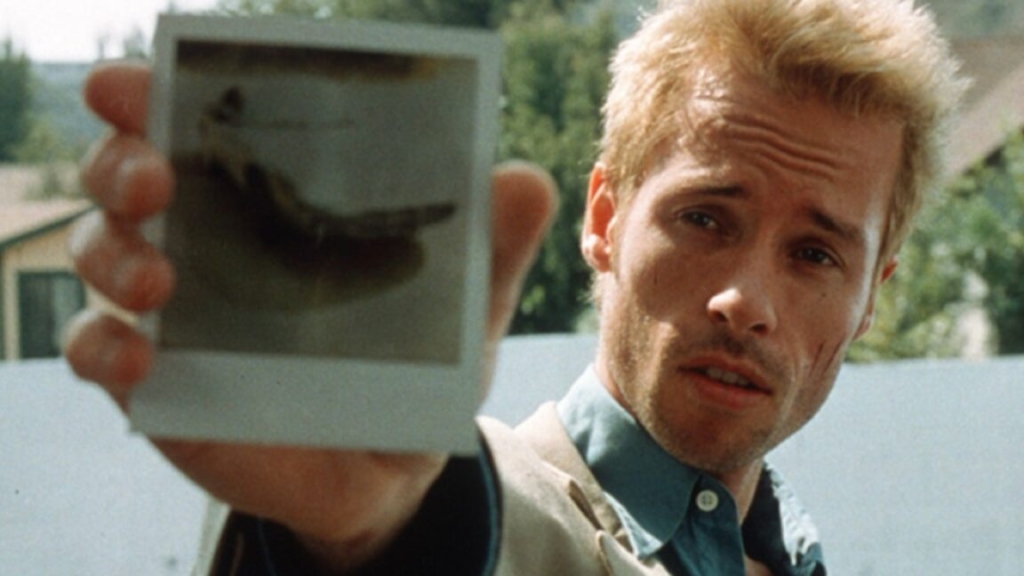
Leonard Shelby’s condition—anterograde amnesia—isn’t just a plot device; it’s the film’s philosophical engine. His polaroids, handwritten notes, and elaborate tattoo system represent humanity’s desperate attempts to create permanence in an impermanent world. Yet the film’s greatest twist reveals that these “facts” are as malleable as memory itself. Teddy’s final revelation—that Leonard has likely already killed his wife’s “killer” and is now perpetuating his own cycle of vengeance—transforms the narrative from a quest for justice into a study of self-deception.
The backward structure serves this theme perfectly. Just as Leonard cannot remember what came before, the audience cannot see what comes after. Every scene answers a question the previous scene posed, but raises new questions about what preceded it. It’s a Mobius strip of narrative, where beginning and end become meaningless concepts.
Technical Brilliance and Stylistic Innovation
Nolan’s direction in Memento demonstrates the confidence of a filmmaker who knows exactly what he’s doing, even if the audience doesn’t—at least not yet. The black-and-white sequences, which run forward in time, provide the only moments of narrative stability, yet they’re deliberately less visually dynamic than the color sequences. This contrast mirrors Leonard’s mental state: the mundane reality of his condition versus the vivid, chaotic world of his investigation.
The film’s editing, by Dody Dorn, is nothing short of surgical. Each cut serves the dual purpose of advancing the plot while deepening the mystery. The transitions between color and black-and-white sequences are timed with mathematical precision, creating a rhythm that becomes almost hypnotic.
Even the film’s aspect ratio and color grading contribute to its disorienting effect. The desaturated palette of the color sequences creates a sense of unreality, while the warmer tones of the black-and-white scenes paradoxically feel more “real”—even though they represent Leonard’s most constructed narrative.
Cultural Impact and Legacy
In the years since its release, Memento has become more than a film—it’s a cultural touchstone, a reference point for discussions about narrative structure, memory, and the nature of truth. It’s been studied in film schools, analyzed in academic papers, and referenced in everything from Breaking Bad to Inside Out.
The film’s influence extends beyond cinema. Its exploration of memory and identity has resonated with neuroscientists, psychologists, and philosophers. The concept of “Memento syndrome” has entered popular discourse as a metaphor for our collective struggle with information overload and the fragility of digital memory in the age of social media.
Perhaps most significantly, Memento established Christopher Nolan as a director who could deliver both intellectual rigor and mainstream entertainment—a rare combination that would define his subsequent career. From Inception to Interstellar to Oppenheimer, Nolan has continued to explore themes of time, memory, and perception, but Memento remains his most purely experimental work, the film where he took the biggest risks and reaped the greatest rewards.
The 25th Anniversary: Why Memento Still Matters
As Memento celebrates its 25th anniversary, its relevance has only grown. In an era of “alternative facts,” deepfakes, and curated social media identities, the film’s central question—how do we know what’s true?—feels more urgent than ever.
The film also serves as a reminder of what independent cinema can achieve. Made for less than the cost of a single superhero movie’s marketing campaign, Memento proved that originality, intelligence, and bold storytelling could compete with formulaic blockbusters. It’s a testament to the power of ideas over budget, of vision over convention.
For audiences watching Memento for the first time in 2026, the experience remains as disorienting and exhilarating as it was in 2001. The film doesn’t just hold up—it has matured like a fine wine, its complexities revealing themselves more fully with each viewing. It’s a film that demands to be discussed, debated, and deconstructed, a puzzle box that never quite reveals all its secrets.
Conclusion: The Gift That Keeps on Giving
Memento is more than a film; it’s an experience, a challenge, a mirror held up to our own unreliable memories and self-deceptions. It’s the movie that made Christopher Nolan the filmmaker he is today, and its influence can be traced through every subsequent work in his filmography.
As we celebrate its 25th anniversary, Memento stands as proof that the most powerful stories are often the ones that don’t hold our hands, that trust the audience to do some of the heavy lifting. It’s a film that respects its viewers’ intelligence, that rewards attention and analysis, and that continues to reveal new layers with each viewing.
In the words of Teddy, “You don’t want the truth. You make up your own truth.” Memento forces us to confront that uncomfortable reality—and in doing so, becomes a film that is, paradoxically, unforgettable.
Tags & Viral Phrases:
Christopher Nolan Memento 25th anniversary, backward narrative structure, anterograde amnesia thriller, Guy Pearce Leonard Shelby, Carrie-Anne Moss Natalie, Joe Pantoliano Teddy, Jonathan Nolan Memento Mori, Borges Funes the Memorious inspiration, indie film masterpiece, $4.5 million budget box office hit, memory deception identity, polaroid tattoo investigation, psychological neo-noir, narrative innovation cinema, unreliable narrator thriller, Christopher Nolan breakthrough film, mind-bending storytelling, revenge justice cycle, Dody Dorn editing masterpiece, black and white color contrast, cultural impact legacy, alternative facts deepfakes relevance, independent cinema success story, puzzle box narrative, self-deception survival mechanism, Christopher Nolan filmography origin, Oscar nominated screenplay, film school essential viewing, memory construction identity, truth versus perception, 2001 cinema landmark, Christopher Nolan Oppenheimer connection, narrative structure influence, psychological thriller classic, memory loss investigation, moral ambiguity characters, experimental mainstream cinema, film editing precision, aspect ratio storytelling, desaturated color grading, narrative Mobius strip, beginning end meaningless, neuroscience psychology philosophy, social media curated identity, information overload digital memory, blockbuster originality intelligence, vision convention filmmaking, unforgettable cinematic experience, audience intelligence respect, layered meanings revelations, truth make your own truth, Christopher Nolan directorial evolution, film analysis discussion, narrative deconstruction, cinema landmark anniversary, influential independent film, storytelling puzzle box, unreliable memories self-deception, Christopher Nolan visionary director, Memento cinematic legacy
,

Leave a Reply
Want to join the discussion?Feel free to contribute!