
Artemis II live updates as crew splashes down near San Diego after historic moon mission
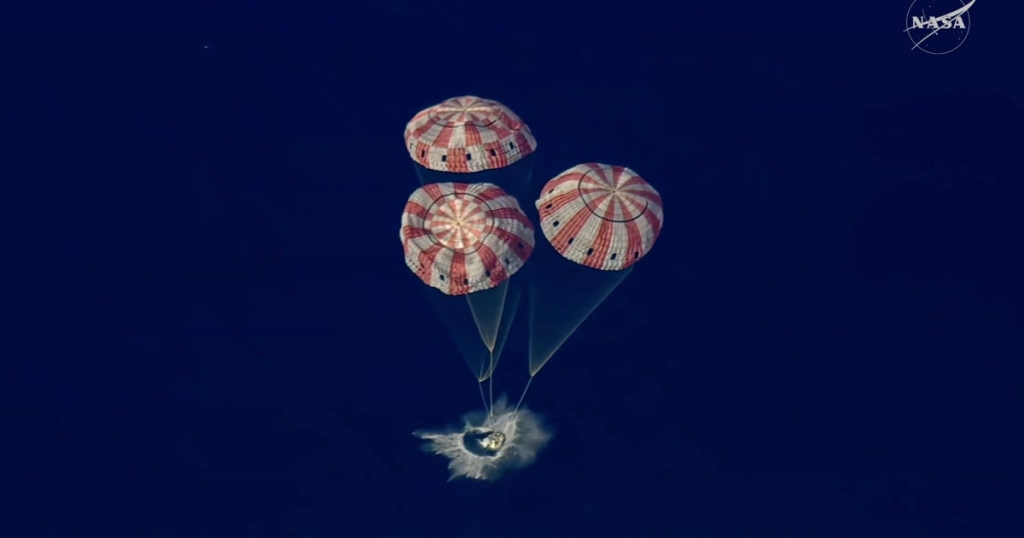
Orion’s Fiery Return: NASA’s Artemis I Capsule Set for High-Stakes Pacific Splashdown
After a historic 25-day mission that pushed the boundaries of human spaceflight, NASA’s Orion spacecraft is preparing for a dramatic homecoming. The uncrewed capsule, which has been hurtling through deep space since its November 16 launch atop the Space Launch System (SLS) rocket, is now on a collision course with Earth’s atmosphere — and the reentry promises to be nothing short of spectacular.
The Countdown to Reentry
According to NASA’s meticulously planned timeline, the Orion capsule will begin its descent back to Earth at precisely 7:53 p.m. ET. This marks the start of a high-stakes sequence that will test the limits of the spacecraft’s heat shield and engineering prowess. Just 24 seconds after reentry begins, and approximately 1,950 miles from its intended splashdown point, the capsule will encounter temperatures so extreme that they will generate a sheath of electrically charged plasma around it. This plasma, while a testament to the intense friction of atmospheric reentry, will temporarily sever all communications between Orion and mission control — a nail-biting moment for engineers and space enthusiasts alike.
A Blaze of Glory
As the capsule plunges deeper into Earth’s atmosphere, the heat shield will bear the brunt of the inferno. At the one-minute-and-22-second mark, temperatures will peak at a staggering 5,000 degrees Fahrenheit — a blistering heat that is half as hot as the visible surface of the sun. This is the moment when the heat shield, a marvel of modern engineering, will prove its worth, protecting the spacecraft and its future human occupants from being incinerated.
The communications blackout, caused by the plasma sheath, is expected to last approximately six minutes. For those following the mission, this will be a tense period of radio silence. But once the plasma dissipates, Orion will emerge from the fiery embrace of reentry, now traveling at a still-blistering 9,000 mph, less than 200 miles from its target splashdown point.
Parachutes and Precision
As the spacecraft continues its descent, it will pass through an altitude of 100,000 feet eight minutes after entry. Just one minute later, it will drop below the speed of sound, marking a critical transition in its journey. At an altitude of 50,000 feet and traveling at around 300 mph, the capsule will deploy 11 parachutes in a carefully choreographed sequence. These parachutes will slow and stabilize the spacecraft, preparing it for the final phase of its descent.
The grand finale comes when three pilot chutes deploy, pulling out Orion’s three massive 116-foot-wide main parachutes. These parachutes will begin inflating at an altitude of about 6,000 feet, gradually reducing the capsule’s speed to a gentle 17 mph. This controlled descent will culminate in a splashdown in the Pacific Ocean, where recovery teams will be waiting to retrieve the spacecraft and analyze its performance.
A Milestone for Artemis
This mission, known as Artemis I, is a crucial step in NASA’s broader Artemis program, which aims to return humans to the Moon and eventually send astronauts to Mars. While this particular flight is uncrewed, it serves as a proving ground for the technologies and systems that will support future crewed missions. The successful reentry and splashdown of Orion will not only validate years of engineering and testing but also pave the way for Artemis II, which will carry astronauts around the Moon, and Artemis III, which aims to land the first woman and the next man on the lunar surface.
The World Watches
As the world watches with bated breath, the Orion spacecraft’s return to Earth is more than just a technical achievement — it is a symbol of humanity’s unyielding drive to explore the cosmos. From the searing heat of reentry to the serene splashdown in the Pacific, every moment of this mission is a testament to the ingenuity, courage, and ambition that define space exploration.
So, set your clocks for 7:53 p.m. ET, and prepare to witness history in the making. The Orion spacecraft is coming home, and its journey is a reminder that the stars are within our reach.
Tags & Viral Phrases:
Orion spacecraft, Artemis I, NASA, Space Launch System, reentry, heat shield, plasma, splashdown, Pacific Ocean, 5,000 degrees Fahrenheit, parachutes, Artemis program, lunar exploration, Mars missions, space exploration, human spaceflight, uncrewed mission, engineering marvel, cosmic journey, mission control, deep space, NASA timeline, 7:53 p.m. ET, 25-day mission, Space Launch System rocket, electrically charged plasma, communications blackout, 9,000 mph, 17 mph splashdown, 116-foot-wide parachutes, recovery teams, future of space travel, humanity’s drive to explore, cosmic frontier, groundbreaking mission, technological achievement, space innovation, interstellar ambition, NASA’s next giant leap, Orion’s fiery return, the stars are within our reach.
,


Leave a Reply
Want to join the discussion?Feel free to contribute!