
How Russia’s SU-34 Flies So Far Without Refueling
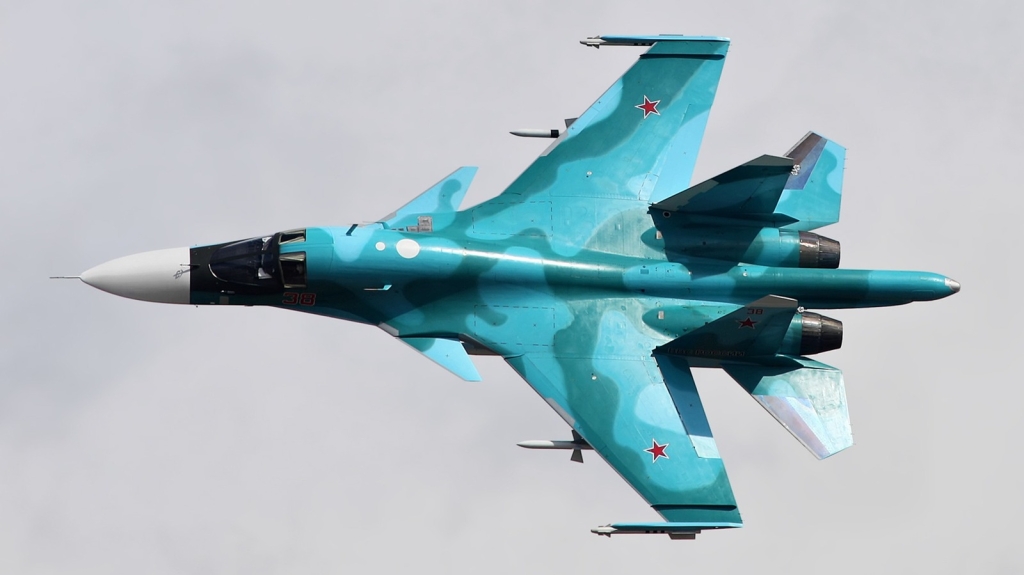
The Su-34 Fullback: Russia’s Intercontinental Bomber That Could Fly From Moscow to Washington Without Refueling
In the annals of military aviation, few aircraft have captured the imagination quite like Russia’s Sukhoi Su-34 Fullback. This formidable warplane, which has been making headlines during Russia’s ongoing conflict in Ukraine, possesses a capability that would have seemed like science fiction during World War II: the ability to fly from Moscow to Washington, D.C. without a single refueling stop.
A Journey of Nearly 5,000 Miles
The Su-34’s intercontinental reach is nothing short of remarkable. With a maximum ferry range that can exceed 4,971 miles when equipped with external fuel tanks, this Russian bomber can theoretically strike targets on the other side of the world. To put this in perspective, that’s roughly the distance from Moscow to Washington, D.C.—a journey of over 4,867 miles that would take most commercial airliners around 10 hours to complete.
During World War II, Adolf Hitler famously dreamed of bombing the United States, but the technology of the time simply couldn’t deliver. Today, that dream has become a reality for Russia’s air force, though thankfully such capabilities remain theoretical rather than practical in today’s geopolitical landscape.
The Engineering Marvel Behind the Range
What makes the Su-34 so special? The answer lies in its massive size and ingenious fuel capacity. This is no ordinary fighter jet—measuring an impressive 76.5 feet in length with a 48-foot wingspan, the Su-34 is built like a flying fuel tank.
Under normal operations, the Su-34 already boasts impressive range capabilities. But when Russia needs to push the envelope, the aircraft can be outfitted with three PTB-3000 external fuel tanks mounted on its hard points. These aren’t your average drop tanks—each one holds a staggering 793 gallons of fuel, adding to the bomber’s already substantial internal fuel capacity.
With this configuration, the Su-34 transforms from a long-range fighter into a true intercontinental strategic platform. The math is simple but impressive: internal fuel capacity plus three massive external tanks equals a range that can touch nearly every corner of the globe.
Not Just About Range
While its intercontinental capabilities make headlines, the Su-34 is far more than just a long-distance flyer. This 4.5-generation fighter (sometimes called a 4++ generation aircraft) has proven its worth repeatedly in combat situations. Its robust design allows it to operate from rough airstrips, and its advanced avionics and weapons systems make it a formidable opponent in any theater of operations.
The aircraft’s versatility is evident in its design. Unlike many modern fighters that prioritize speed and maneuverability above all else, the Su-34 was built with a specific mission in mind: to deliver precision strikes at extreme distances. Its large size accommodates a spacious cockpit for two crew members, advanced navigation systems, and the ability to carry a wide variety of weapons—from precision-guided munitions to long-range cruise missiles.
How Does It Compare to American Fighters?
When placed alongside American aircraft, the Su-34’s capabilities become even more impressive. The United States’ longest-range fighter, the F-35C Lightning II, has an internal fuel capacity of 3,002 gallons and a range of 1,381 miles. While the F-35 can extend its range through aerial refueling—a capability the Su-34 doesn’t require—the Russian aircraft’s unrefueled range remains unmatched.
It’s worth noting that the F-35 program is evolving. The upcoming Block 4 upgrade, expected to be completed by 2031, will introduce external fuel tanks for the F-35. However, even with these additions, it’s unlikely the Lightning II will match the Su-34’s unrefueled intercontinental range.
The Future Looks Even Brighter
The Su-34’s story is far from over. Russia has plans to further enhance this already impressive aircraft. The most significant upcoming upgrade involves the AL-51F engine, currently being developed for the Su-57 5th-generation fighter. This new powerplant promises improved fuel efficiency, which could extend the Su-34’s already impressive range even further.
This engine swap represents more than just a simple upgrade—it’s a strategic decision that ensures the Su-34 remains relevant well into the future. By incorporating technology from Russia’s most advanced fighter program, Moscow is effectively creating a bridge between 4.5-generation and 5th-generation capabilities.
A Proven Combat Record
Since entering Russian service in 1990, the Su-34 has seen extensive combat action. Its most prominent deployment has been in Syria, where it conducted thousands of combat missions against various opposition groups. More recently, it has been used extensively in the Russo-Ukrainian War, though several aircraft have been lost in the conflict.
Current estimates suggest that Russia’s air force operates around 123 Su-34s, though this number fluctuates as new aircraft are produced and others are lost in combat. Production continues at a steady pace, indicating that Russia views this platform as a cornerstone of its strategic air capabilities for the foreseeable future.
Strategic Implications
The Su-34’s intercontinental range has significant strategic implications. While it’s highly unlikely that Russia would ever use these aircraft to strike Washington, D.C. (such an action would constitute an act of war with catastrophic consequences), the mere capability serves as a powerful deterrent and projection of military might.
In practical terms, this range allows Russia to conduct long-range patrols, respond to crises across its vast territory, and maintain a credible threat posture without relying on forward bases or aerial refueling infrastructure. This independence from support assets makes the Su-34 particularly valuable in scenarios where Russia’s access to overseas bases or tanker aircraft might be limited.
The Numbers Game
Let’s break down the Su-34’s impressive specifications:
- Length: 76.5 feet
- Wingspan: 48 feet
- Internal fuel capacity: Substantial (exact figures classified)
- External fuel tanks: Three PTB-3000 tanks, 793 gallons each
- Maximum ferry range: 4,971+ miles
- Crew: Two (pilot and weapons systems operator)
- Service ceiling: Over 50,000 feet
- Maximum speed: Mach 1.8
These numbers represent the culmination of decades of Russian aerospace engineering, combining lessons learned from previous generations of aircraft with cutting-edge technology.
A Testament to Russian Engineering
The Su-34 Fullback stands as a testament to Russian engineering prowess and strategic thinking. In an era where many air forces are moving toward smaller, more agile fighters, Russia has doubled down on range and payload capacity. This approach reflects both the vast geography of the country it defends and the strategic doctrine that guides its military planning.
As geopolitical tensions continue to evolve and the nature of warfare changes, the Su-34’s unique capabilities ensure it will remain a key player in Russia’s military arsenal for years to come. Whether serving as a long-range strike platform, a strategic deterrent, or a symbol of Russian aerospace achievement, this remarkable aircraft has earned its place in aviation history.
Tags: Su-34, Russian bomber, intercontinental range, military aviation, Sukhoi, strategic bomber, Russo-Ukrainian War, Moscow to Washington, long-range fighter, Russian Air Force, military technology, aerial warfare, Cold War 2.0, military capabilities, aviation engineering
Viral phrases: “Moscow to Washington without refueling,” “Russia’s secret weapon,” “The bomber that changed everything,” “How far can it really fly?,” “The numbers that will shock you,” “Why America should be concerned,” “The aircraft that Hitler only dreamed about,” “Russia’s flying fuel tank,” “The future of strategic bombing,” “What makes this bomber unstoppable”
Viral sentences: “This Russian bomber can fly from Moscow to Washington without stopping for fuel—here’s how,” “The Su-34’s range is so impressive it puts American fighters to shame,” “Russia’s secret to intercontinental strikes isn’t what you think,” “Why the Su-34 might be the most important aircraft you’ve never heard of,” “The engineering marvel that gives Russia a strategic edge,” “How one aircraft could change the balance of global power,” “The numbers behind Russia’s most impressive military achievement,” “What happens when a fighter jet becomes a strategic bomber,” “The upgrade that will make the Su-34 even more dangerous,” “Why this Russian aircraft keeps American military planners up at night”
,


Leave a Reply
Want to join the discussion?Feel free to contribute!