
Bigger checks, fewer bets: Seattle startup deal count drops to lowest level since 2020
Venture Capital in Seattle: A Tale of Concentration and Opportunity in Q1 2026
The Seattle startup ecosystem has entered a fascinating new chapter in 2026, one characterized by both challenge and opportunity. As the first quarter numbers roll in, a complex picture emerges of an innovation hub adapting to the realities of venture capital’s new normal—where fewer deals command more capital, and the race for artificial intelligence supremacy is reshaping the competitive landscape.
The Numbers Tell a Compelling Story
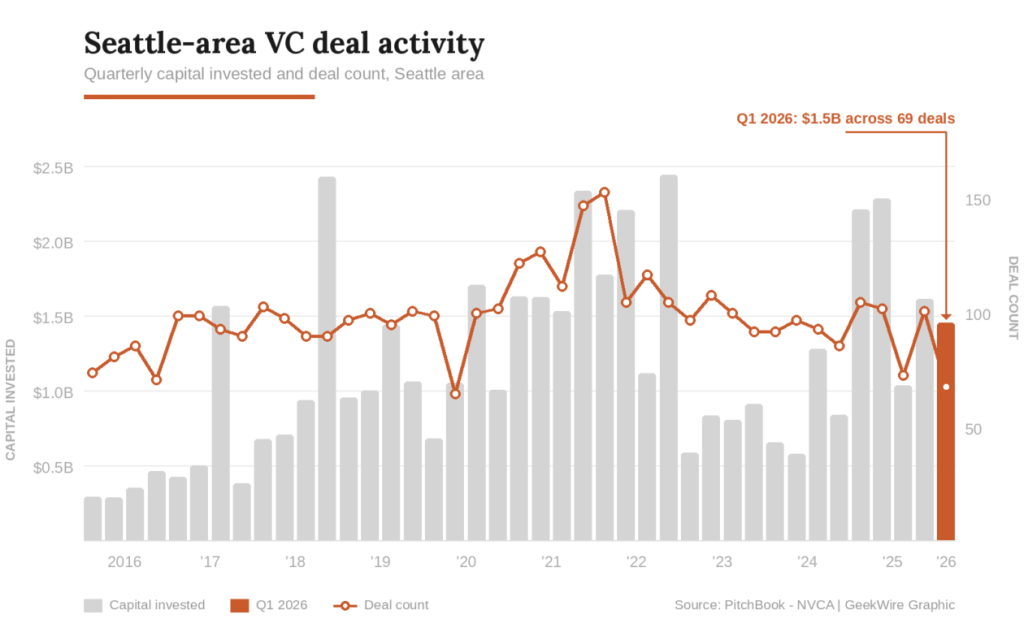
Seattle-area startups secured approximately $1.5 billion in venture funding across 69 deals during the first quarter of 2026, according to the highly anticipated PitchBook-NVCA Venture Monitor. While this figure might appear robust at first glance, the underlying trends reveal a market in transition.
The deal count of 69 represents the lowest quarterly figure since mid-2020, marking a significant departure from the region’s historical patterns. For context, Seattle logged 152 deals in a single quarter at its 2022 peak—more than double today’s figure. This contraction reflects a broader national trend where venture capital is increasingly concentrating into fewer, larger rounds.
The New Math of Venture Capital
The shift toward larger, more concentrated funding rounds isn’t merely a Seattle phenomenon—it’s a fundamental restructuring of how venture capital operates in the AI era. Across the United States, startups raised an astounding $267 billion in Q1 2026, more than doubling the previous record. However, this headline-grabbing figure masks an even more striking reality: just five deals, including rounds by OpenAI, Anthropic, and xAI, accounted for nearly three-quarters of that total.
“VC has entered the era of consensus deals, and that dynamic will likely persist,” observe the authors of the PitchBook-NVCA report. “Across all stages and series, a small portion of companies is vastly outraising the rest.”
This concentration creates a paradox for the broader startup ecosystem. While aggregate funding numbers might look healthy, the reality is that many promising companies are finding it increasingly difficult to secure capital, even as a select few command unprecedented valuations and investment rounds.
Seattle’s Position in the National Landscape
In the first quarter rankings, the Seattle area secured the seventh position nationally by total capital raised and tenth by deal count. This performance represents a slight decline from the region’s historical standing, where it typically ranked between sixth and eighth on both measures from 2017 to 2020.
The competitive landscape is shifting. Austin has surpassed Seattle in deal value, while Miami has overtaken it in deal count. These changes reflect the dynamic nature of the venture capital ecosystem, where emerging hubs are attracting attention and capital traditionally directed toward established markets.
Space: Seattle’s Unexpected Bright Spot
Amid the broader contraction, one sector stands out as a beacon of growth: space technology. The Seattle suburbs south and east of the city have become an unexpected hub for space innovation, with several companies securing substantial funding rounds.
Stoke Space in Kent raised an impressive $350 million, while Starcloud in Redmond landed $170 million to build space-based data centers. Portal Space Systems in Bothell closed on more than $61 million, including a recently reported $50 million round from Starburst. Combined, these three companies represent $580 million in investment, creating a formidable cluster of space technology innovation in the region.
This concentration of space startups building rockets, orbital data centers, and spacecraft propulsion systems positions Seattle as a serious contender in the new space economy, complementing its traditional strengths in software and cloud computing.
AI and Infrastructure: The New Battleground
The artificial intelligence revolution continues to dominate venture capital allocation, with 88.8% of all U.S. venture deal value going to AI companies in Q1 2026. Seattle’s funding landscape reflects this national trend, with seven of the ten largest deals in the region carrying AI tags.
Notable AI-related funding included a $300 million Series D for Temporal, the Bellevue-based developer infrastructure startup that has positioned itself at the intersection of AI and software development tools. Seattle-based Overland AI secured $100 million to scale its autonomous military ground vehicles, demonstrating the defense sector’s growing appetite for AI capabilities.
Perhaps most intriguing is the $60 million seed funding for Entire, a developer platform launched by former GitHub CEO Thomas Dohmke. Based in the Seattle area, Entire represents the next generation of AI-powered development tools, building on the region’s deep expertise in software engineering and cloud infrastructure.
The Remote Work Reality Check
The venture capital landscape is also being reshaped by the remote work revolution. Xbow, an autonomous cybersecurity company founded by GitHub Copilot creator Oege de Moor, raised $120 million in a Series C round that valued it at more than $1 billion. While Xbow lists Seattle as its headquarters, the reality is more nuanced—its address is a mailbox at a Pioneer Square co-working space, and its roughly 200 employees are distributed globally.
This arrangement exemplifies the new normal for many technology companies, where “headquarters” designations don’t necessarily reflect meaningful local presence. It’s a reminder that in an increasingly distributed world, traditional metrics for measuring startup ecosystems may need reevaluation.
The Path Forward
The concentration of venture capital into fewer, larger deals presents both challenges and opportunities for the Seattle startup ecosystem. On one hand, the reduced deal count and increased competition for funding could make it harder for early-stage companies to secure capital. On the other hand, the massive investments flowing into AI and infrastructure create opportunities for companies that can position themselves at the intersection of these transformative technologies.
The space sector’s strength offers a template for how regional clusters can emerge around specific technological domains, potentially providing a path for other sectors to follow. As traditional software and cloud companies face increased competition for capital, the ability to innovate in emerging fields like space technology, AI infrastructure, and autonomous systems may become increasingly important.
Looking Ahead
As we move through 2026, several factors will shape Seattle’s venture capital landscape. The continued evolution of AI technology will likely drive further concentration of capital into companies that can demonstrate clear competitive advantages. The space sector’s momentum could accelerate, potentially establishing Seattle as a serious competitor to traditional space hubs. And the remote work revolution will continue to blur the lines between local and distributed companies, challenging conventional wisdom about what constitutes a regional startup ecosystem.
The $1.5 billion raised in Q1 2026 represents both a continuation of Seattle’s venture capital tradition and a departure from its historical patterns. How the region’s entrepreneurs, investors, and policymakers respond to these changes will determine whether Seattle can maintain its position as a leading innovation hub in an increasingly competitive and concentrated venture capital landscape.
Tags & Viral Phrases:
- AI dominance reshapes venture capital
- Seattle’s venture capital contraction continues
- Space startups ignite Seattle’s innovation scene
- The era of consensus deals arrives
- Remote work challenges traditional startup metrics
- Billion-dollar cybersecurity exits from Seattle
- AI infrastructure becomes new venture battleground
- Seattle vs Austin vs Miami: The venture capital race
- Space technology clusters emerge in Seattle suburbs
- Developer tools ride the AI wave
- Autonomous vehicles attract massive defense funding
- The paradox of healthy numbers, starving startups
- GitHub alumni launch next-generation AI platforms
- Venture capital concentration creates ecosystem risks
- Seattle’s space economy takes off
- AI companies command 88.8% of venture dollars
- The new math of startup funding
- Remote-first companies redefine “headquarters”
- Space-based data centers raise $170M
- Temporal’s $300M AI infrastructure bet
- Overland AI’s military autonomous vehicle push
- Entire platform launches with $60M seed
- Xbow cybersecurity reaches $1B+ valuation
- Seattle venture capital rankings slip
- Space startups secure $580M combined
- The future of distributed tech companies
- AI tags dominate Seattle’s largest deals
- Venture capital enters new era of concentration
,


Leave a Reply
Want to join the discussion?Feel free to contribute!