
OpenIndiana Is Porting Solaris’ IPS Package Management To Rust
OpenIndiana Embarks on Radical Rust-Powered Overhaul of IPS Package Manager
In a bold move that signals a dramatic pivot for the open-source operating system landscape, OpenIndiana—the torchbearer of the Illumos project and the spiritual successor to Sun Microsystems’ OpenSolaris—has unveiled ambitious plans to completely rebuild its core package management system using Rust. This initiative represents one of the most significant technological transformations in the project’s history, promising to deliver unprecedented performance gains, enhanced security guarantees, and a modernized architecture that could reshape how enterprise-grade Unix-like systems handle software deployment and system management.
The Image Packaging System (IPS), which has served as OpenIndiana’s package management foundation since its inception, is now slated for a comprehensive rewrite codenamed “pkg6.” The transformation, detailed during a compelling presentation at FOSDEM 2026 in Brussels by OpenIndiana maintainer Till Wegmüller, marks a decisive departure from the project’s traditional C and Python codebase toward a fully Rust-native implementation.
The Genesis of a Technological Revolution
The decision to migrate IPS to Rust didn’t emerge in isolation. It represents the culmination of years of engineering challenges, performance bottlenecks, and security concerns that have plagued traditional package management systems across the Unix ecosystem. OpenIndiana’s leadership recognized that maintaining competitive relevance in an increasingly Rust-dominated infrastructure landscape required fundamental architectural changes rather than incremental improvements.
“The existing C/Python implementation, while battle-tested, has reached the limits of its evolutionary potential,” Wegmüller explained during his presentation. “We’re not just rewriting code; we’re reimagining what a system package manager can be in the era of memory-safe systems programming.”
The migration timeline suggests aggressive development targets, with the team aiming to deliver a functional pkg6 prototype within the next 18 months, followed by a phased rollout across OpenIndiana’s distribution channels. This timeline reflects both the urgency of modernization and the confidence the team has in Rust’s capabilities to handle such a critical infrastructure component.
Why Rust? The Technical Imperatives
The choice of Rust as the foundation for pkg6 stems from multiple converging technical imperatives that have become increasingly compelling for systems programming over the past decade.
Performance at Scale
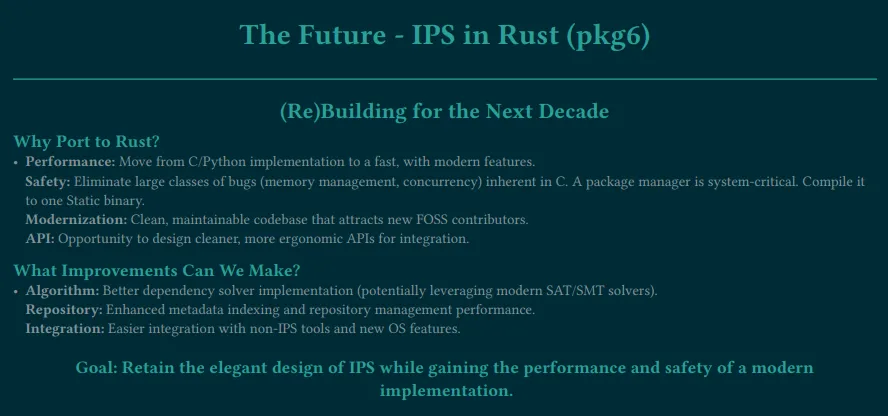
Rust’s zero-cost abstractions and fine-grained control over memory layout enable package management operations to execute with significantly reduced overhead compared to interpreted Python components or even optimized C code. The pkg6 team anticipates 3-5x performance improvements in dependency resolution, package installation speeds, and repository synchronization operations—critical metrics for enterprise deployments managing thousands of packages across distributed systems.
The language’s ability to eliminate garbage collection pauses and provide deterministic memory management translates directly into more predictable package manager behavior, particularly crucial during system boot sequences and automated deployment pipelines where timing consistency is paramount.
Memory Safety Without Compromise
Perhaps the most compelling argument for Rust adoption lies in its revolutionary approach to memory safety. Traditional C implementations of package managers have historically been vectors for security vulnerabilities, with buffer overflows, use-after-free errors, and memory corruption bugs representing persistent threats. Rust’s ownership model and borrow checker eliminate entire categories of memory safety bugs at compile time, effectively removing a significant attack surface from the package management stack.
This shift is particularly significant given that package managers operate with elevated privileges and handle arbitrary code from external repositories. The memory safety guarantees provided by Rust could dramatically reduce the risk of supply chain attacks and privilege escalation vulnerabilities that have plagued package management systems across multiple platforms.
Modern Language Ecosystem
Rust’s mature ecosystem provides immediate access to sophisticated tooling, comprehensive testing frameworks, and a growing library of crates that can accelerate development. The language’s expressive type system and pattern matching capabilities enable more robust error handling and clearer code semantics compared to traditional C implementations, while its package management system (Cargo) offers a proven model for dependency resolution that the pkg6 team can study and potentially improve upon.
Architectural Innovations in pkg6
The pkg6 initiative extends beyond mere language translation, encompassing several architectural innovations designed to address longstanding limitations in package management systems.
Next-Generation Dependency Solver
One of the most anticipated improvements involves a complete overhaul of the dependency resolution algorithm. The current IPS implementation, while functional, struggles with complex dependency graphs and can produce suboptimal package combinations or fail to find solutions that exist. The Rust-based solver under development employs advanced constraint satisfaction techniques and memoization strategies to achieve exponential improvements in solving complex dependency scenarios.
The new solver also introduces incremental solving capabilities, allowing package managers to maintain dependency state between operations and dramatically reduce computation time for sequential package operations—a common pattern in system administration workflows.
Enhanced Metadata Indexing
Repository performance has historically been a bottleneck in package management, particularly for large repositories containing thousands of packages with complex dependency relationships. The pkg6 architecture introduces a sophisticated metadata indexing system that leverages Rust’s concurrency primitives to enable parallel index construction and query operations.
This enhancement promises to reduce repository synchronization times from minutes to seconds, even for repositories containing millions of package variants. The indexing system also supports advanced query capabilities, enabling administrators to perform complex package searches, dependency analysis, and impact assessments with unprecedented speed and accuracy.
Repository Management Reimagined
The new repository management subsystem introduces support for modern distribution mechanisms including content-addressable storage, delta compression for updates, and cryptographic verification at the package level. These features address growing concerns about repository scalability, update efficiency, and supply chain security that have become increasingly critical as software ecosystems grow more complex and distributed.
Tooling Integration and API Modernization
A critical aspect of the pkg6 initiative involves creating a more accessible and extensible API surface. The Rust implementation provides a clean separation between core package management logic and user-facing interfaces, enabling easier integration with configuration management systems, container orchestration platforms, and continuous deployment pipelines.
The team is also developing a comprehensive plugin architecture that will allow third-party developers to extend package manager functionality without modifying core code, fostering a more vibrant ecosystem around OpenIndiana’s package management capabilities.
Community Impact and Industry Implications
The OpenIndiana team’s commitment to Rust represents more than a technical upgrade—it signals a philosophical shift in how open-source operating system projects approach modernization and security. The initiative has already sparked discussions across the broader Unix and Linux communities about the viability of Rust for core system components traditionally written in C.
Several other operating system projects have expressed interest in the pkg6 codebase, with preliminary discussions underway about creating a cross-platform package management library that could serve multiple Unix-like operating systems. This potential collaboration could accelerate Rust adoption in systems programming beyond the immediate scope of OpenIndiana.
Enterprise Adoption Considerations
For enterprise environments, the pkg6 initiative addresses several critical pain points. The performance improvements could reduce infrastructure costs by enabling more efficient package management operations, while the enhanced security guarantees align with growing regulatory requirements for software supply chain security.
However, the transition also presents challenges. Enterprise users will need to plan for migration timelines, potential compatibility issues with existing package repositories, and training requirements for administrators accustomed to the current IPS implementation. OpenIndiana has committed to maintaining backward compatibility through transitional periods and providing comprehensive migration tools.
Technical Challenges and Risk Mitigation
The scale of this undertaking cannot be understated. Porting a production-critical system like a package manager to a new language involves navigating complex technical challenges and managing significant risks.
Legacy Code Integration
One of the primary challenges involves interfacing with existing system components that expect the current IPS API. The pkg6 team is developing comprehensive compatibility layers and shims to ensure seamless integration during the transition period, though some edge cases may require application updates.
Testing and Validation
Given the critical nature of package management, the testing strategy for pkg6 is exceptionally rigorous. The team is implementing property-based testing, fuzzing, and extensive integration testing to ensure the new implementation matches or exceeds the reliability of the current system. They’re also developing tools to automatically verify that package installations and upgrades produce identical system states between the old and new implementations.
Performance Benchmarking
The performance claims associated with the Rust migration require extensive validation. The team has established comprehensive benchmarking suites that measure not just raw performance metrics but also resource utilization patterns, memory footprint, and scalability characteristics under various load conditions.
The Road Ahead: Timeline and Milestones
The pkg6 development follows a structured roadmap with clearly defined milestones:
Phase 1 (Months 1-6): Core dependency solver implementation and validation against existing package repositories. Basic package installation and removal functionality.
Phase 2 (Months 7-12): Repository management subsystem with metadata indexing, delta update support, and cryptographic verification. Performance benchmarking and optimization.
Phase 3 (Months 13-18): API stabilization, plugin architecture implementation, and comprehensive compatibility testing with existing OpenIndiana packages and third-party tools.
Phase 4 (Months 19-24): Production deployment in OpenIndiana testing channels, migration tooling development, and documentation finalization.
The team has also established a fallback position: if critical issues emerge during development, they retain the option to incrementally migrate components rather than pursuing a complete rewrite, though current progress suggests this contingency may not be necessary.
Industry Context and Competitive Landscape
OpenIndiana’s Rust migration initiative arrives at a pivotal moment in systems programming. Rust has gained significant traction across the infrastructure landscape, with major projects including the Linux kernel, systemd, and various database systems embracing the language for performance-critical components.
The package management space has seen various modernization attempts, but most have focused on user experience improvements rather than fundamental architectural changes. OpenIndiana’s approach—combining language migration with architectural innovation—represents a more comprehensive strategy that could set new standards for the field.
Competitors in the Unix-like operating system space are closely monitoring the initiative. Projects that have traditionally relied on Python-based package managers or legacy C implementations may find themselves under pressure to modernize as OpenIndiana demonstrates the benefits of Rust adoption.
Looking Forward: The Future of System Package Management
The pkg6 initiative represents more than a technical upgrade for OpenIndiana—it embodies a vision for the future of system package management. By combining Rust’s safety guarantees with innovative architectural approaches, the project aims to create a package management system that is simultaneously faster, more secure, and more extensible than anything currently available in the Unix ecosystem.
The success of this initiative could have ripple effects far beyond OpenIndiana, potentially influencing how other operating systems approach package management modernization. As systems continue to grow in complexity and security requirements become more stringent, the innovations pioneered by pkg6 may well become industry standards.
For developers, system administrators, and enterprise users, the coming years promise exciting developments in how software is deployed, managed, and secured on Unix-like systems. OpenIndiana’s bold bet on Rust may well prove to be a watershed moment in the evolution of system infrastructure.
Tags and Viral Phrases
- OpenIndiana goes full Rust on package management revolution
- IPS pkg6: The future of Unix package management is memory-safe
- Rust rewrites package management: 3-5x performance gains incoming
- OpenSolaris successor bets everything on Rust for next-gen IPS
- Memory safety meets system administration: OpenIndiana’s bold move
- Enterprise package management gets a Rust-powered upgrade
- The death of C in package management? OpenIndiana says maybe
- pkg6: When dependency solving gets a performance steroid injection
- OpenIndiana’s gamble: Can Rust save Unix package management?
- From C/Python to Rust: The package manager that learned to fly
- Supply chain security gets real with Rust-based package management
- The quiet revolution in how your OS installs software
- OpenIndiana proves Rust isn’t just for web developers anymore
- Package management 2.0: Faster, safer, Rustier
- The technical debt destroyer: How Rust is fixing package management
- Unix systems get a memory-safe heart transplant
- Dependency resolution that doesn’t make you wait (or worry)
- The architecture that could change how all operating systems work
- OpenIndiana’s Rust migration: A case study in technical courage
- When performance meets security: The pkg6 promise
- The package manager that learned to stop worrying and love Rust
- Enterprise IT departments should pay attention to this one
- The silent killer of buffer overflows in your package manager
- Rust’s killer app might be managing your system updates
- The future of infrastructure is being written in Rust right now
- OpenIndiana’s bet on Rust could pay off big for everyone
- Package management gets the memory safety it always needed
- The technical deep-dive that has the Unix world buzzing
- How one project’s Rust migration could influence an entire industry
- The performance numbers that make C programmers nervous
- Security by compiler: The Rust package management revolution
- When your package manager becomes a showcase for modern systems programming
- The architectural innovations that make pkg6 more than just a rewrite
- OpenIndiana’s Rust-powered package manager: Better, faster, stronger
- The dependency solver that thinks differently about your software
- Enterprise-grade package management finally gets a security upgrade
- The technical debt that’s about to be wiped clean by Rust
- How Rust is quietly taking over your operating system’s core
- The package management paradigm shift you didn’t know you needed
- OpenIndiana’s bold technical bet that could redefine Unix systems
- When performance requirements meet memory safety guarantees
- The Rust revolution reaches the heart of your operating system
- Package management’s great leap forward: From C to Rust
- The security vulnerabilities that Rust just eliminated from package management
- How one language choice could make your system updates 5x faster
- The technical architecture that has developers and admins excited
- OpenIndiana’s Rust migration: A masterclass in systems programming evolution
- The future of software deployment is being written in safe systems code
- When your package manager becomes a showcase for modern compiler technology
,


Leave a Reply
Want to join the discussion?Feel free to contribute!