
CFTC’s one-man show gets awkward on the Hill as lawmakers hammer Selig on sports bets, staffing gaps and corruption claims
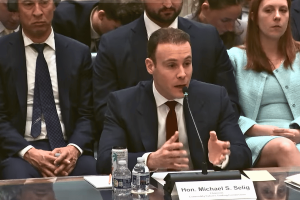
CFTC Chair Michael Selig Faces Heated Capitol Hill Grilling Over Prediction Markets, Sports Betting, and Political Ties
In a tense and at times combative hearing before the House Agriculture Committee on April 16, 2026, Commodity Futures Trading Commission (CFTC) Chairman Michael Selig found himself on the defensive as lawmakers challenged the agency’s oversight of prediction markets, accusing them of enabling sports betting under the guise of financial innovation. The hearing quickly evolved from a routine oversight session into a high-stakes clash over market integrity, tribal sovereignty, and allegations of political favoritism.
“Consumers Can’t Tell the Difference,” Lawmakers Warn
The hearing’s central tension emerged early when Representative Gabe Vasquez (D-NM) confronted Selig with a blunt assessment: prediction markets and sportsbooks are functionally identical to the average consumer. “The odds are functionally the same,” Vasquez stated, “and consumers couldn’t care less if they’re using an official sportsbook or engaging with a prediction markets platform.”
Vasquez’s argument struck at the heart of the CFTC’s regulatory dilemma. While the agency maintains that prediction markets serve legitimate hedging purposes, lawmakers pointed out that products like Kalshi’s “Will Jose Altuve hit a home run tonight?” contracts look suspiciously like sports wagers. “Airlines hedge fuel costs, farmers hedge crop prices—that is very different from putting money on the outcome of a baseball game,” Vasquez argued, questioning whether such contracts hedge “any real economic risk.”
Selig’s response—that “there are many risks that could be hedged through various contracts in our markets”—did little to assuage concerns. The exchange highlighted the growing disconnect between the CFTC’s regulatory framework and the reality of products flooding the market.
Tribal Gaming Communities Sound Alarm Over Lost Revenue
The hearing took a sharper turn when Vasquez raised tribal sovereignty concerns. He argued that federally recognized tribes have spent decades building gaming systems with “compacts, licensing, integrity rules, age verification, and consumer protection.” When prediction markets operate outside this structure, he said, “it undermines tribal sovereignty and state protection.”
Vasquez specifically cited the Pueblo of Laguna, noting that communities are losing revenue that funds “childcare, education, infrastructure, and the overall well-being of their community.” This aligns with ongoing legal challenges: twenty-seven states have backed tribal appellants in federal litigation against Kalshi, with tribes arguing that prediction markets threaten the compact-based structure created under the Indian Gaming Regulatory Act.
Indian Gaming Association Chairman David Z. Bean has called prediction markets “an attempt to bypass tribal authority and recast gambling as a financial product.” The hearing made clear that this is no longer just an industry dispute—it’s a full-blown political and legal battle with billions in revenue at stake.
Political Connections Spark “Corruption” Accusations
The atmosphere grew even more charged when Representative Jim McGovern (D-MA) brought up the political elephant in the room: Donald Trump Jr.’s dual board roles with Kalshi and Polymarket. “It seems to me like the only reason two competing companies hired the same person is because they think he must be really, really, really valuable,” McGovern said, his sarcasm cutting through the formal hearing room.
McGovern then asked directly whether anyone in the White House had urged the CFTC to drop its probe into Polymarket. Selig’s response—”we treat all market participants alike,” “we don’t pick winners and losers,” and “it’s insulting that you’re insinuating that we would play political games”—only seemed to fuel McGovern’s skepticism.
“No, I’m wary because it smells like corruption,” McGovern replied. “I’ll be honest with you.” The exchange marked a dramatic shift from policy discussion to allegations of political interference, with McGovern suggesting that the administration’s ties to prediction market companies had compromised regulatory oversight.
One Commissioner, Massive Responsibility
Adding to the tension was the revelation that Selig was testifying as the only sitting member of what should be a five-member commission. Reuters reported that Selig told lawmakers the agency would not wait for the other four seats to be filled before issuing new regulations, stating, “We cannot, for the sake of the American people, slow down in our rulemaking.”
Selig attempted to downplay staffing concerns, telling Representative Shontel Brown that “a lot of that fake news out there about us being under-resourced is incorrect.” However, this claim contradicts recent developments: in February, five Democratic senators expressed “deep concern” that the CFTC’s Chicago enforcement office had shrunk from 20 enforcement attorneys to none, raising questions about the agency’s capacity to oversee an increasingly complex market.
The CFTC’s Regulatory Tightrope
The hearing exposed the fundamental challenge facing the CFTC: how to regulate prediction markets that increasingly resemble sports betting while maintaining their classification as legitimate financial products. The agency has been pushing new guidance and a formal rulemaking process, but the expansion of sports-style offerings by platforms like Kalshi has pushed the industry closer to the exact kind of betting that state and tribal regulators say is already heavily regulated for good reason.
Selig’s Wall Street Journal op-ed arguing that prediction markets serve a “legitimate economic function” now faces the practical reality that consumers see little difference between betting on presidential elections and betting on baseball games. The CFTC’s filing of a friend-of-the-court brief supporting Crypto.com in Ninth Circuit litigation suggests the agency is digging in on its position, but Thursday’s hearing made clear that Capitol Hill is increasingly skeptical.
Industry Expansion Meets Regulatory Pushback
The timing of the hearing is particularly significant given recent industry developments. Kalshi has been aggressively expanding into sports-style offerings, including contracts on touchdowns, point spreads, and total scores. This expansion comes as the CFTC has been working to establish clearer regulatory frameworks, creating a collision between innovation and oversight.
The hearing also highlighted the broader context of prediction markets’ rapid growth. What began as niche platforms for political forecasting have evolved into sophisticated betting venues that blur the lines between financial markets and gambling. The question now is whether the CFTC can adapt its regulatory framework quickly enough to address these developments.
A Regulatory Reckoning Approaches
As the hearing concluded, it was clear that the CFTC faces a critical juncture. Lawmakers appeared unconvinced by the agency’s assurances that everything is under control. The combination of tribal sovereignty concerns, allegations of political favoritism, and questions about regulatory capacity has created a perfect storm of scrutiny.
The prediction market industry’s growth has been nothing short of meteoric, but Thursday’s hearing suggested that regulatory reckoning may be approaching. Whether the CFTC can maintain its position that these are legitimate financial products—or whether lawmakers will force a reclassification that brings them under gambling regulations—remains one of the most pressing questions in financial regulation today.
What’s certain is that the debate over prediction markets has moved from industry conference rooms to the halls of Congress, and the outcome will have profound implications for how Americans can bet on everything from elections to baseball games in the years to come.
Tags: CFTC, prediction markets, sports betting, Kalshi, Polymarket, tribal gaming, Michael Selig, Donald Trump Jr., congressional hearing, market regulation, gambling, financial products, tribal sovereignty, Capitol Hill, corruption allegations, staffing shortages, event contracts, hedging, Indian Gaming Regulatory Act
Viral Phrases: “Consumers can’t tell the difference,” “smells like corruption,” “one-man show,” “gambling wearing a lanyard,” “fake news about under-resourcing,” “picking winners and losers,” “bypass tribal authority,” “legitimate economic function,” “stress test for the CFTC’s theory,” “betting with better stationery,” “recast gambling as a financial product”
,


Leave a Reply
Want to join the discussion?Feel free to contribute!