
China Provides Glimpse of Colossal Orbital Aircraft Carrier
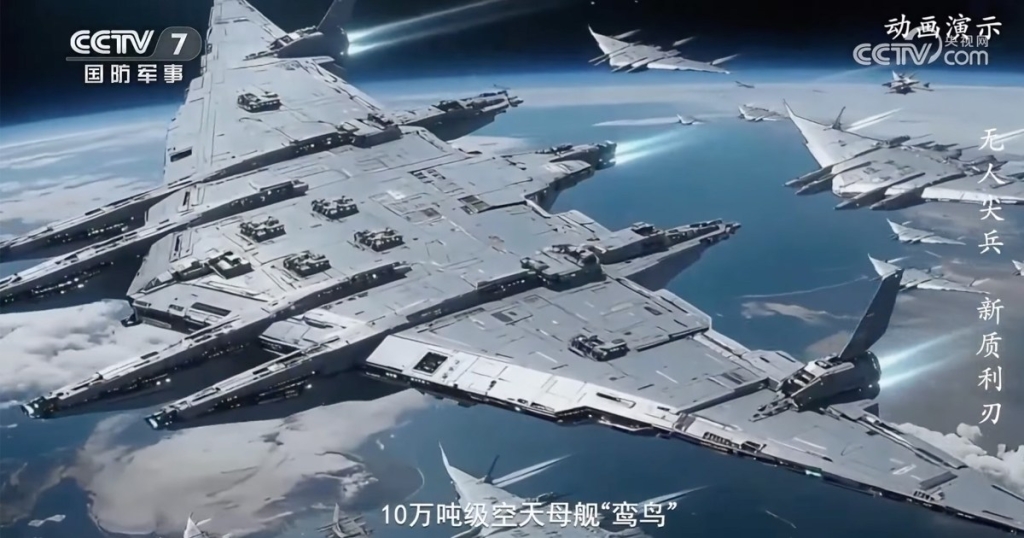
China’s “Star Wars” Space Carrier: The Luan Niao and Its Orbital Drone Fleet
In a revelation that sounds straight out of science fiction, China has unveiled conceptual designs for an enormous orbital mothership called the Luan Niao—a spacecraft that could revolutionize military operations from the edge of space. The announcement, made through state media channels, has sent shockwaves through defense and aerospace communities worldwide.
A Behemoth from the Stratosphere
The Luan Niao isn’t just another aircraft carrier—it’s a space-based behemoth that would dwarf any military vessel in history. According to design specifications shared by Chinese state media, this orbital mothership would measure nearly 800 feet from nose to tail and span an incredible 2,244 feet in width. To put that in perspective, that’s roughly the length of three football fields laid end-to-end, with a wingspan that would make it visible from the ground on a clear day.
The spacecraft’s proposed mass is equally staggering—clocking in at approximately 120,000 tons. This massive structure would serve as a launch platform for 88 autonomous “Xuan Nu” fighter drones, which would operate in the upper limits of Earth’s stratosphere, conducting missions from altitudes where traditional aircraft cannot reach.
The Xuan Nu Fighters: 6th Generation Warfare
The Xuan Nu fighters represent China’s vision for next-generation aerial combat. These hypothetical 6th generation jets have been circulating through aerospace trade shows since at least 2019, showcasing what Chinese engineers believe will be the future of air warfare. Unlike traditional aircraft, these autonomous fighters would operate with minimal human intervention, using advanced AI systems to conduct complex missions in the harsh environment of near-space.
The fighters are designed to be launched from the Luan Niao while it orbits at the edge of space, giving them unprecedented range and the ability to strike targets anywhere on Earth without the need for traditional airbases or aircraft carriers. This orbital launch capability would provide China with a strategic advantage that current military powers simply cannot match.
The South Heaven Gate Project
The Luan Niao and Xuan Nu concepts are part of something much larger called the “South Heaven Gate Project,” a coordinated initiative to align China’s aerospace and defense sectors around ambitious, long-term goals. While the concepts themselves have existed for years—the Luan Niao idea dates back a full decade—they’ve been newly revived as part of this comprehensive push to advance China’s military capabilities.
The project has sparked considerable excitement within China, with netizens creating fictional stories set in a near future where the People’s Republic operates a fleet of these massive carriers, circling the globe and projecting power from orbit. State media coverage has been enthusiastic, presenting these concepts as achievable goals rather than distant fantasies.
Strategic Implications
Defense experts are taking notice of the potential strategic implications. Peter Layton, a defense expert and fellow at Australia’s Griffith Asia Institute, told the Telegraph that if the Luan Niao ever becomes reality, it would “outclass pretty much everyone” in terms of military capability.
“The advantage of operating from the edge of space is that you’re also out of range of the weather, generally speaking—and you’re out of range of most defensive systems,” Layton explained. This would give China the ability to deploy military assets anywhere in the world without warning, bypassing traditional air defense systems that are designed to counter threats from lower altitudes.
The orbital nature of the platform means it could potentially circumnavigate the globe, maintaining constant surveillance and strike capabilities over multiple regions simultaneously. This represents a fundamental shift in how military power could be projected, moving from terrestrial bases to space-based platforms.
Technical Challenges and Timeline
While the concept is undoubtedly impressive, significant technical hurdles remain. Launching a 120,000-ton spacecraft into orbit would require energy and propulsion systems that don’t currently exist. The structural engineering challenges alone are monumental—building a spacecraft of this scale that could withstand the stresses of launch and orbital operations pushes the boundaries of current materials science.
However, China’s rapid technological advancement in recent years cannot be ignored. The nation has made significant strides in areas ranging from quantum computing to fusion energy research, and its space program has achieved milestones that were once considered decades away. What seems impossible today may not stay that way for long, especially with the focused resources and long-term planning that characterize Chinese strategic initiatives.
Context and Comparison
The Luan Niao announcement comes at a time when China is already making waves in other technological domains. The country has been rapidly expanding its solar energy production capacity, with new installations that experts describe as “mind-blowing” in scale. China’s robotics industry has also advanced to the point where Western executives report being “shaken” after visiting Chinese facilities.
This pattern of technological leapfrogging suggests that China views military aerospace as the next frontier for its innovation-driven growth model. The Luan Niao represents not just a weapons system, but a statement of technological ambition and strategic intent.
The Road Ahead
While the Luan Niao remains firmly in the conceptual stage, its unveiling serves multiple purposes. It acts as a technological goalpost for Chinese engineers and scientists, provides a narrative of inevitable progress for domestic audiences, and sends a message to international observers about China’s long-term military planning.
Whether or not this particular design ever flies, the concepts it embodies—space-based military platforms, autonomous drone swarms, and orbital launch capabilities—are likely to shape the future of warfare. The question isn’t whether such systems will eventually exist, but rather which nations will develop them first and how the international community will respond to this new paradigm of space-based military power.
The Luan Niao may be science fiction today, but history has shown that today’s science fiction often becomes tomorrow’s military reality. As China continues to invest heavily in aerospace, artificial intelligence, and space technology, the line between conceptual spacecraft and operational weapons systems may become increasingly blurred.
Tags: China space program, Luan Niao spacecraft, orbital mothership, Xuan Nu fighters, 6th generation jets, South Heaven Gate Project, space-based military, autonomous drones, stratosphere operations, Chinese defense technology, orbital launch platform, military aerospace, space warfare, near-space operations, strategic military advantage
Viral Phrases: “outclass pretty much everyone,” “Star Wars space carrier,” “orbital drone fleet,” “edge of space dominance,” “120,000 ton spacecraft,” “2,244 foot wingspan,” “China’s military from orbit,” “game-changing military technology,” “future of warfare,” “space-based military power,” “autonomous fighter drones,” “strategic advantage from space,” “revolutionary aerospace concept,” “China’s military ambitions,” “orbital launch capabilities”
,


Leave a Reply
Want to join the discussion?Feel free to contribute!