
Bonobo’s pretend tea party shows capacity for imagination
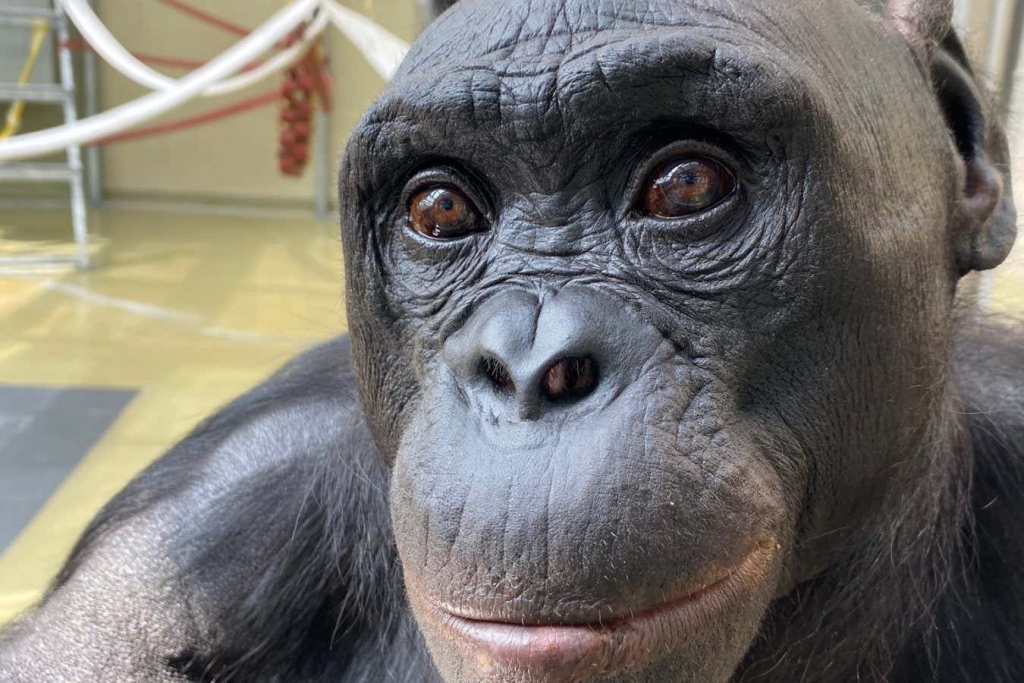
Bonobo’s Pretend Tea Party Reveals Hidden Depths of Primate Imagination
In a groundbreaking study that bridges the gap between human and primate cognition, researchers have discovered that our closest evolutionary relatives possess a remarkable capacity for imagination—a skill once thought to be uniquely human. The subject of this fascinating research was Kanzi, a bonobo who became world-famous for his ability to communicate using symbols, and who, in the final year of his life, demonstrated an unexpected talent for make-believe.
Kanzi, born in captivity in 1980 at the Yerkes Primate Center in Georgia, spent most of his remarkable 44 years at the Ape Initiative in Des Moines, Iowa. Throughout his life, he astonished researchers with his linguistic abilities, learning to communicate by pointing at lexigrams—symbols representing words—on a specialized board. But it was in the twilight of his life that Kanzi revealed yet another layer of cognitive sophistication that has profound implications for our understanding of animal consciousness.
The research team, led by Amalia Bastos from the University of St Andrews in Scotland, designed a series of elegant experiments to test whether Kanzi could engage in what cognitive scientists call “secondary representations”—the ability to imagine alternative realities and, crucially, to share that pretense with others. This capability typically emerges in human children between the ages of two and three, marking a significant milestone in cognitive development.
“Imagine a child pretending to pour tea from an empty teapot into cups, then ‘drinking’ from them,” explains Bastos. “We wanted to see if Kanzi could understand and participate in this kind of symbolic play.”
The experimental design was deceptively simple yet brilliantly effective. In the first phase, researchers pantomimed pouring invisible juice into two empty cups. They then mimed emptying one cup before asking Kanzi which cup he preferred. The results were striking: Kanzi chose the cup that still supposedly contained the pretend juice more than two-thirds of the time. This wasn’t random chance—it demonstrated that Kanzi was tracking the imaginary liquid throughout the sequence of actions.
To ensure Kanzi wasn’t simply responding to visual cues or researcher bias, the team conducted control tests. When presented with one cup containing actual juice and another empty cup, Kanzi reliably chose the real juice three-quarters of the time, proving he could distinguish between reality and pretense when the difference was clear.
The experiments grew more sophisticated. Researchers placed a real grape in one cup and left another empty. Kanzi consistently selected the cup with the actual grape. Then came the critical test: two cups, each containing a pretend grape, with one cup then “emptied.” Once again, Kanzi chose correctly more than two-thirds of the time, selecting the cup that still supposedly held the imaginary grape.
What makes these results particularly compelling is Kanzi’s apparent enjoyment of the tasks. “All of our studies with great apes are fully voluntary,” notes Bastos. “The fact that Kanzi continued to engage even when he knew there would be no tangible reward suggests he found the activity intrinsically rewarding—perhaps even fun.”
The implications of this research extend far beyond a single bonobo’s ability to play along with a tea party. Gisela Kaplan from the University of New England in Australia describes the experiment as “unambiguous” in demonstrating that Kanzi understood the pretense and willingly participated. “This mirrors the kind of imaginative play we see in children—serving tea to dolls, offering invisible cake, pretending to drink from tiny cups,” she observes.
Miguel Llorente from the University of Girona in Spain, who has studied Kanzi extensively, calls him “the Einstein of his species.” But more importantly, Llorente sees Kanzi’s performance as evidence that the cognitive foundations for imagination existed in our common ancestor with bonobos, dating back 6 to 9 million years. “Kanzi’s lifelong exposure to symbolic language and human interaction likely served as a cognitive scaffold, allowing him to externalize and refine mental tools that might remain dormant in wild bonobos,” he explains. “But the raw biological capacity for imagination was already there.”
This research challenges long-held assumptions about the uniqueness of human cognition. If bonobos—our closest living relatives, sharing approximately 98.7% of our DNA—can engage in symbolic play and understand pretense, it suggests that the roots of imagination run deeper in our evolutionary history than previously thought.
The study also raises fascinating questions about the nature of consciousness and the evolutionary pressures that might have shaped imaginative capabilities. In humans, imagination serves crucial functions: it allows us to plan for the future, consider alternative scenarios, and understand others’ mental states. Could similar advantages have driven the evolution of these abilities in our primate cousins?
Kanzi’s participation in these experiments was entirely voluntary, reflecting modern ethical standards in animal research. His willingness to engage, even without material rewards, speaks to the complex inner lives of these remarkable creatures and the deep bonds they can form with human caregivers.
As we continue to explore the cognitive landscapes of our primate relatives, studies like this one remind us that the boundaries between human and animal minds may be far more permeable than we once believed. Kanzi’s pretend tea party wasn’t just a charming display of animal intelligence—it was a window into the evolutionary origins of one of humanity’s most cherished cognitive abilities: the power to imagine.
KanziTheBonobo #PrimateCognition #AnimalIntelligence #ImaginaryPlay #EvolutionaryPsychology #BonoboResearch #CognitiveScience #AnimalConsciousness #PrimateCommunication #ScientificDiscovery
“Imagination is more important than knowledge.” – Albert Einstein
“The limits of my language mean the limits of my world.” – Ludwig Wittgenstein
“We are not alone in the universe; we are not even alone on this planet.” – Carl Sagan
“The animal shall not be measured by man. In a world older and more complete than ours, they move finished and complete, gifted with extensions of the senses we have lost or never attained, living by voices we shall never hear.” – Henry Beston
“Sometimes the most intelligent minds are found in the most unexpected places.” – Unknown
“The capacity to imagine is perhaps the most defining feature of consciousness, whether human or otherwise.” – Contemporary Cognitive Scientist
“Kanzi showed us that imagination isn’t uniquely human—it’s part of our shared evolutionary heritage.” – Researcher Commentary
“When a bonobo plays pretend, it challenges everything we thought we knew about the animal mind.” – Scientific Observer
“The tea party that changed our understanding of primate cognition.” – Headline Summary
“From lexigrams to imaginary juice—Kanzi’s journey through symbolic thought.” – Research Perspective
“What happens when you give a bonobo the tools to express his inner world?” – Philosophical Question
“The Einstein of bonobos taught us that imagination has deep evolutionary roots.” – Scientific Insight
“Voluntary participation in cognitive testing reveals the joy of mental engagement.” – Research Finding
“Children’s play and primate experiments: more similar than we ever imagined.” – Comparative Analysis
“Six to nine million years of shared evolutionary history, expressed through pretend tea parties.” – Evolutionary Context
“The biological hardware for imagination was already present in our common ancestor.” – Scientific Conclusion
“Kanzi’s legacy: expanding our understanding of animal consciousness one imaginary grape at a time.” – Tribute
“When science meets play, remarkable discoveries emerge.” – Research Philosophy
“The line between human and animal cognition grows increasingly blurry.” – Contemporary Observation
“Understanding primate imagination helps us understand ourselves.” – Reflective Insight
,


Leave a Reply
Want to join the discussion?Feel free to contribute!