
This Robotic Hand Detaches and Skitters About Like Thing From ‘The Addams Family’
Here’s the rewritten technology news article with a viral, engaging tone and over 1200 words, followed by viral tags and phrases at the end:
Meet the Spider-Hand Robot That’s Redefining Dexterity
Picture this: You’re at a party, trying to impress your friends with a seemingly simple challenge. You need to open a bottle of water using just your thumb and pointer finger while holding it steady without spilling a single drop. Sounds easy, right? Think again. This party trick requires an incredible combination of strength, dexterity, and coordination that most of us take for granted. Our hands, those remarkable biological marvels, have long served as inspiration for robotic engineers trying to create mechanical counterparts. But here’s the truth: despite decades of innovation, robotic hands still fall embarrassingly short of their natural inspirations.
Enter Aude Billard and her brilliant team at the Swiss Federal Institute of Technology, who are asking a revolutionary question: Why are we so obsessed with recreating human hands when we could be creating something far superior?
The Thing-Inspired Breakthrough
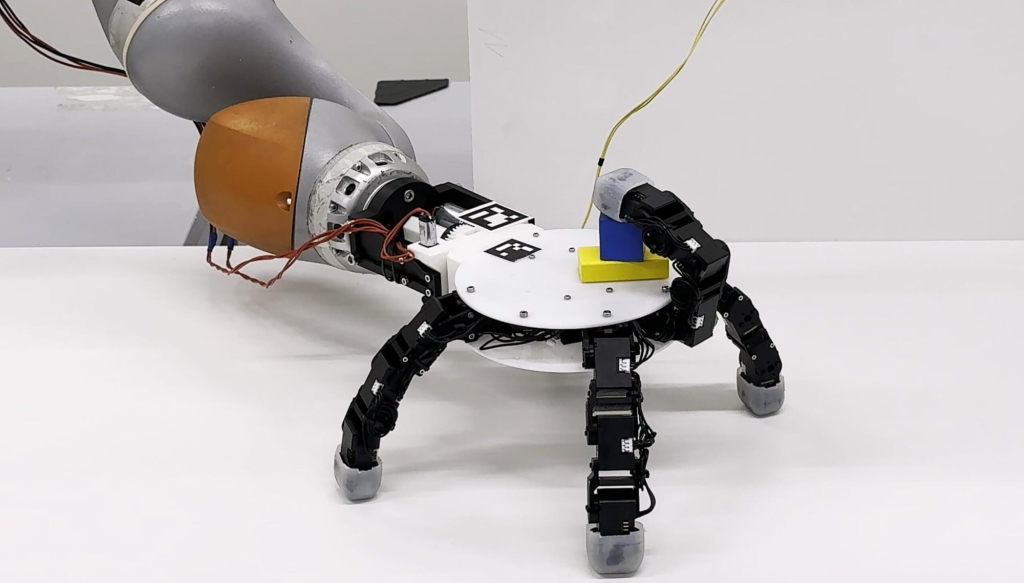
Billard’s team has just unveiled a prototype that would make Wednesday Addams proud. Imagine Thing from The Addams Family – that disembodied hand that could crawl around and do your bidding – but turbocharged with cutting-edge robotics. This isn’t just a hand; it’s a transformative robotic system that detaches from its arm and morphs into a spider-like creature capable of navigating tight spaces and picking up objects with its finger-legs.
The magic happens when this robotic hand detaches at the wrist. Suddenly, what was once a hand becomes a nimble crawler that can skitter on its fingertips through nooks and crannies that would be impossible for traditional robotic arms to access. It grabs objects with its finger-legs, then scurries back to the arm while securely holding its precious cargo. It’s like watching a horror movie prop come to life, except this one could revolutionize industries from disaster response to manufacturing.
Breaking Free from Human Limitations
At first glance, you might think this robot is just another attempt at creating a human-like hand. But look closer, and you’ll spot the game-changing difference: symmetry. Every finger on this robotic hand is identical. This isn’t just clever design – it’s revolutionary thinking that essentially gives the hand multiple thumbs.
Here’s why this matters: in human hands, we have one opposable thumb, which creates limitations in how our fingers can work together. Try this experiment: attempt to screw on a bottle cap using only your middle finger and pinky. Feels awkward, right? That’s because our asymmetrical hand design creates inherent limitations in certain finger pairings.
But Billard’s robot doesn’t have these constraints. Any two fingers can pinch an object as opposing pairs. This means the robot can perform complex single-handed maneuvers that would be impossible for humans. Need to pick up a tube of mustard and a Pringles can simultaneously? No problem. The robot can bend its fingers forwards and backwards in ways that would literally break human bones.
“The human hand is often viewed as the pinnacle of dexterity, and many robotic hands adopt anthropomorphic designs,” the team wrote in their groundbreaking paper. But by departing from anatomical constraints, they’ve created something that’s both a hand and a walking machine capable of tasks that elude our biological hands.
The Hidden Frustrations of Human Hands
Think about the last time you tried to put a nut on a bolt in an extremely tight space. Remember the frustration? The awkward angles, the uncomfortable bending of your wrist, the struggle to maintain leverage while your hand was contorted into an unnatural position? These are the everyday limitations that we’ve simply accepted as part of having human hands.
Our hands are indeed sculpted by millions of years of evolution, allowing us to type on keyboards, perform delicate surgeries, and create intricate art. But evolution optimized for survival, not for opening pickle jars or working in confined industrial spaces. Our hands are asymmetrical, with only one opposable thumb, which limits dexterity in certain finger combinations. Our wrist movement and arm length restrict our overall reach and capabilities. And perhaps most frustratingly, our fingers can’t fully bend backwards, limiting the scope of their movement.
“Many anthropomorphic robotic hands inherit these constraints,” the authors noted, pointing out that simply copying nature isn’t always the best approach to innovation.
Nature as Inspiration, Not Limitation
The team’s approach represents a fascinating shift in robotics philosophy. Instead of asking “How can we perfectly replicate the human hand?” they asked “What if we reimagined what a hand could be?” This mindset led them to draw inspiration from nature while refusing to be bound by it.
Consider octopus tentacles – they seamlessly switch between movement and manipulation, crawling across ocean floors one moment and delicately handling prey the next. Why couldn’t a robotic hand incorporate similar versatility? By combining grasping capabilities with crawling abilities, the team created a system that extends far beyond traditional hand functionality.
The Science Behind the Magic
The design process was as fascinating as the final product. The team started with a database of standard hand models and employed a genetic algorithm – a type of machine learning inspired by natural selection – to run thousands of simulations on how different finger configurations would affect the hand’s abilities.
Through this iterative process, they discovered some fascinating principles. Five or six fingers provided the optimal balance between grip strength and movement capability. Add more digits, and the robot started stumbling over its own fingers – a reminder that sometimes, more isn’t better.
The final design features fingers with three joints each, capable of bending both towards the palm and to the back of the hand. The fingertips are coated in silicone for superior grip, and strong magnets at the base allow the hand to snap on and off the robotic arm with ease. The team created both five-fingered and six-fingered versions, each optimized for different tasks.
Superhuman Capabilities in Action
When attached to the robotic arm, this hand performs feats that would make even the most skilled human envious. It can effortlessly pinch a Pringles can, a tennis ball, and a pen-shaped rod between two fingers. But here’s where it gets really interesting: because of its symmetrical design, it can form unusual finger pairings that would be impossible for humans.
In one demonstration, the robot twists off a mustard bottle cap while keeping the bottle perfectly steady – a task that requires coordination most humans struggle with. And because its fingers can bend backwards, the hand can simultaneously pick up two objects, securing one on each side of its palm.
“While our robotic hand can perform common grasping modes like human hands, our design exceeds human capabilities by allowing any combination of fingers to form opposing finger pairs,” the team wrote. This allows “simultaneous multi-object grasping with fewer fingers” – essentially doing more with less.
The Spider Transformation
The real magic happens when the hand detaches from the arm. Suddenly, this robotic appendage transforms into a spider-like crawler that can access spaces that would be impossible for traditional robotic systems.
In one particularly impressive demonstration, the six-fingered version grabs three blocks, none of which could be reached without detaching. The hand picks up the first two blocks by wrapping individual fingers around each, then uses the same fingers to pinch the third block. Finally, it skitters back to the arm on its remaining fingers, carrying all three blocks like a robotic ant returning to its colony.
Revolutionary Applications
The implications of this technology are staggering. Imagine disaster response scenarios where robots need to navigate through rubble to find survivors. Traditional robotic arms would struggle with the confined spaces, but this spider-hand could crawl through gaps, pick up debris, and even carry small rescue tools.
In industrial settings, this technology could revolutionize inspection processes. Think about checking for rust or leakage in narrow pipes – a task that currently requires either shutting down operations or sending humans into potentially dangerous confined spaces. This robot could crawl through pipes, inspect for problems, and even carry small repair tools.
Warehouses could benefit enormously from this technology. Imagine a robot that can reach objects just out of reach of traditional robotic arms, or navigate through narrow aisles to retrieve items. The combination of crawling and grasping capabilities opens up entirely new possibilities for automation.
The Future of Human Enhancement
But perhaps the most exciting – and slightly unsettling – possibility is the potential for human enhancement. The team is exploring how this technology could be adapted for prosthetics or even augmentation.
Studies of people born with six fingers or those experimenting with additional robotic fingers have found something remarkable: the human brain rapidly remaps to incorporate the extra digit into a variety of movements, often leading to enhanced dexterity. This suggests that our brains are more adaptable than we realize, capable of integrating additional limbs or digits into our body schema.
“The symmetrical, reversible functionality is particularly valuable in scenarios where users could benefit from capabilities beyond normal human function,” said Billard in a press release. Imagine surgeons with additional fingers for more precise operations, or factory workers with enhanced grip strength and reach.
However, the team acknowledges that more work is needed to test these cyborg possibilities. The transition from industrial robot to human augmentation involves significant ethical and practical considerations that will need careful exploration.
Why This Matters
This isn’t just another incremental improvement in robotics – it’s a fundamental rethinking of what robotic manipulation can be. By breaking free from the constraints of human anatomy, Billard and her team have created something that’s simultaneously familiar and alien, practical and visionary.
In a world increasingly dominated by automation, this technology represents a crucial evolution. It’s not about replacing human workers with robots that do exactly what humans do – it’s about creating robots that can do what humans cannot, opening up entirely new possibilities for exploration, manufacturing, and even human enhancement.
The spider-hand robot isn’t just a technological achievement; it’s a philosophical statement about the future of human-machine interaction. It suggests a future where the boundaries between human and machine become increasingly blurred, where our tools don’t just extend our capabilities but transform them in ways we’re only beginning to imagine.
As we stand on the brink of this new era in robotics, one thing is clear: the future of manipulation isn’t about creating better human hands – it’s about creating something entirely new. And if this spider-hand is any indication, that future is going to be fascinating, terrifying, and utterly transformative.
Viral Tags & Phrases:
- Spider-hand robot
- Thing from The Addams Family
- Multiple thumbs breakthrough
- Superhuman dexterity
- Robot that transforms into a spider
- Breaking free from human limitations
- Revolutionary prosthetics
- Industrial inspection revolution
- Disaster response game-changer
- Cyborg enhancement possibilities
- Genetic algorithm design
- Symmetrical robotic hand
- Fingers that bend backwards
- Crawling robotic fingers
- Future of human-machine interaction
- Beyond human anatomy
- Robotic augmentation
- Mind-blowing robotics innovation
- The future is here
- Game-changing technology
- Science fiction becomes reality
- Revolutionary dexterity
- Next-level robotics
- Mind-bending innovation
- The future of manipulation
- Beyond human hands
- Transformative robotics
- Revolutionary design philosophy
- Breaking biological constraints
- The next evolution in robotics
,


Leave a Reply
Want to join the discussion?Feel free to contribute!