
Synchronised volcanic eruptions on Io hint at a spongy interior
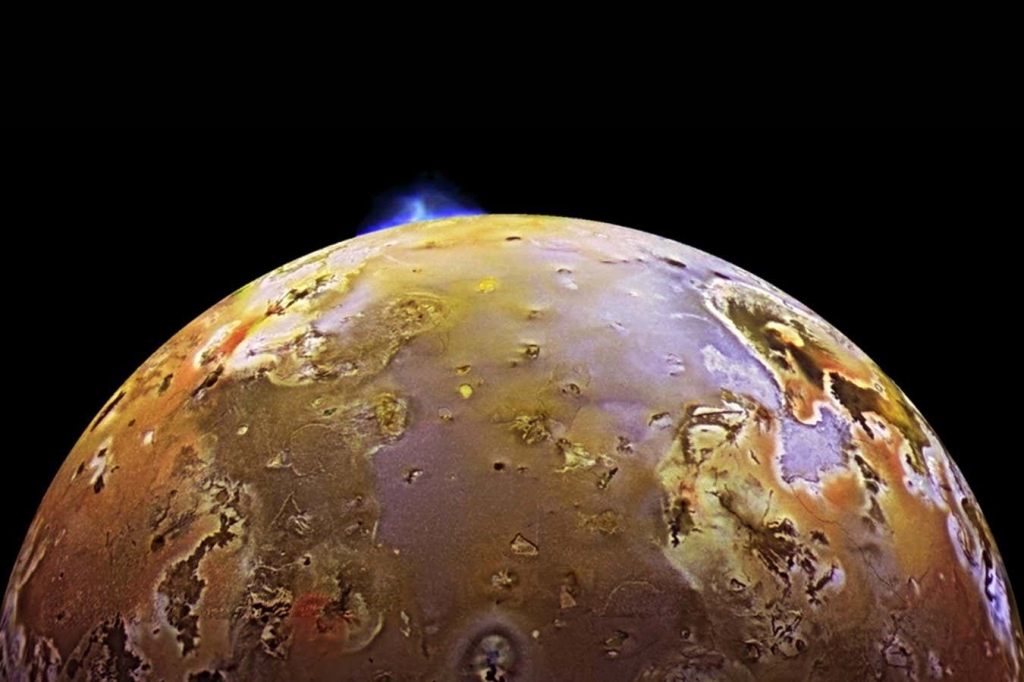
Jupiter’s Moon Io Unleashes Cataclysmic Volcanic Fury: Scientists Stunned by Five Simultaneous Eruptions
In an astronomical spectacle that has left planetary scientists both awestruck and perplexed, Jupiter’s volcanic moon Io has unleashed an unprecedented volcanic cataclysm, with five massive eruptions occurring simultaneously in what researchers are calling a “once-in-a-lifetime” event.
The extraordinary eruptions, which took place in late 2024, were first detected by NASA’s Juno spacecraft as it orbited the gas giant. What began as observations of a single enormous lava flow near Io’s south pole quickly escalated into the realization that five distinct volcanic hotspots were erupting in concert, painting the moon’s surface with rivers of molten rock across an astonishing 65,000 square kilometers—an area roughly the size of Sri Lanka or the U.S. state of West Virginia.
“This was beyond anything we’ve ever seen on Io,” says Dr. Jani Radebaugh, planetary geologist at Brigham Young University and lead researcher on the observation team. “There was this one gigantic eruption and lava flow that first caught our eye, but on second look, all these other hotspots lit up as well. The sheer volume of magma involved is staggering—we can’t quite wrap our minds around it.”
The energy released during this volcanic symphony exceeded that of any previously documented eruption on Io, making it the most powerful volcanic event ever recorded on any celestial body in our solar system. The scale is almost incomprehensible: imagine standing at the edge of a frozen valley that suddenly transforms into a churning lake of lava, only to turn and witness another massive fissure opening in the ground, simultaneously disgorging its own torrent of molten rock.
“It would be terrifying, and so beautiful,” Radebaugh adds, capturing both the scientific fascination and primal fear such an event would inspire.
The Mystery Beneath Io’s Surface
This unprecedented volcanic activity has reignited one of planetary science’s most enduring mysteries: what exactly lies beneath Io’s crust? For decades, scientists believed the moon harbored a global magma ocean beneath its surface—a vast reservoir of molten rock that could explain its extreme volcanic activity. However, recent observations have definitively ruled out this hypothesis, leaving researchers scrambling to explain how such massive volumes of magma can reach the surface.
Io, despite being only slightly larger than Earth’s moon, is the most volcanically active body in our solar system. This hyperactivity is driven by tidal heating—the constant gravitational tug-of-war between Jupiter and the other Galilean moons creates tremendous internal friction, heating Io’s interior to extreme temperatures. Yet the mechanism by which this heat translates into surface eruptions remains poorly understood.
Dr. Radebaugh and her colleagues propose a fascinating new model: Io’s interior may function like a “magma sponge”—an interconnected network of porous chambers that fill with lava before erupting through the surface. This sponge-like structure could explain how multiple eruptions can occur simultaneously, as different regions of the sponge become saturated and release their contents in coordinated bursts.
However, confirming this hypothesis will require more detailed observations, and with Juno having moved to a more distant orbit, such data may be years away. The scientific community now faces a waiting game, hoping for future missions to provide the close-up views necessary to unravel Io’s volcanic secrets.
A Window into Earth’s Volcanic Past
Beyond the immediate spectacle, Io’s extreme volcanism offers scientists a unique window into our own planet’s geological history. During Earth’s early years, when our planet was significantly hotter and more geologically active, volcanic processes may have resembled those currently observed on Io.
“This is actually like early Earth when it was much hotter and more active,” explains Radebaugh. “Io can tell us a lot about our past.” The moon serves as a natural laboratory, allowing researchers to study volcanic processes under conditions that no longer exist on our home planet but were once prevalent during the Hadean and Archean eons, over 2.5 billion years ago.
Understanding Io’s volcanism could therefore provide crucial insights into how Earth’s atmosphere, oceans, and even the conditions necessary for life first developed. The gases released during volcanic eruptions—water vapor, carbon dioxide, sulfur compounds—played essential roles in creating Earth’s primordial environment.
The Technological Marvel Behind the Discovery
The detection of this unprecedented event showcases the remarkable capabilities of modern space exploration technology. NASA’s Juno spacecraft, which arrived at Jupiter in 2016, was originally designed to study the gas giant’s atmosphere, magnetic field, and interior structure. However, its instruments have proven adept at observing the Jovian system’s diverse moons, including the volcanic hellscape of Io.
Juno’s Jovian Infrared Auroral Mapper (JIRAM) was particularly instrumental in detecting the heat signatures of the simultaneous eruptions. This instrument, designed to study Jupiter’s aurorae in infrared light, proved equally capable of mapping thermal emissions from Io’s surface, allowing scientists to identify and track multiple active volcanic regions in real-time.
The spacecraft’s close flybys of Io—approaching within 1,500 kilometers (930 miles) of the moon’s surface—provided unprecedented resolution of its volcanic features. These daring maneuvers, which subjected Juno to intense radiation from Jupiter’s magnetosphere, demonstrate the risks scientists are willing to take to expand our understanding of the solar system.
Implications for Future Exploration
The discovery of these simultaneous eruptions has significant implications for future missions to the Jupiter system. Any spacecraft planning to explore Io will need to account for the possibility of extreme volcanic activity, potentially requiring enhanced radiation shielding and thermal protection systems.
Moreover, the finding strengthens the case for dedicated missions to Io. While Juno has provided invaluable data, a spacecraft specifically designed to study Io’s volcanism—perhaps equipped with ground-penetrating radar, seismic sensors, and high-resolution thermal cameras—could revolutionize our understanding of tidal heating and volcanic processes.
Several mission concepts have been proposed, including the Io Volcano Observer (IVO), which would conduct multiple flybys of Io to map its volcanic activity, measure its internal structure, and search for evidence of a magma ocean or sponge-like interior. The success of Juno’s observations of Io’s eruptions may provide the impetus needed to prioritize such missions in NASA’s future exploration plans.
The Broader Context: Volcanism in the Solar System
Io’s extreme volcanism is part of a broader story of geological activity throughout our solar system. From the cryovolcanoes of Saturn’s moon Enceladus to the ancient lava plains of Venus, volcanic processes have shaped the surfaces of many worlds.
On Mars, the massive Olympus Mons—the largest known volcano in the solar system—stands as a testament to the Red Planet’s volcanic past. Meanwhile, Earth’s own volcanic activity continues to reshape our planet, creating new land, influencing climate, and providing the geothermal energy that may have nurtured the first forms of life.
Studying these diverse volcanic systems helps scientists understand the fundamental processes that drive geological activity across different environments. Each world offers unique insights: Venus’s thick atmosphere and runaway greenhouse effect, Mars’s lack of plate tectonics, Enceladus’s icy eruptions—and now Io’s tidal-powered inferno.
The Human Element: Scientists’ Reactions
For the researchers involved, the discovery of these simultaneous eruptions represents both a professional triumph and a humbling reminder of nature’s power. The moment of realization—when what appeared to be a single eruption revealed itself as five distinct volcanic events—was described by team members as “electrifying.”
Planetary scientist Dr. Ashley Davies of NASA’s Jet Propulsion Laboratory, who has studied Io’s volcanism for over two decades, called the discovery “transformative.” “We’ve been watching Io erupt for years, but this event changes everything,” he said. “It forces us to completely rethink our models of how magma moves through planetary interiors.”
The emotional impact of such discoveries cannot be overstated. For scientists who have dedicated their careers to understanding these distant worlds, moments like these validate years of theoretical work and observational patience. As one researcher put it: “This is why we do what we do. To witness something this extraordinary, something that challenges everything we thought we knew—that’s the ultimate reward.”
Tags & Viral Phrases:
- 🌋 Jupiter’s Moon Io erupts with FIVE volcanoes at once
- 🔥 Most powerful volcanic event ever recorded in the solar system
- 🌍 Io reveals secrets about Earth’s volcanic past
- 🚀 NASA’s Juno spacecraft captures unprecedented cosmic spectacle
- 💥 65,000 square kilometers of lava flow—larger than West Virginia!
- 🔍 Magma sponge theory could solve mystery of Io’s interior
- 🎥 Spacecraft witnesses terrifyingly beautiful lava lakes forming
- ⚡ Tidal heating creates solar system’s most active volcanism
- 🤔 Scientists baffled by source of massive magma volumes
- 🛰️ Groundbreaking discovery showcases power of modern space tech
- 🔬 Io Volcano Observer mission could unlock more secrets
- 🌌 Window into early Earth when our planet was a volcanic inferno
- 📊 Infrared mapping reveals hidden thermal activity
- 🎯 Planetary geology breakthrough challenges existing models
- 🧠 Scientific community abuzz with new theories and questions
,

Leave a Reply
Want to join the discussion?Feel free to contribute!