
Initial AMD Zen 6 “znver6” Support Merged For LLVM/Clang
AMD Zen 6 Support Lands in LLVM Ahead of Product Launch
In a significant development for the open-source compiler ecosystem, AMD’s next-generation Zen 6 processor support has been merged into the LLVM/Clang codebase. This early integration marks a departure from AMD’s historical pattern of releasing compiler support only at or after product launch, signaling a more collaborative approach with the open-source community.
Early Compiler Integration Signals AMD’s Strategic Shift
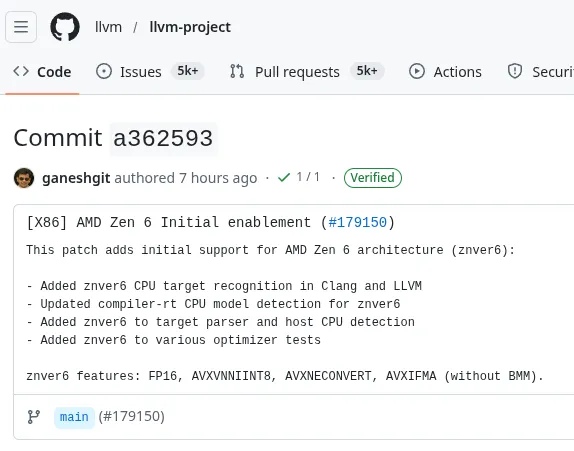
The znver6 target, representing AMD’s forthcoming Zen 6 microarchitecture, was committed overnight to the LLVM/Clang repository. This follows similar support that landed in the GNU Compiler Collection (GCC) back in December 2023, where -march=znver6 support was merged for GCC 16. The timing is particularly noteworthy as it demonstrates AMD’s commitment to ensuring developers have access to optimized toolchains well in advance of the actual hardware release.
LLVM/Clang is currently tracking what will become version 23, with a stable release scheduled for September 2024. The possibility exists for this Zen 6 enablement to be back-ported to the upcoming LLVM/Clang 22 stable series, which is set for release in late February. This would provide even earlier access to developers using the current stable toolchain.
Technical Details and Current Limitations
The current LLVM implementation supports basic znver6 compilation but doesn’t yet include support for Zen 6’s new AVX-512 BMM (Bit Manipulation) instructions. These specialized instructions enable bit matrix multiply and bit reversal operations, which are particularly valuable for cryptographic and compression workloads. The AVX-512 BMM support is expected to arrive in a subsequent patch, following the pattern established with other advanced instruction set extensions.
An interesting caveat in the current implementation is that Zen 6 is still relying on Zen 5 tuning information. The instruction tuning and cost tables, which are crucial for optimal code generation, have not yet been updated for the new architecture. This represents a common challenge in early processor support, where basic compilation works but performance optimization requires additional architecture-specific data from the hardware vendor.
Historical Context and Industry Implications
This proactive approach to compiler support represents a significant shift from AMD’s historical practices. In previous generations, AMD often released compiler support only when the processors were already on the market or even months after launch. This delay created a chicken-and-egg problem where developers couldn’t fully optimize their software for new AMD hardware until after users had already purchased it.
The current timeline is particularly advantageous given the release cycles of major compilers. GCC operates on a slower release schedule, with GCC 16.1 expected in March-April 2024. Even with LLVM’s more aggressive six-month release cadence, having support land now means that by the time Zen 6 processors hit the market (likely in late 2024 or early 2025), developers will have had access to optimized toolchains for over a year.
Graphics Division Also Advances
Concurrent with the CPU support, AMD has also added the GFX1170 “RDNA 4m” target to LLVM’s AMDGPU backend. This suggests that AMD is taking a comprehensive approach to ensuring both its CPU and GPU product lines have robust open-source compiler support across different market segments.
What This Means for Developers and the Ecosystem
For software developers, this early compiler support means they can begin testing and optimizing their applications for Zen 6 architecture months or even years before the hardware becomes available. This is particularly valuable for performance-critical applications, high-performance computing workloads, and operating system developers who need to ensure optimal performance on new hardware.
The move also strengthens AMD’s position in the server and high-performance computing markets, where compiler optimization can significantly impact total cost of ownership and performance per watt metrics. Enterprise customers and cloud providers will appreciate having access to production-ready toolchains when evaluating new hardware platforms.
Looking Ahead
As the compiler community continues to refine Zen 6 support, we can expect additional features and optimizations to land in the coming months. The back-porting decision for LLVM 22 will be particularly important for developers who prefer to work with stable releases rather than nightly builds or release candidates.
The successful integration of znver6 into both GCC and LLVM toolchains demonstrates the maturation of AMD’s collaboration with the open-source community and sets a positive precedent for future processor launches. It also puts pressure on competitors to ensure similar levels of toolchain support for their upcoming architectures.
Tags: AMD, Zen 6, znver6, LLVM, Clang, GCC, compiler support, AVX-512, BMM instructions, open-source, processor architecture, performance optimization
Viral Phrases: “AMD breaks tradition with early Zen 6 compiler support”, “Compiler readiness months before processor launch”, “Open-source community gets head start on next-gen AMD CPUs”, “AMD’s znver6 target lands in LLVM overnight”, “Breaking: Zen 6 support arrives in LLVM codebase”, “Game-changing move for AMD’s compiler strategy”, “Developers rejoice: Early access to Zen 6 optimization”, “AMDGPU also gets RDNA 4m support in parallel development”, “Compiler readiness becomes AMD’s new competitive advantage”
,


Leave a Reply
Want to join the discussion?Feel free to contribute!