
Stellantis swallows $26 billion costs as it rethinks its EV strategy
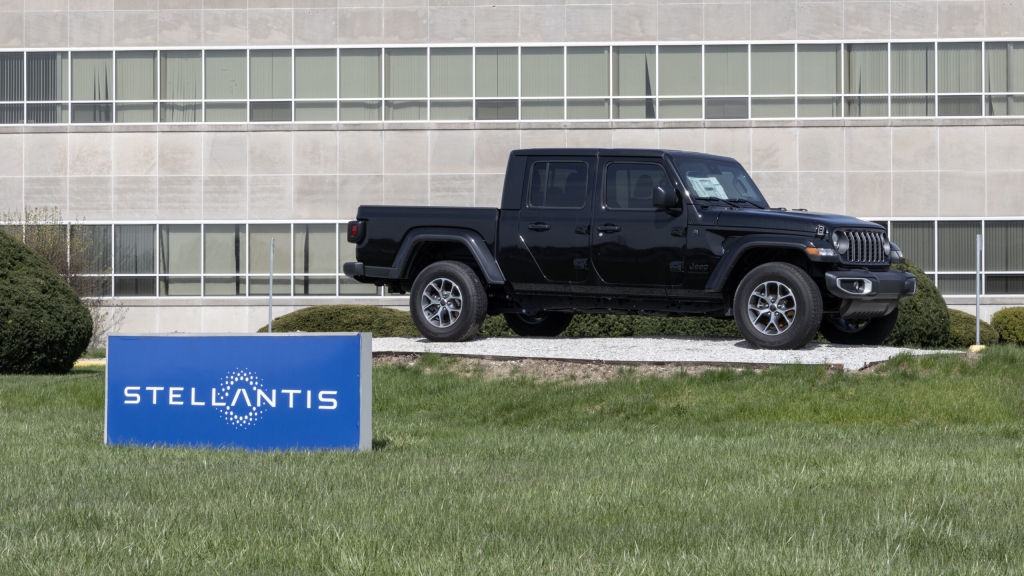
Stellantis Takes a $26.2 Billion Hit as EV Dream Crashes into Reality
In a seismic shift that’s sending shockwaves through the automotive industry, Stellantis—the multinational powerhouse behind iconic brands like Jeep, Dodge, Chrysler, Ram, Fiat, Peugeot, and Maserati—has announced a staggering $26.2 billion write-down, marking one of the most dramatic reversals in corporate strategy we’ve seen in recent years.
The announcement, delivered with the gravity of a corporate obituary, signals the death knell for what many once considered the inevitable electric vehicle revolution in America. Stellantis CEO Carlos Tavares didn’t mince words during the earnings call, stating bluntly that the company must “reset” its entire business model to align with “market realities” that have proven far less enthusiastic about EVs than Wall Street analysts predicted.
The Great EV Bubble Bursts
Just three years ago, the narrative was crystal clear: internal combustion engines were dinosaurs, electric vehicles were the meteor, and anyone not adapting would face extinction. The Biden administration had laid out ambitious plans to have EVs comprise 50% of new vehicle sales by 2030, backed by billions in infrastructure investments and consumer incentives. Battery factories were breaking ground across the Midwest, creating what was hailed as the “battery belt” of American manufacturing might.
But beneath the surface, tectonic shifts were already underway. While Tesla continued its march and legacy automakers poured billions into EV development, a growing chorus of skepticism began to emerge from unexpected quarters.
Toyota, the world’s largest automaker, had been notably absent from the EV gold rush, instead doubling down on hybrids and hydrogen technology. Industry insiders whispered that the Japanese giant had “bet wrong” on EVs, but Toyota executives remained publicly skeptical, warning that the transition was being rushed without adequate infrastructure or consumer readiness.
Meanwhile, America’s car dealerships—those brick-and-mortar institutions that have defined automotive retail for generations—began pushing back against the electric future. These businesses, many family-owned and operating on thin margins, faced enormous costs to retrofit showrooms, invest in charging infrastructure, and retrain staff on complex new technologies. Their resistance wasn’t merely about comfort with the status quo; it was about survival in an industry where profit margins are measured in percentage points.
Political Winds Shift, Industry Reels
The 2024 election delivered a political earthquake that would reshape the automotive landscape overnight. The Republican victory brought with it a fundamental realignment of priorities, and nowhere was this more evident than in transportation policy.
The federal EV tax credit—once a powerful incentive that could reduce the purchase price of electric vehicles by up to $7,500—was abruptly terminated. For consumers weighing the often $10,000-$20,000 premium of electric vehicles over comparable gasoline models, this removal of financial support proved decisive.
But the assault on electrification went far beyond consumer incentives. The ambitious National Electric Vehicle Infrastructure (NEVI) program, designed to create a comprehensive network of fast-charging stations along America’s highways, saw its funding evaporate. States that had been planning charging corridors suddenly found themselves holding planning documents worth millions but lacking the federal dollars to execute them.
The Environmental Protection Agency’s tough new emissions standards, which would have effectively mandated a significant shift toward electric vehicles through increasingly stringent fleet-wide requirements, were scrapped entirely. In their place, a more lenient approach emerged that essentially told automakers they could “sell as many gas-guzzlers as you like” without fear of penalties.
Perhaps most tellingly, federal regulators announced they would no longer enforce fuel economy violations, sending a clear message that the era of holding automakers accountable for their environmental impact had ended.
The Stellantis Write-Down: Anatomy of a Corporate Reckoning
The $26.2 billion charge that Stellantis announced represents more than just a financial adjustment—it’s a complete revaluation of the company’s future. The write-down encompasses several major components:
First, there’s the tangible asset impairment. Stellantis had invested heavily in EV-specific platforms, battery technology partnerships, and manufacturing facilities configured for electric vehicle production. Much of this infrastructure, designed for a high-volume EV future that hasn’t materialized, must now be revalued at significantly lower levels.
Second, the company is taking substantial charges related to its strategic pivot back toward internal combustion engines and hybrids. This includes the costs of maintaining and updating older platforms that were scheduled for retirement, as well as investments in improving the efficiency of existing gasoline and diesel engines.
Third, there are the restructuring costs associated with shifting production priorities, retraining workforces, and potentially closing or converting facilities that were earmarked for EV production.
The scale of the write-down is particularly noteworthy because it exceeds the combined impact of similar moves by other major automakers. Ford’s December announcement of a $19.5 billion write-down, while substantial, now appears modest in comparison. General Motors followed in January with a $6 billion charge related to canceled EV projects, bringing the total financial impact across America’s Big Three to nearly $52 billion in just three months.
Industry-Wide Implications
Stellantis’s announcement isn’t occurring in isolation—it’s the latest data point in what’s becoming a clear industry trend. The company’s decision to “reset” its strategy reflects a broader recognition that the American market for electric vehicles, at least in the near term, is far smaller than many had anticipated.
Several factors are converging to create this perfect storm:
Consumer Resistance: Despite years of marketing and education efforts, many American consumers remain hesitant about electric vehicles. Range anxiety persists even as modern EVs offer 300+ miles of range. Charging infrastructure, while improving, still lags behind the ubiquitous nature of gas stations. And the higher upfront costs, even with lower operating expenses, continue to deter budget-conscious buyers.
Economic Uncertainty: Inflation, rising interest rates, and economic anxiety have made consumers more price-sensitive than ever. In this environment, the premium required for electric vehicles becomes even harder to justify, especially when gasoline prices, while volatile, have remained relatively manageable.
Cultural Factors: In many parts of America, particularly rural areas and truck-centric regions, there’s a cultural attachment to traditional vehicles that electric alternatives have struggled to overcome. The image of electric vehicles as “city cars” or “coastal elite” products has proven surprisingly resilient.
Infrastructure Gaps: Despite significant investment, America’s charging infrastructure remains fragmented and often unreliable. Reports of broken chargers, incompatible networks, and charging speeds that fall short of promises have created a trust deficit among potential buyers.
The Global Context
While Stellantis’s writedown dominates headlines in America, the global picture remains more nuanced. European markets continue to see stronger EV adoption, driven by stricter emissions regulations, higher fuel prices, and dense urban environments where electric vehicles make more practical sense.
China, the world’s largest automotive market, has embraced electric vehicles with a speed and scale that continues to astonish. Chinese brands like BYD have surpassed Tesla in global EV sales, and the country’s domestic market shows no signs of the hesitation evident in America.
This divergence creates a complex challenge for global automakers like Stellantis. The company must now manage parallel strategies: maintaining its commitment to electrification in markets where it makes economic sense while pivoting back to internal combustion engines in the United States.
What Comes Next?
The automotive industry is now entering uncharted territory. The rapid about-face from EV enthusiasm to combustion engine pragmatism represents one of the most dramatic strategic reversals in modern corporate history.
For Stellantis, the path forward involves several key initiatives:
Platform Consolidation: The company plans to streamline its vehicle architectures, creating more flexible platforms that can accommodate multiple powertrains—gasoline, hybrid, and electric—depending on market demands. This “multi-energy” approach allows for rapid adaptation as regional preferences evolve.
Hybrid Focus: Rather than abandoning electrification entirely, Stellantis is doubling down on hybrid technology. These vehicles offer many of the efficiency benefits of electric vehicles while maintaining the familiarity and convenience of gasoline power. In many ways, hybrids represent the pragmatic middle ground that Toyota identified years ago.
Cost Reduction: The writedown will be followed by aggressive cost-cutting measures across the organization. This includes simplifying vehicle lineups, reducing investment in underperforming segments, and potentially consolidating manufacturing operations.
Market Segmentation: Stellantis plans to take a more nuanced approach to different American market segments, recognizing that EV adoption varies dramatically by region, income level, and vehicle type. While compact cars might see continued electric options in urban markets, trucks and SUVs—which dominate American sales—will likely remain primarily gasoline-powered for the foreseeable future.
The Broader Economic Impact
The automotive industry’s pivot away from rapid electrification has ripple effects throughout the economy. The battery factories that were celebrated as the future of American manufacturing now face an uncertain future, with some potentially never reaching full production capacity.
Auto workers, many of whom had been promised a bright future in EV manufacturing, now face the prospect of jobs that may never materialize or, worse, existing jobs that could be eliminated as production strategies shift.
The charging infrastructure that was being built out across the country, often with significant local government support and taxpayer funding, now represents a stranded asset in many cases—useful for the growing number of EVs on the road, but far short of the comprehensive network that was envisioned.
Looking Ahead: The Long Game
Despite the dramatic nature of Stellantis’s announcement, it would be premature to declare the electric vehicle revolution dead. Rather, what we’re witnessing is a recalibration—a recognition that technological transitions, especially in mature industries like automotive, rarely follow the smooth, exponential curves that Silicon Valley entrepreneurs and optimistic analysts prefer to project.
The reality is that electric vehicles will continue to grow their market share, but at a pace dictated more by infrastructure development, cost reduction, and genuine consumer demand than by regulatory mandates or corporate enthusiasm. In this slower, more organic transition, traditional automakers may actually have an advantage over newer entrants who bet everything on rapid EV adoption.
For Stellantis, the $26.2 billion writedown represents not just a financial hit, but a painful lesson in the dangers of misreading market signals and overcommitting to a single technological trajectory. As the company “resets” its strategy, the broader industry will be watching closely to see whether this represents a temporary course correction or the beginning of a fundamental rethinking of automotive’s electric future.
One thing is certain: the road to electrification, once envisioned as a highway to the future, has revealed itself to be a more winding path with unexpected detours, potholes, and occasional dead ends. For Stellantis and its fellow travelers in the automotive industry, navigating this terrain will require not just technological innovation, but strategic flexibility and a willingness to adapt to the often messy realities of consumer behavior and market economics.
tags
Stellantis #ElectricVehicles #AutomotiveIndustry #EVWriteDown #CarlosTavares #Jeep #Dodge #Fiat #Peugeot #AutomotiveStrategy #ICEVs #HybridVehicles #CarDealers #BidenAdministration #TrumpAdministration #EVTaxCredit #ChargingInfrastructure #BatteryFactories #Ford #GeneralMotors #Toyota #MarketReality #CorporateStrategy #AutomotiveRestructuring #NEVIProgram #EmissionsStandards #FuelEconomy #GasGuzzlers #KeiCars #ConsumerResistance #EconomicUncertainty #CulturalFactors #InfrastructureGaps #GlobalContext #PlatformConsolidation #CostReduction #MarketSegmentation #EconomicImpact #StrandedAssets #TechnologicalTransition #StrategicFlexibility
viral
Stellantis takes a $26.2 billion hit as the EV dream crashes into reality
The great electric vehicle bubble bursts: How Stellantis lost billions betting on an American EV revolution that never came
From EV optimism to combustion pragmatism: Inside Stellantis’s dramatic $26.2 billion corporate reset
The day the music died: How political shifts killed America’s electric vehicle future
Stellantis’s painful lesson: Why misreading market signals cost $26.2 billion
The $52 billion reckoning: How America’s Big Three automakers are abandoning their EV dreams
Toyota was right all along? How hybrids became the pragmatic middle ground
Car dealers strike back: How traditional retailers killed the electric vehicle revolution
The charging infrastructure that never was: Billions spent on a network that won’t materialize
Political whiplash: How one election flipped the entire automotive industry on its head
The great automotive pivot: Why Stellantis is running back to gasoline as fast as it can
$26.2 billion question: Was the electric vehicle revolution just wishful thinking?
The battery belt blues: What happens to all those factories now?
Consumer resistance: The hidden force that derailed America’s EV future
Economic anxiety kills innovation: How inflation and interest rates ended the EV dream
Cultural attachment to gas guzzlers: Why Americans just won’t quit their trucks
The multi-energy approach: How Stellantis plans to survive the EV mess
Stranded assets and broken promises: The real cost of misreading the market
Slow and steady wins the race? Why the organic EV transition might actually work
The pragmatic pivot: How traditional automakers might actually benefit from a slower EV transition
,


Leave a Reply
Want to join the discussion?Feel free to contribute!