
NASA Finds Earth’s Oxygen Follows a Hidden Magnetic Rhythm
NASA Uncovers Hidden Magnetic Rhythm Behind Earth’s Oxygen Supply
In a discovery that sounds like it belongs in science fiction but is grounded in hard planetary science, NASA researchers have revealed that Earth’s magnetic field and atmospheric oxygen levels have been dancing to the same rhythm for nearly half a billion years. This unexpected synchronization suggests a profound and previously unknown connection between the planet’s deep interior processes and the life-supporting conditions we depend on.
The finding emerged from an exhaustive analysis of geological and paleomagnetic records conducted by NASA’s Goddard Space Flight Center. Scientists examined data spanning hundreds of millions of years, comparing fluctuations in the strength of Earth’s magnetic field with changes in atmospheric oxygen concentration preserved in ancient rock formations and ice cores.
What they found was remarkable: during periods when the magnetic field weakened, oxygen levels tended to drop. Conversely, when the magnetic shield strengthened, oxygen concentrations rose. This pattern held true across multiple geological epochs, suggesting a causal relationship rather than mere coincidence.
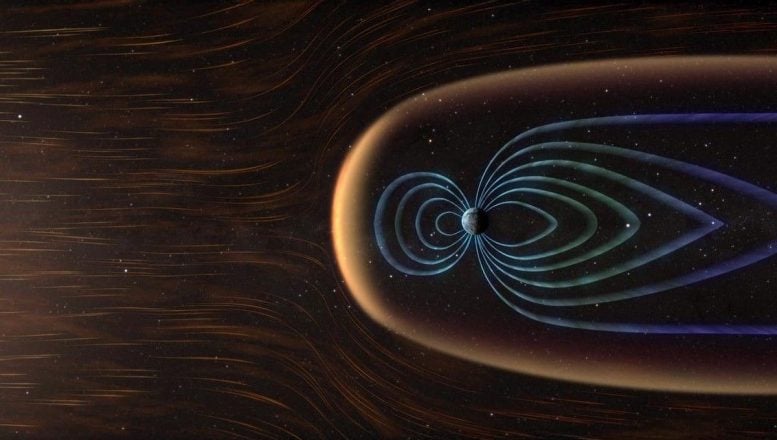
Earth’s magnetic field is generated by the churning of molten iron in the planet’s outer core, approximately 1,800 miles beneath our feet. This invisible shield extends far into space, deflecting harmful solar wind and cosmic radiation that would otherwise strip away our atmosphere. The field isn’t static—it strengthens and weakens over geological timescales, occasionally even reversing polarity entirely.
The oxygen connection appears to work through a mechanism involving atmospheric escape. When the magnetic field weakens, more charged particles from the solar wind can penetrate deeper into Earth’s upper atmosphere. These particles can energize atmospheric molecules, including oxygen, giving them enough velocity to escape into space. During periods of stronger magnetic shielding, this atmospheric erosion process slows significantly.
This discovery has profound implications for our understanding of Earth’s habitability. It suggests that the conditions allowing complex life to thrive aren’t simply the result of surface processes like photosynthesis, but are intimately connected to the planet’s internal dynamics. The magnetic field acts as an invisible guardian, not just protecting us from radiation, but helping to maintain the very air we breathe.
The research also provides new context for understanding mass extinction events in Earth’s history. Several major die-offs coincide with periods of magnetic field weakening, suggesting that reduced atmospheric protection may have contributed to environmental stress during these crises. The most famous example is the Hangenberg Crisis about 359 million years ago, which saw both a collapse in magnetic field strength and significant oxygen depletion.
Perhaps most intriguingly, this finding raises questions about the habitability of other planets. Mars, for instance, lost its global magnetic field billions of years ago and subsequently lost most of its atmosphere and surface water. The NASA study suggests that a planet’s magnetic field might be just as crucial for maintaining habitable conditions as its distance from its star or the presence of liquid water.
The research team used advanced computer modeling to simulate how changes in magnetic field strength affect atmospheric escape rates. Their models showed that during periods when Earth’s magnetic field was only 10% of its current strength, the planet could have lost oxygen at rates up to three times higher than today. This would have significant implications for the evolution of complex life, which requires higher oxygen concentrations to support energy-intensive metabolisms.
The synchronization between magnetic field and oxygen levels also appears to have influenced the course of biological evolution. The rise of complex multicellular life during the Cambrian explosion, for example, coincided with a period of magnetic field strengthening and rising oxygen levels. Similarly, the emergence of large, active animals in the oceans during the Ordovician period followed another phase of magnetic enhancement.
This discovery represents a major shift in how scientists think about planetary habitability. Rather than viewing a planet’s surface environment in isolation, we must now consider how deep interior processes can shape surface conditions over geological timescales. Earth’s magnetic field, generated by processes in the core, turns out to be a critical component of the life support system that has allowed our planet to remain habitable for billions of years.
The research also has practical implications for understanding current environmental changes. While human activities are not directly affecting the magnetic field, the study highlights how interconnected Earth’s systems truly are. Changes in one part of the planet can have cascading effects on seemingly unrelated systems, a principle that applies to both natural processes and human-induced changes.
Looking forward, this discovery opens new avenues for research into planetary science and the search for life beyond Earth. Future missions to Mars and other planets will need to consider not just surface conditions, but also the history of magnetic field generation when assessing habitability potential.
The NASA team plans to extend their analysis to even earlier periods in Earth’s history, hoping to determine when this magnetic-oxygen synchronization first began. They’re also collaborating with biologists to better understand how changing oxygen levels might have influenced the course of evolution, potentially revealing new insights into why life on Earth took the particular path it did.
This groundbreaking research reminds us that Earth is a complex, interconnected system where events deep within the planet can have profound effects on the surface world where life exists. The invisible magnetic field that guides compass needles and creates auroras turns out to be a vital component of the planetary machinery that makes life possible.
magnetic field oxygen connection
Earth’s magnetic rhythm
planetary habitability mystery
atmospheric oxygen escape
core-mantle life connection
paleomagnetic oxygen study
NASA Earth magnetic research
deep time planetary processes
mass extinction magnetic link
Mars atmosphere loss comparison
Cambrian explosion magnetic timing
planetary life support systems
geological magnetic field changes
atmospheric erosion protection
Earth’s invisible guardian field
biological evolution magnetic influence
interconnected Earth systems
planetary science breakthrough
habitable planet requirements
core-generated life conditions
,


Leave a Reply
Want to join the discussion?Feel free to contribute!